







Question: SQL PLUS exercies As you do the exercises, it is a good idea to copy/paste your query as well as your query result into a
SQL PLUS exercies As you do the exercises, it is a good idea to copy/paste your query as well as your query result into a word processor. 3-1. Stu sname Jones Smith Evans Adams Create two tables, Stu(sname, majorcode) and Major(majorcode, majordesc) with the data shown. Use VARCHAR2(2) for codes and appropriate data-types for the other attributes.
a.) Display the Cartesian product (no WHERE clause). Use SELECT *.... How many rows did you get? How many rows will you always get when combining two tables with n and m rows in them (Cartesian product)?
b.) Display an equi-join of Stu and Major on majorCode (show this both ways: first using an appropriate WHERE clause; and second, using ANSI SQL standard syntax). Use table aliases. How many rows did you get?
c.) Leave off the column qualifiers (the aliases) on the equi-join in step b. What do you get? This will give an error because of ambiguous column names.
d.) Use the COUNT(*) function instead of SELECT * in the query. Use COUNT to show the number of rows in the result set of the equi-join and the Cartesian product. Do the equi-join first with COUNT, then comment out the WHERE clause for the second answer (put -- in front of the word WHERE).
e.) Add two more major codes to the Major table as follows:
f.) Add two more students to the Stu table as follows:
g.) Display all the student names (snames) and majorDescs. Make sure all the students as well as all the majors are shown in the result set, whether the students have a major or not, and whether the major has students or not.
Here is the table
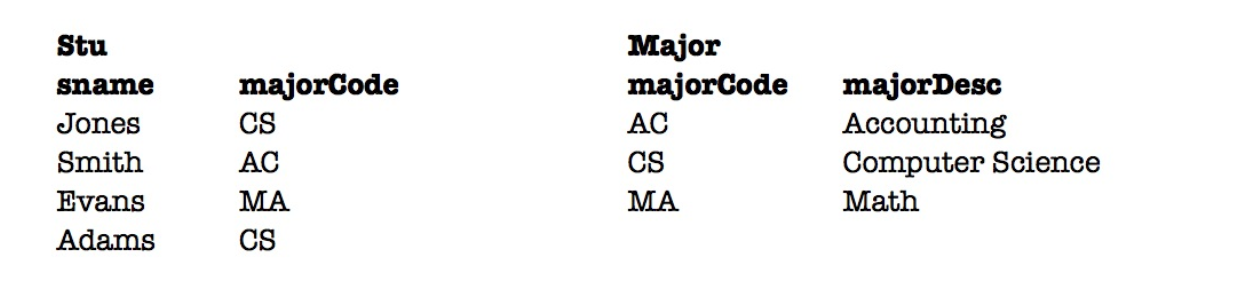
Stu snamemajorCode Jones Smith Evans Adams CS AC MA CS Major majorCode majorDesc AC CS MA Accounting Computer Science Math
Step by Step Solution
There are 3 Steps involved in it

Get step-by-step solutions from verified subject matter experts
 Study Help