







Question: Start with the file loadkepler_template.m to create a function m-file named loadkepler.m that loads the Kepler orbital parameters contained in the text file gps_kepler.dat into
Start with the file loadkepler_template.m to create a function m-file named loadkepler.m that loads the Kepler orbital parameters contained in the text file gps_kepler.dat into a structure (the comments in the template file describe the contents of the data file). Then create a simple driver program named test_kepler_LastName.m that calls the function to load in the data file and also creates a bar chart of the longitude of the ascending node parameter using satellite ID number as the x-axis (the call to the bar function must, of course, use the created structure in the input arguments.
Here is the loadkepler_template.m
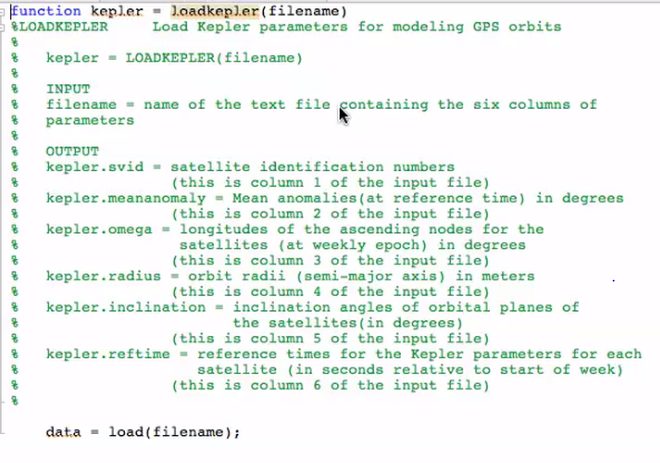
lEunction kepler loadkepler(filename) 1 Load Kepler parameters for modeling GPS orbits %LOADKEPLE % kepler LOADKEPLER ( filename ) . INPUT filename name of the text file ontaining the six columns of % parameters OUTPUT % kepler . svid- satellite identification numbers % kepler.meananomaly Mean anomalies (at reference time) in degrees % kepler.omega - longitudes of the ascending nodes for the (this is column 1 of the input file) (this is column 2 of the input file) satellites (at weekly epoch) in degrees (this is column 3 of the input file) % kepler . radius - orbit radii (semi-major axis) in meters (this is column 4 of the input file) % kepler . inclination = inclination angles of orbital planes of the satellites(in degrees) (this is column 5 of the input file) % kepler.reftime - reference times for the Kepler parameters for each satellite (in seconds relative to start of week) (this is column 6 of the input file) data load (filename) lEunction kepler loadkepler(filename) 1 Load Kepler parameters for modeling GPS orbits %LOADKEPLE % kepler LOADKEPLER ( filename ) . INPUT filename name of the text file ontaining the six columns of % parameters OUTPUT % kepler . svid- satellite identification numbers % kepler.meananomaly Mean anomalies (at reference time) in degrees % kepler.omega - longitudes of the ascending nodes for the (this is column 1 of the input file) (this is column 2 of the input file) satellites (at weekly epoch) in degrees (this is column 3 of the input file) % kepler . radius - orbit radii (semi-major axis) in meters (this is column 4 of the input file) % kepler . inclination = inclination angles of orbital planes of the satellites(in degrees) (this is column 5 of the input file) % kepler.reftime - reference times for the Kepler parameters for each satellite (in seconds relative to start of week) (this is column 6 of the input file) data load (filename)
Step by Step Solution
There are 3 Steps involved in it

Get step-by-step solutions from verified subject matter experts
 Study Help