







Question: Start with the following Java code: class Node { private String data; private Node next; public Type getData() { return data; } public Node getNext()
Start with the following Java code:
class Node {
private String data;
private Node next;
public Type getData() {
return data;
}
public Node getNext() {
return next;
}
public void setData(Type data) {
this.data = data;
}
public void setNext(Node next) {
this.next = next;
}
public String toString() {
return "Node: " + getData();
}
}
///////////////////
Modify the code to complete the following conditions:
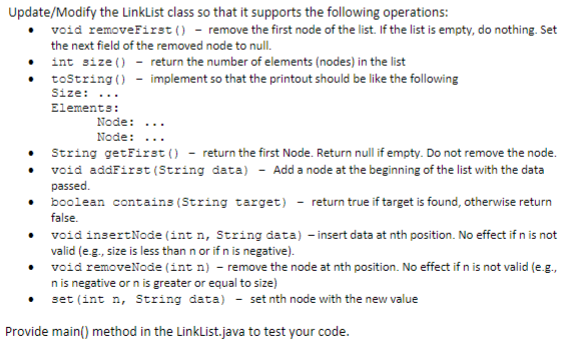
Update/Modify the LinkList class so that it supports the following operations: void removeFirst- remove the first node of the list. If the list is empty, do nothing. Set the next field of the removed node to null. int size ( ) -return the number of elements (nodes) in the list toString ( ) Size: . Elements: -implement so that the printout should be like the following Node: Node: String getFirst - return the first Node. Return null if empty. Do not remove the node. void addFirst (String data)- Add a node at the beginning of the list with the data passed false. valid (e.g., size is less than n or if n is negative). n is negative or n is greater or equal to size) boolean contains (String target) - return true if target is found, otherwise return . void insertNode (int n, String data) - insert data at nth position. No effect if n is not . void removeNode (int n) - remove the node at nth position. No effect if n is not valid (e.g., set (int n, String data) - set nth node with the new value Provide main() method in the LinkList.java to test your code
Step by Step Solution
There are 3 Steps involved in it

Get step-by-step solutions from verified subject matter experts
 Study Help