



Question: Starting next year, you will need $15,000 annually for 4 years to complete your education. (One year from today you will withdraw the first $15,000.)
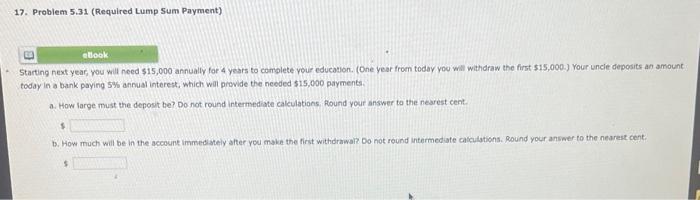
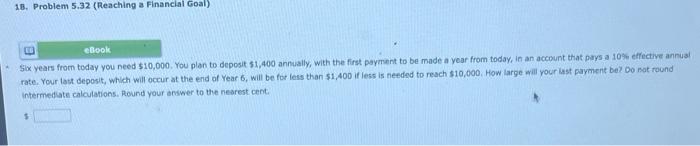
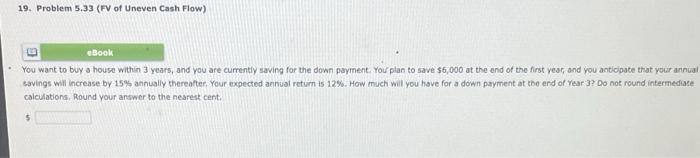
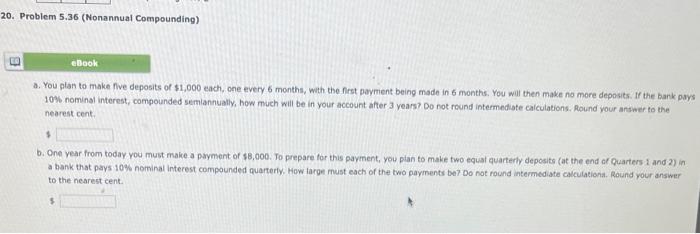
Starting next year, you will need $15,000 annually for 4 years to complete your education. (One year from today you will withdraw the first $15,000.) Your uncie deposits an amount today in a bank paying 5% annual interes, which wal previde the needed 515,000 payments. a. How large must the depost be? Do not round intermediate calculations, found your answer to the nearest cent. 4. b. How much wil be in the account immediately after you make the first withdrawai? Do not reund intermediate cakculations. Round your answer to the nearest cent. 5. 18. Problem 5.32 (Reaching a Financial Goal) Stx years from today you need $10,000. You plan to deposit 51,400 annually, with the first payment to be made a year from today, in an account that prys a 10% effective annual rate. Your last deposit, which will occur at the end of Year 6 , will be for less than $1,400 if less is needed to reach $10,000, How large aili your last payment be? Do nat round intermedate calculations. Round your answer to the nearest cent. 5 19. Problem 5.33 (FV of Uneven Cash Flow) You want to buy a house within 3 years, and you are currently saving for the down payment. you plan to save $6,000 at the end of the first year, and you antiopate that your annual savings will increase by 15% annually thereatter. Your oxpected annual return is 12%. How much will you have for a down payment at the end of year 3 ? Do not round intermediate calculations, Round your answer to the nearest cent. 5 a. You plan to make five deposits of $1,000 each, one every 6 months, with the first payment being made in 6 months. You wul then make no more deposits. If the bank pays 10% nominal interest, compounded semiannually, how much will be in your account after 3 years? Do not round intermediate calculations. Round your answer to the nearest cent. b. One year from today you must make a payment of $8,000. To prepare for this payment, you pian to make two equat quarterfy deposits (at the end of quarters 1 and 2) in a bank that pays 10% nominal interest compounded quarterfy. How targe must each of the two payments be? Do not round intermediate calculationa. Round your answer. to the nearest cent. 5
Step by Step Solution
There are 3 Steps involved in it

Get step-by-step solutions from verified subject matter experts