







Question: stat2160 questions Question 9 [1 point) While attempting to measure its risk exposure for the upcoming year, an insurance company notices a trend between the
stat2160 questions
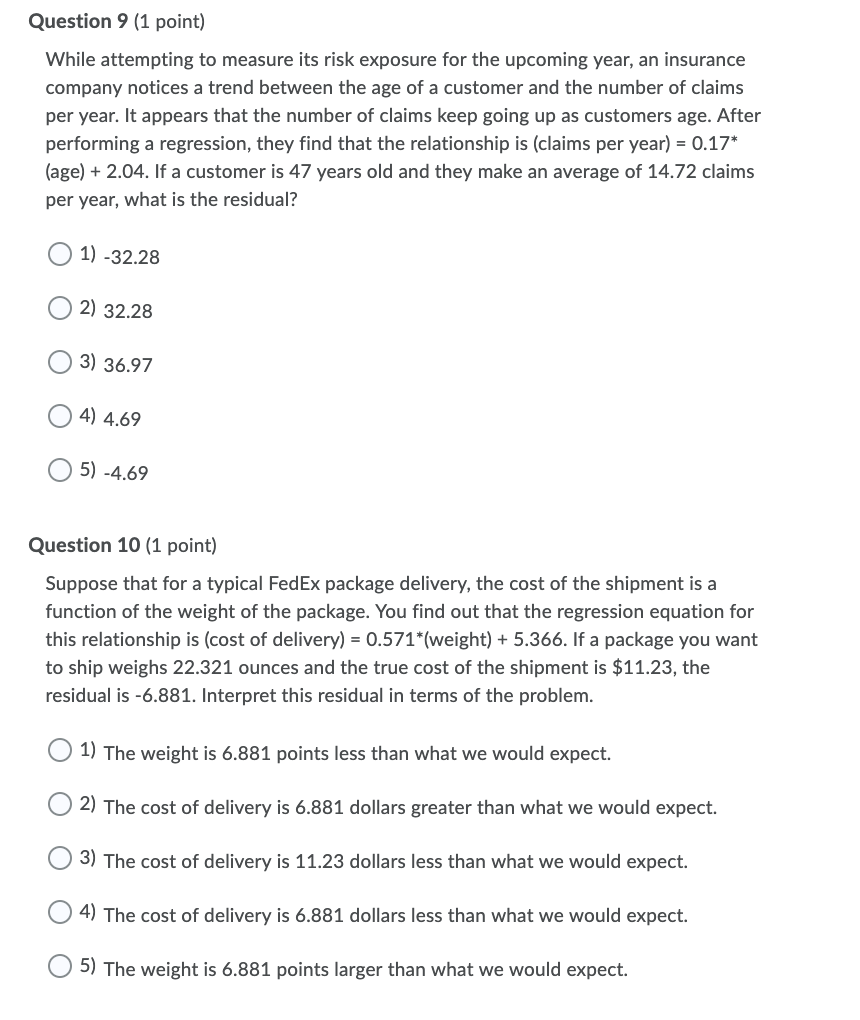
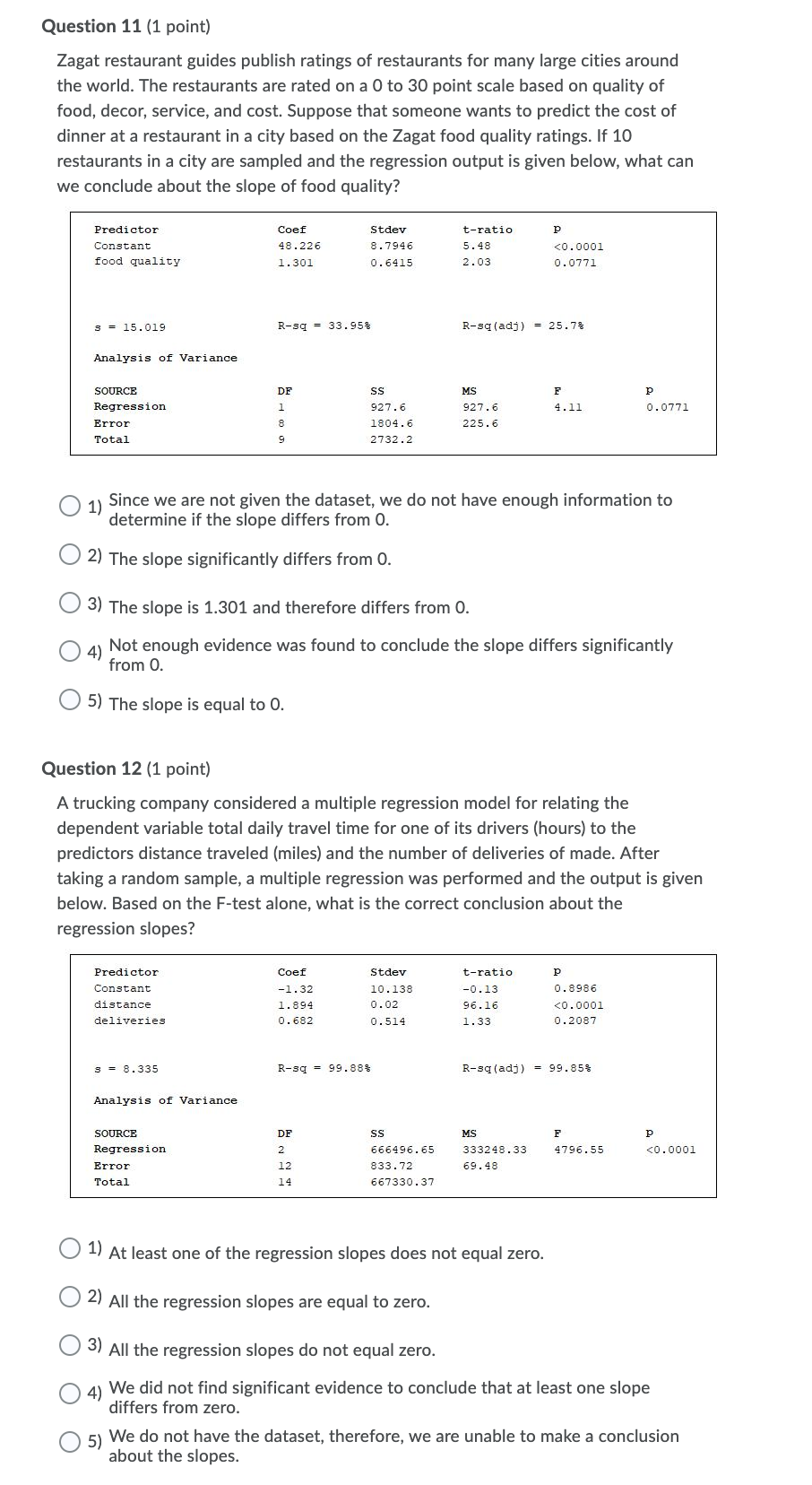
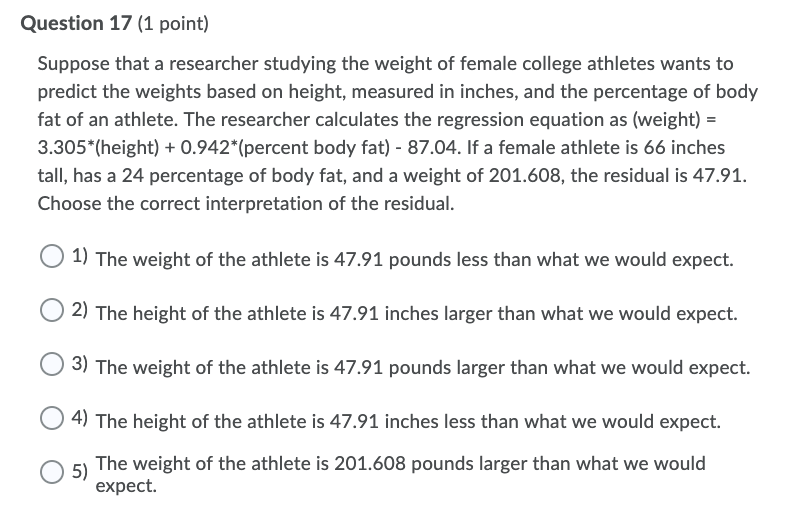
Question 9 [1 point) While attempting to measure its risk exposure for the upcoming year, an insurance company notices a trend between the age of a customer and the number of claims per year. It appears that the number of claims keep going up as customers age. After performing a regression, they find that the relationship is (claims per year} = 0.17\"\" (age) + 2.04. If a customer is 47 years old and they make an average of 14.72 claims per yearI what is the residual? O 1) -32.28 0 2) 32.28 0 3) 36.97 0 4) 4.69 O 5) -4.69 Question 10 {1 point) Suppose that for a typical FedEx package delivery, the cost of the shipment is a function of the weight of the package. You find out that the regression equation for this relationship is (cost of delivery) = O.571*[weight) + 5.366. If a package you want to ship weighs 22.321 ounces and the true cost of the shipment is $11.23I the residual is -6.881. Interpret this residual in terms of the problem. 0 1) The weight is 6.881 points less than what we would expect. 0 2) The cost of delivery is 6.881 dollars greater than what we would expect. 0 3) The cost of delivery is 11.23 dollars less than what we would expect. 0 4) The cost of delivery is 6.881 dollars less than what we would expect. 0 5) The weight is 6.881 points larger than what we would expect. Question 11 {1 point) Zagat restaurant guides publish ratings of restaurants for many large cities around the world. The restaurants are rated on a 0 to 30 point scale based on quality of foodI decorI service, and cost. Suppose that someone wants to predict the cost of dinner at a restaurant in a city based on the Zagat food quality ratings. If 10 restaurants in a city are sampled and the regression output is given below, what can we conclude about the slope of food quality? Predi ctor Coef Stdev t ratio D Constant 48.226 8.7946 5.48 (0.0001 food quality 1.301 0.6415 2.03 0.0771 3 = 15319 Rsq = 33.95% Rsqtadj} = 25.7% Analysis of Variance SOURCE. D)? 55 HE E P Regression 1 927.6 927.6 4.1]. 0.0771 Error 8 1804.6 225.6 Total 9 2732 . 2 O 1) Since we are not given the dataset, we do not have enough information to determine if the slope differs from 0. O 2) The slope significantly differs from 0. O 3) The slope is 1.301 and therefore differs from 0. O 4) Not enough evidence was found to conclude the slope differs significantly from O. O 5) The slope is equal to 0. Question 12 {1 point) A trucking company considered a multiple regression model for relating the dependent variable total daily travel time for one of its drivers (hours} to the predictors distance traveled (miles) and the number of deliveries of made. After taking a random sample, a multiple regression was performed and the output is given below. Based on the F-test alone, what is the correct conclusion about the regression slopes? Predi ctor Coef Stdev t ratio D Constant 1.32 10.138 0.13 0.8986 distance 1.894 0.02 96.16 (0.0001 deliveries 0.682 0.514 1.33 0.2087 s = 8.335 Rsq = 99.88% Rsqtadj} = 99.85% Analysis of Variance SOURCE D)? 55 HE E P Regression 2 666496.65 333248.33 4796.55 (0.0001 Error 12 833.72 69.48 Total 14 667330.37 O 1) At least one of the regression slopes does not equal zero. 0 2) All the regression slopes are equal to zero. 0 3) All the regression slopes do not equal zero. 0 4) We did not find significant evidence to conclude that at least one slope differs from zero. 0 5) We do not have the dataset, therefore, we are unable to make a conclusion about the slopes. Question 17 {1 point) Suppose that a researcher studying the weight of female college athletes wants to predict the weights based on height, measured in inches, and the percentage of body fat of an athlete. The researcher calculates the regression equation as (weight) = 3.305*(height} + 0.942*(percent body fat) - 87.04. If a female athlete is 66 inches tall, has a 24 percentage of body fat. and a weight of 201.608. the residual is 47.91. Choose the correct interpretation of the residual. O 1) The weight of the athlete is 47.91 pounds less than what we would expect. 0 2) The height of the athlete is 47.91 inches larger than what we would expect. 0 3) The weight of the athlete is 47.91 pounds larger than what we would expect. 0 4) The height of the athlete is 47.91 inches less than what we would expect. 0 5) The weight of the athlete is 201.608 pounds larger than what we would expect
Step by Step Solution
There are 3 Steps involved in it

Get step-by-step solutions from verified subject matter experts
 Study Help