







Question: State Machine in the example has the WCET (worst-case execution time) in Page 5 on the scheduler used in the example, the state actions? A.
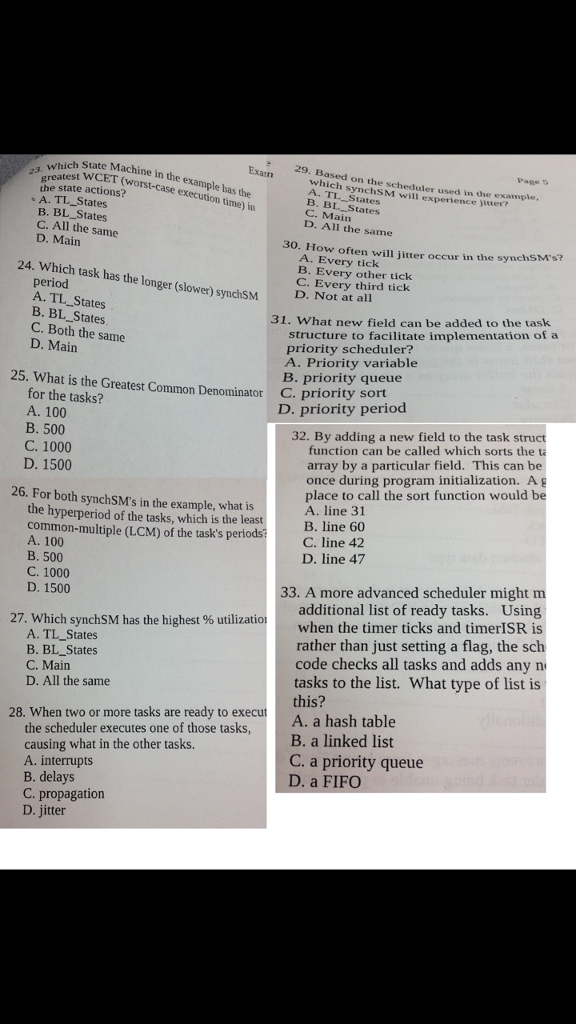
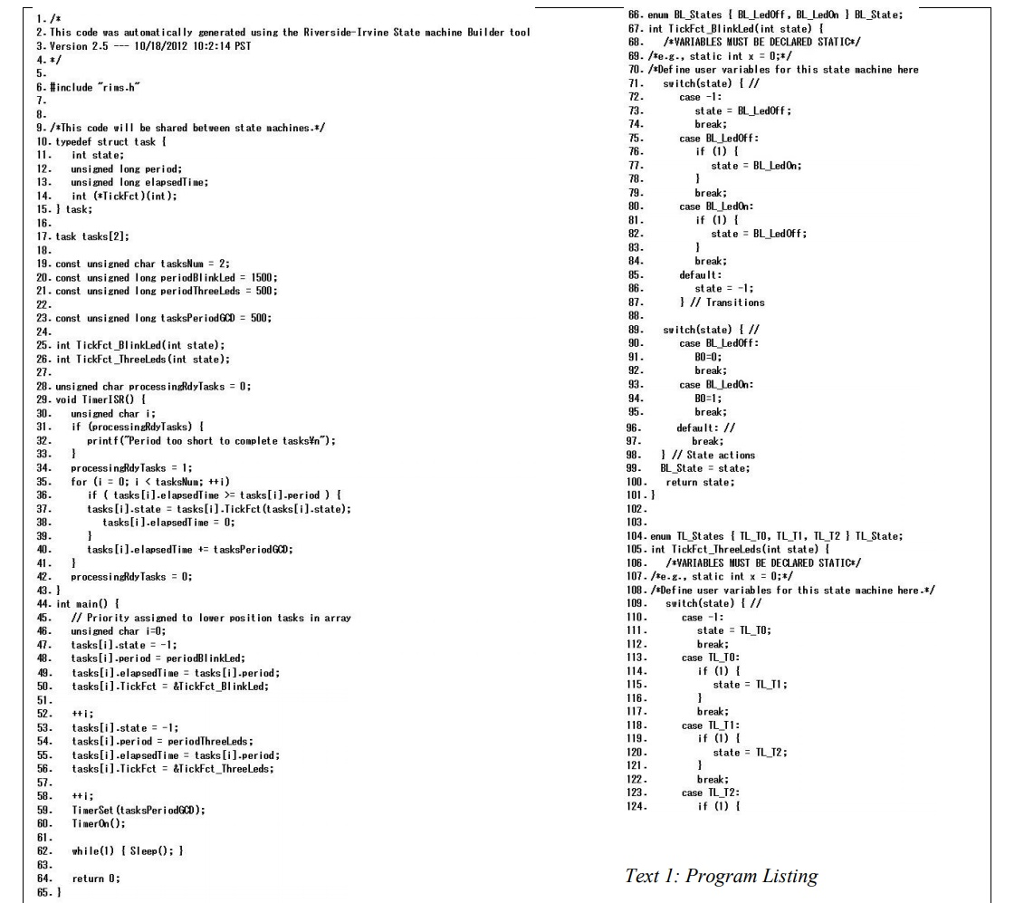
State Machine in the example has the WCET (worst-case execution time) in Page 5 on the scheduler used in the example, the state actions? A. B. BL States C. All the same D. Main which synchSM will experience jitter A. TL States B. BL States C. Main D. All the same 30. How low often will jitter occur in the synchSM's? A. Every tick B. Every other tick C. Every third tick D. Not at all 24. Which task has the longer (slower) synchSM period A. TL States B. BL States C. Both the same D. Main 31. What new field can be added to the task structure to facilitate implementation of a priority scheduler? A. Priority variable 25. What is the Greatest Common Denominator C. priority sort for the tasks? A. 100 B. 500 C. 1000 D. 1500 D. priority period 32. By adding a new field to the task struct function can be called which sorts the ta array by a particular field. This can once during program initialization. A place to call the sort function would be A. line 31 B. line 60 C. line 42 D. line 47 26. For both synchSM's in the example, what is the hyperperiod of the tasks, which is the least common-multiple (LCM) of the task's periods A. 100 B. 500 C. 1000 D. 1500 33. A more advanced scheduler might m additional list of ready tasks. Using when the timer ticks and timerISR is rather than just setting a flag, the sch code checks all tasks and adds any n tasks to the list. What type of list is this? 27, which synchSM has the highest % utilizatio1 A. TL_States B. BL States C. Main D. All the same 28. When two or more tasks are ready to execut sh tahl the scheduler executes one of those tasks, causing what in the other tasks. A. interrupts B. delays C. propagation D. jitter B. a linked list C. a priority queue D. a FIFO State Machine in the example has the WCET (worst-case execution time) in Page 5 on the scheduler used in the example, the state actions? A. B. BL States C. All the same D. Main which synchSM will experience jitter A. TL States B. BL States C. Main D. All the same 30. How low often will jitter occur in the synchSM's? A. Every tick B. Every other tick C. Every third tick D. Not at all 24. Which task has the longer (slower) synchSM period A. TL States B. BL States C. Both the same D. Main 31. What new field can be added to the task structure to facilitate implementation of a priority scheduler? A. Priority variable 25. What is the Greatest Common Denominator C. priority sort for the tasks? A. 100 B. 500 C. 1000 D. 1500 D. priority period 32. By adding a new field to the task struct function can be called which sorts the ta array by a particular field. This can once during program initialization. A place to call the sort function would be A. line 31 B. line 60 C. line 42 D. line 47 26. For both synchSM's in the example, what is the hyperperiod of the tasks, which is the least common-multiple (LCM) of the task's periods A. 100 B. 500 C. 1000 D. 1500 33. A more advanced scheduler might m additional list of ready tasks. Using when the timer ticks and timerISR is rather than just setting a flag, the sch code checks all tasks and adds any n tasks to the list. What type of list is this? 27, which synchSM has the highest % utilizatio1 A. TL_States B. BL States C. Main D. All the same 28. When two or more tasks are ready to execut sh tahl the scheduler executes one of those tasks, causing what in the other tasks. A. interrupts B. delays C. propagation D. jitter B. a linked list C. a priority queue D. a FIFO
Step by Step Solution
There are 3 Steps involved in it

Get step-by-step solutions from verified subject matter experts
 Study Help