Question: Statement 2: if :he entity has designated a nancial liability as at a r value through prot or loss and is required to present the
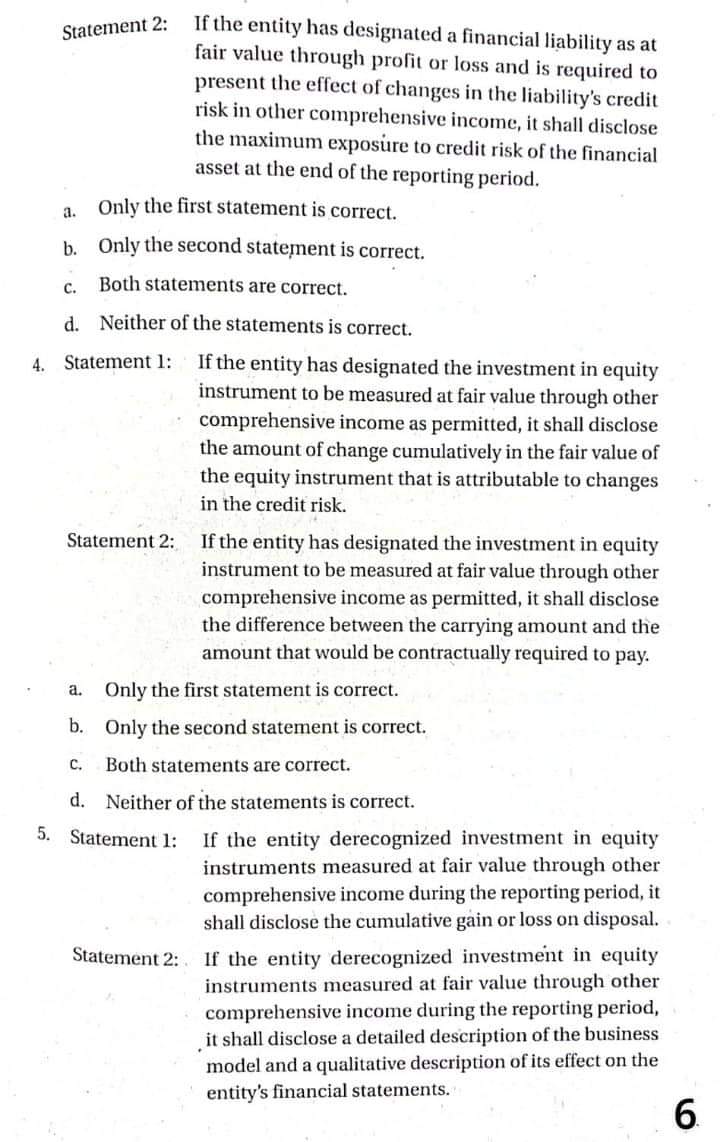
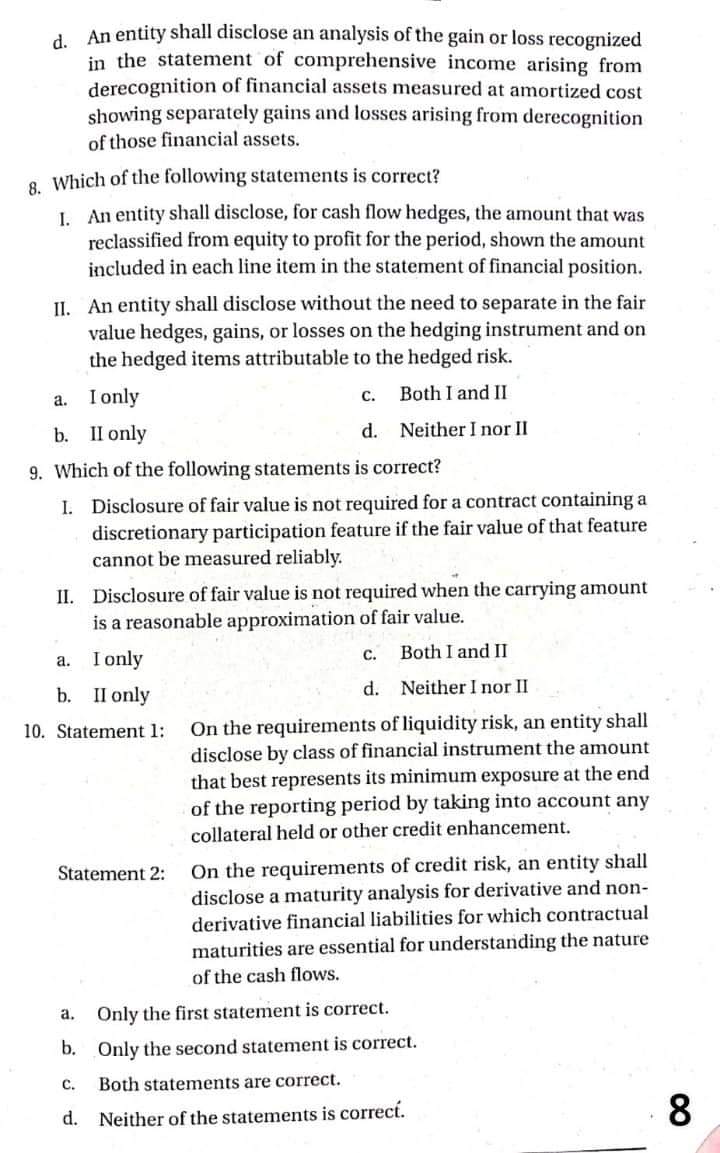
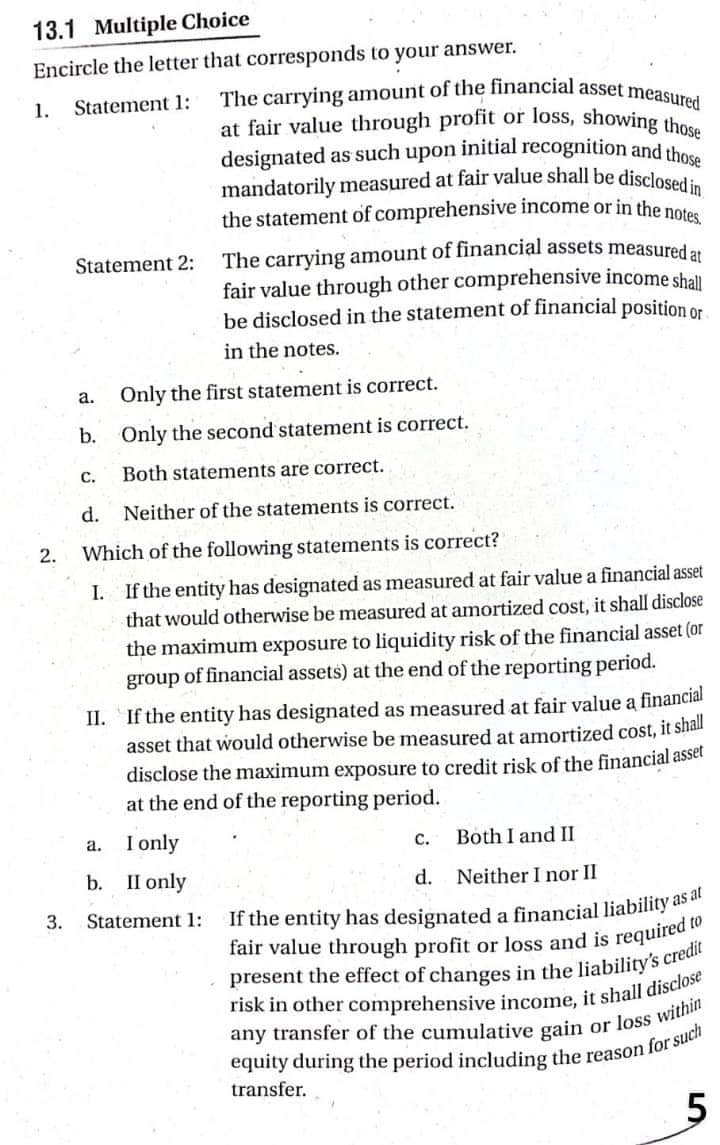
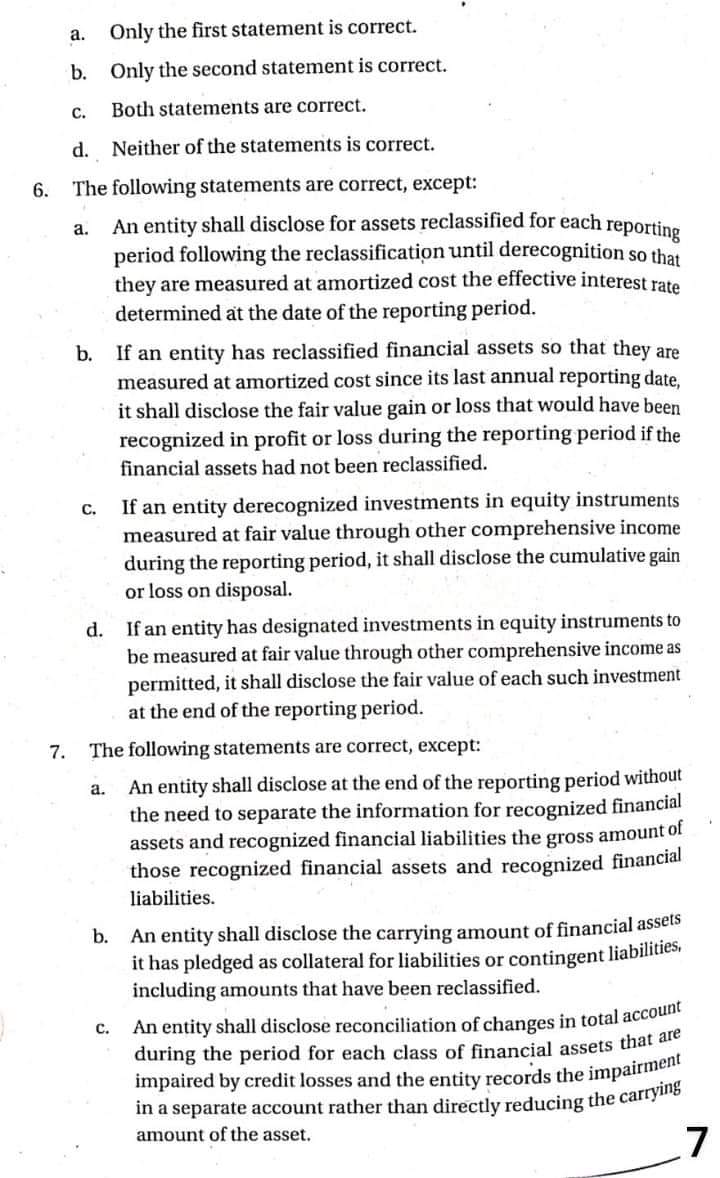
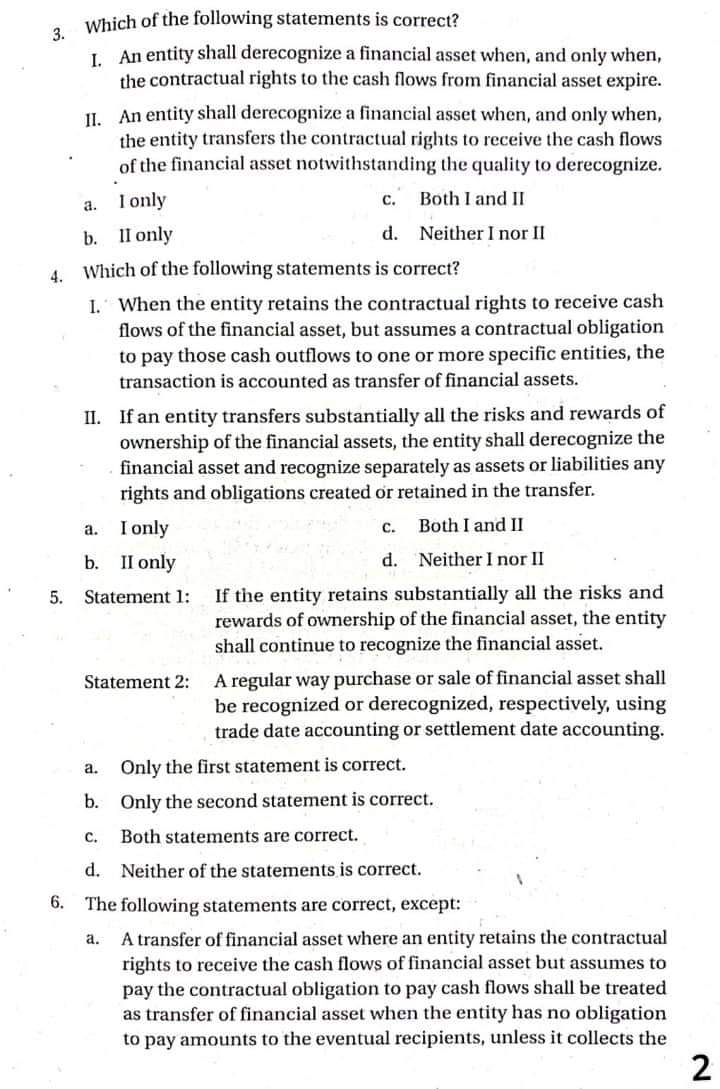
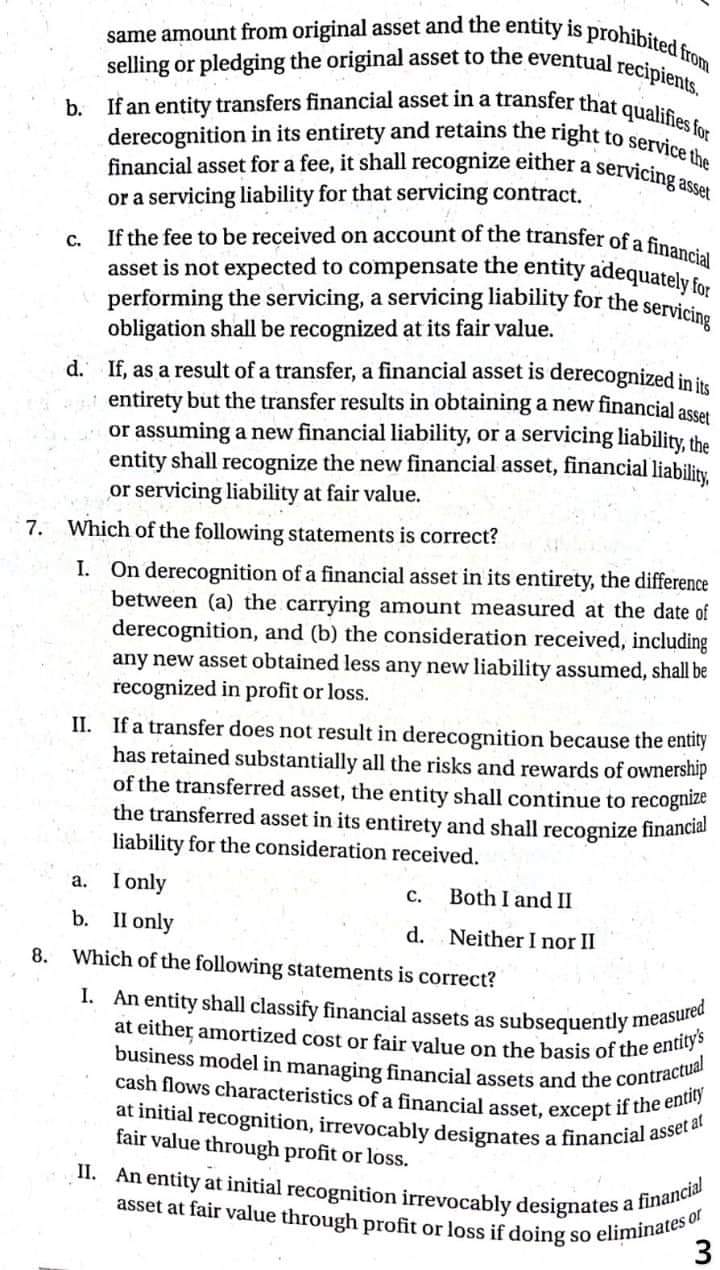
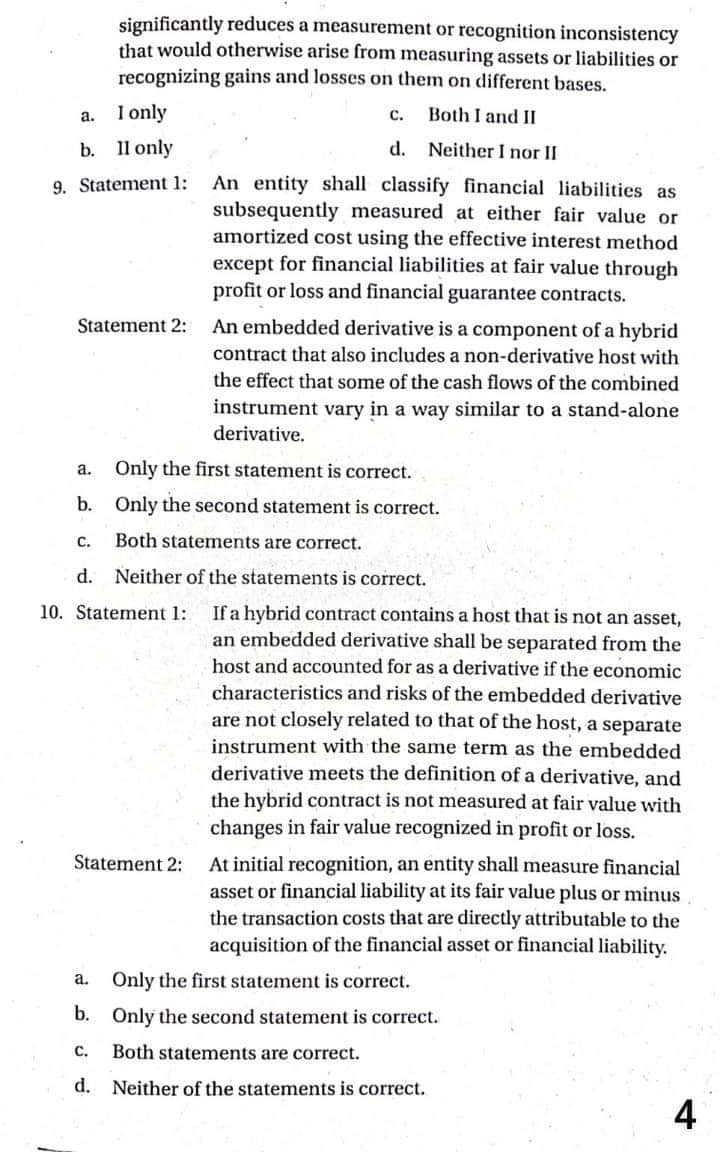
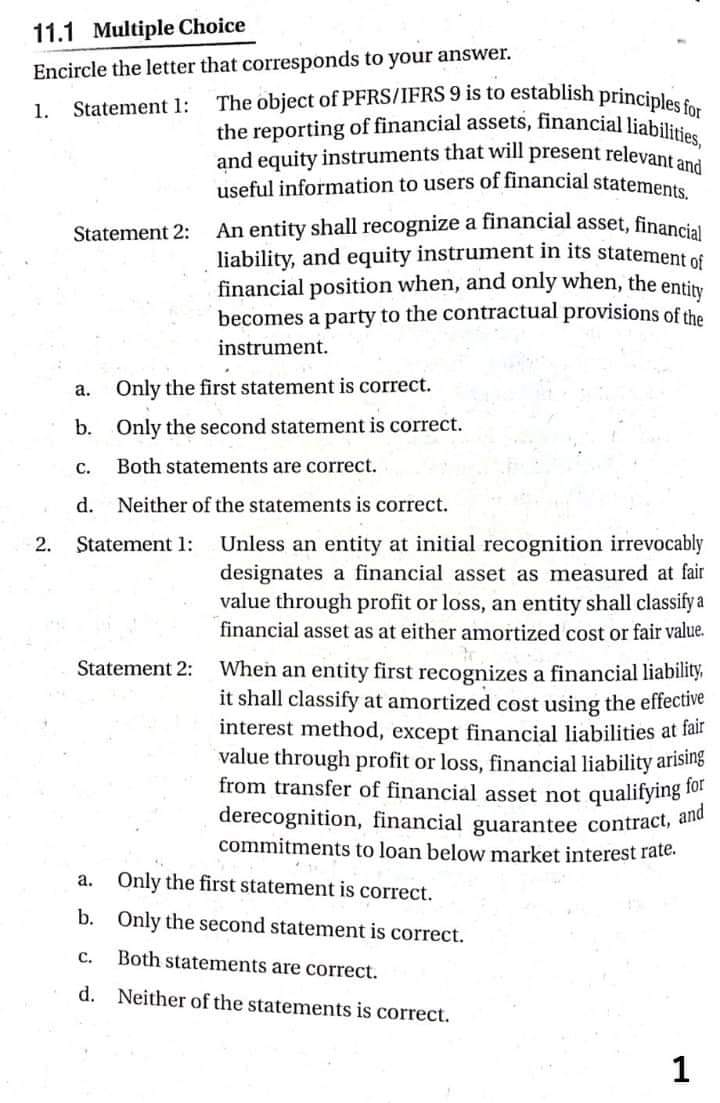
Statement 2: if :he entity has designated a nancial liability as at a r value through prot or loss and is required to present the effect of changes in the liability's credit risk in other comprehensive income. it shall disclose the maximum expositre to credit risk of the nancial asset at the end of the reporting period. a. Only the rst statement is correct. '1 Only the second statement is correct. c. Both statements are correct, :1. Neither of the statements is correct. 4. Statement 1: Statement 2: If theentity has designated the investment in equity instrument to be measured at fair value through other comprehensive income as permitted, it shall disclose the amount of change cumulatively in the fair value of the equity instrument that is attributable to changes in the credit risk. If the entity has designated the investment in equity instrument to be measured at fair value through other comprehensive income as permitted. it shall disclose the difference between the carrying amount and the amount that would he contractually required to pay. Only the rst statement is correct. a. h. Only the second statement is correct. c. Both statements are correct. (1. Neither of the statements is correct. 5- Statement 1: Statement 2: _ 1f the entity derecogniaed investment in equity instruments measured at fair value through other comprehensive income during the reporting period. it shall disclose the cumulative gain or loss on disposal. If the entity dis-recognized investment in equity instruments measured at fair value through other comprehensive income during the reporting period. . it shall disclose a detailed description of the business model and a qualitative description of its effect on the ' entity's nancial statements. d. An entity shall disclose an analysis of the gain or loss recognized in the statement of comprehensive income arising from derecognition of financial assets measured at amortized cost showing separately gains and losses arising from derecognition of those financial assets. 8. Which of the following statements is correct? 1. An entity shall disclose, for cash flow hedges, the amount that was reclassified from equity to profit for the period, shown the amount included in each line item in the statement of financial position. I1. An entity shall disclose without the need to separate in the fair value hedges, gains, or losses on the hedging instrument and on the hedged items attributable to the hedged risk. a. I only C. Both I and II b. II only d. Neither I nor II 9. Which of the following statements is correct? I. Disclosure of fair value is not required for a contract containing a discretionary participation feature if the fair value of that feature cannot be measured reliably. II. Disclosure of fair value is not required when the carrying amount is a reasonable approximation of fair value. a. I only c. Both I and II b. II only d. Neither I nor II 10. Statement 1: On the requirements of liquidity risk, an entity shall disclose by class of financial instrument the amount that best represents its minimum exposure at the end of the reporting period by taking into account any collateral held or other credit enhancement. Statement 2: On the requirements of credit risk, an entity shall disclose a maturity analysis for derivative and non- derivative financial liabilities for which contractual maturities are essential for understanding the nature of the cash flows. a. Only the first statement is correct. b. Only the second statement is correct. C. Both statements are correct. d. Neither of the statements is correct. 813.1 Multiple Choice Encircle the letter that corresponds to your answer. 1. Statement 1: The carrying amount of the financial asset measured at fair value through profit or loss, showing those designated as such upon initial recognition and those mandatorily measured at fair value shall be disclosed in the statement of comprehensive income or in the notes. Statement 2: The carrying amount of financial assets measured at fair value through other comprehensive income shall be disclosed in the statement of financial position or in the notes. a. Only the first statement is correct. b. Only the second statement is correct. c. Both statements are correct. d. Neither of the statements is correct. 2. Which of the following statements is correct? I. If the entity has designated as measured at fair value a financial asset that would otherwise be measured at amortized cost, it shall disclose the maximum exposure to liquidity risk of the financial asset (or group of financial assets) at the end of the reporting period. II. If the entity has designated as measured at fair value a financial asset that would otherwise be measured at amortized cost, it shall disclose the maximum exposure to credit risk of the financial asset at the end of the reporting period. a. Ionly c. Both I and II b. II only d. Neither I nor II 3. Statement 1: If the entity has designated a financial liability as a fair value through profit or loss and is required to present the effect of changes in the liability's credit risk in other comprehensive income, it shall disclose any transfer of the cumulative gain or loss within equity during the period including the reason for such transfer. UTa. Only the first statement is correct. b. Only the second statement is correct. c. Both statements are correct. d. Neither of the statements is correct. 6. The following statements are correct, except: a. An entity shall disclose for assets reclassified for each reporting period following the reclassification until derecognition so that they are measured at amortized cost the effective interest rate determined at the date of the reporting period. b. If an entity has reclassified financial assets so that they are measured at amortized cost since its last annual reporting date, it shall disclose the fair value gain or loss that would have been recognized in profit or loss during the reporting period if the financial assets had not been reclassified. c. If an entity derecognized investments in equity instruments measured at fair value through other comprehensive income during the reporting period, it shall disclose the cumulative gain or loss on disposal. d. If an entity has designated investments in equity instruments to be measured at fair value through other comprehensive income as permitted, it shall disclose the fair value of each such investment at the end of the reporting period. 7. The following statements are correct, except: a. An entity shall disclose at the end of the reporting period without the need to separate the information for recognized financial assets and recognized financial liabilities the gross amount of those recognized financial assets and recognized financial liabilities. b. An entity shall disclose the carrying amount of financial assets it has pledged as collateral for liabilities or contingent liabilities, including amounts that have been reclassified c. An entity shall disclose reconciliation of changes in total account during the period for each class of financial assets that are impaired by credit losses and the entity records the impairment in a separate account rather than directly reducing the carrying amount of the asset. 73. Which of the following statements is correct? 1. An entity shall derecognize a financial asset when, and only when, the contractual rights to the cash flows from financial asset expire. 11. An entity shall derecognize a financial asset when, and only when, the entity transfers the contractual rights to receive the cash flows of the financial asset notwithstanding the quality to derecognize. a. Ionly C. Both I and II b. II only d. Neither I nor II 4. Which of the following statements is correct? 1. When the entity retains the contractual rights to receive cash flows of the financial asset, but assumes a contractual obligation to pay those cash outflows to one or more specific entities, the transaction is accounted as transfer of financial assets. II. If an entity transfers substantially all the risks and rewards of ownership of the financial assets, the entity shall derecognize the financial asset and recognize separately as assets or liabilities any rights and obligations created or retained in the transfer. a. I only c. Both I and II b. II only d. Neither I nor II 5. Statement 1: If the entity retains substantially all the risks and rewards of ownership of the financial asset, the entity shall continue to recognize the financial asset. Statement 2: A regular way purchase or sale of financial asset shall be recognized or derecognized, respectively, using trade date accounting or settlement date accounting. a. Only the first statement is correct. b. Only the second statement is correct. c. Both statements are correct. d. Neither of the statements is correct. 6. The following statements are correct, except: a. A transfer of financial asset where an entity retains the contractual rights to receive the cash flows of financial asset but assumes to pay the contractual obligation to pay cash flows shall be treated as transfer of financial asset when the entity has no obligation to pay amounts to the eventual recipients, unless it collects the 2sallie amount from original asset and the entity is prohibited from selling or pledging the original asset to the eventual recipients b. If an entity transfers financial asset in a transfer that qualifies for derecognition in its entirety and retains the right to service the financial asset for a fee, it shall recognize either a servicing asset or a servicing liability for that servicing contract. C. If the fee to be received on account of the transfer of a financial asset is not expected to compensate the entity adequately for performing the servicing, a servicing liability for the servicing obligation shall be recognized at its fair value. d. If, as a result of a transfer, a financial asset is derecognized in its entirety but the transfer results in obtaining a new financial asset or assuming a new financial liability, or a servicing liability, the entity shall recognize the new financial asset, financial liability, or servicing liability at fair value. 7. Which of the following statements is correct? I. On derecognition of a financial asset in its entirety, the difference between (a) the carrying amount measured at the date of derecognition, and (b) the consideration received, including any new asset obtained less any new liability assumed, shall be recognized in profit or loss. II. If a transfer does not result in derecognition because the entity has retained substantially all the risks and rewards of ownership of the transferred asset, the entity shall continue to recognize the transferred asset in its entirety and shall recognize financial liability for the consideration received. a. I only C. Both I and II b. II only d. Neither I nor II 8. Which of the following statements is correct? 1. An entity shall classify financial assets as subsequently measured at either amortized cost or fair value on the basis of the entity's business model in managing financial assets and the contractual cash flows characteristics of a financial asset, except if the entity at initial recognition, irrevocably designates a financial asset a fair value through profit or loss. 11. An entity at initial recognition irrevocably designates a financial asset at fair value through profit or loss if doing so eliminates of 3significantly reduces a measurement or recognition inconsistency that would otherwise arise from measuring assets or liabilities or recognizing gains and losses on them on different bases. a. I only C. Both I and II b. 1I only d. Neither I nor II 9. Statement 1: An entity shall classify financial liabilities as subsequently measured at either fair value or amortized cost using the effective interest method except for financial liabilities at fair value through profit or loss and financial guarantee contracts. Statement 2: An embedded derivative is a component of a hybrid contract that also includes a non-derivative host with the effect that some of the cash flows of the combined instrument vary in a way similar to a stand-alone derivative. a. Only the first statement is correct. b. Only the second statement is correct. c. Both statements are correct. d. Neither of the statements is correct. 10. Statement 1: If a hybrid contract contains a host that is not an asset, an embedded derivative shall be separated from the host and accounted for as a derivative if the economic characteristics and risks of the embedded derivative are not closely related to that of the host, a separate instrument with the same term as the embedded derivative meets the definition of a derivative, and the hybrid contract is not measured at fair value with changes in fair value recognized in profit or loss. Statement 2: At initial recognition, an entity shall measure financial asset or financial liability at its fair value plus or minus the transaction costs that are directly attributable to the acquisition of the financial asset or financial liability. a. Only the first statement is correct. b. Only the second statement is correct. C. Both statements are correct. d. Neither of the statements is correct. 411.1 Multiple Choice Encircle the letter that corresponds to your answer. 1. Statement 1: The object of PERS/IFRS 9 is to establish principles for the reporting of financial assets, financial liabilities, and equity instruments that will present relevant and useful information to users of financial statements. Statement 2: An entity shall recognize a financial asset, financial liability, and equity instrument in its statement of financial position when, and only when, the entity becomes a party to the contractual provisions of the instrument. a. Only the first statement is correct. b. Only the second statement is correct. C. Both statements are correct. d. Neither of the statements is correct. 2. Statement 1: Unless an entity at initial recognition irrevocably designates a financial asset as measured at fair value through profit or loss, an entity shall classify a financial asset as at either amortized cost or fair value. Statement 2: When an entity first recognizes a financial liability, it shall classify at amortized cost using the effective interest method, except financial liabilities at fair value through profit or loss, financial liability arising from transfer of financial asset not qualifying for derecognition, financial guarantee contract, and commitments to loan below market interest rate. a. Only the first statement is correct. b. Only the second statement is correct. c. Both statements are correct. d. Neither of the statements is correct
Step by Step Solution
There are 3 Steps involved in it
1 Expert Approved Answer
Step: 1 Unlock
Question Has Been Solved by an Expert!
Get step-by-step solutions from verified subject matter experts
Step: 2 Unlock
Step: 3 Unlock
Students Have Also Explored These Related Accounting Questions!









 Study Help