







Question: statistics and probability 2. Consider a stande 52 card deck of playing cards. In total there are four cards that are Aces, four cards that
statistics and probability
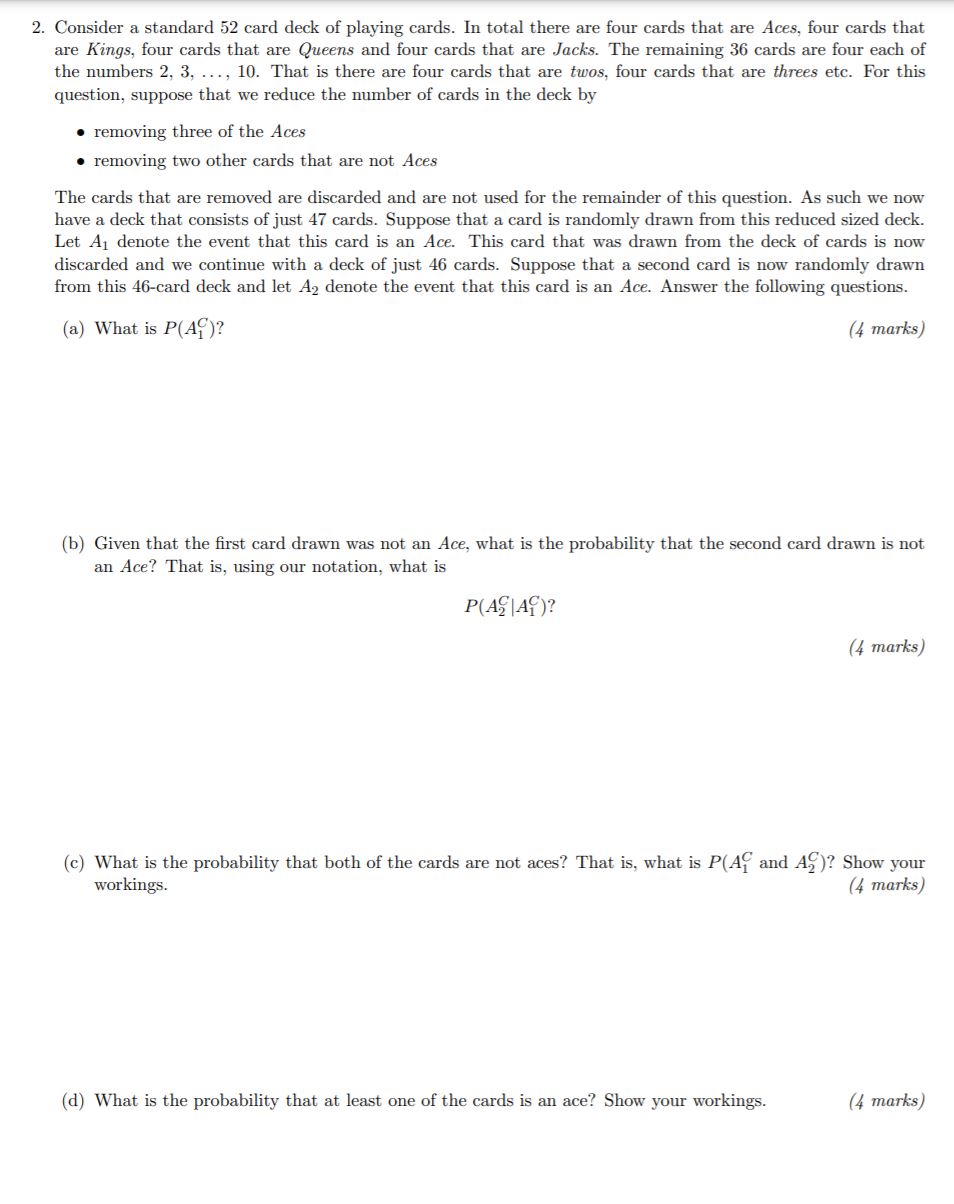

2. Consider a stande 52 card deck of playing cards. In total there are four cards that are Aces, four cards that are Kings, four cards that are Queens and four cards that are Jacks. The remaining 36 cards are four each of the numbers 2, 3, .. . , 10. That is there are four cards that are twos, four cards that are threes etc. For this question, suppose that we reduce the number of cards in the deck by e removing three of the Aces I removing two other cards that are not Aces The cards that are removed are discarded and are not used for the remainder of this question. As such we now have a deck that consists of just 47 cards. Suplmse that a card is randomly drawn from this reduced sized deck. Let A; denote the event that this card is an Ace. This card that was drawn from the deck of cards is now discarded and we continue with a deck of just 46 cards. Suppose that a second card is now randomly drawn from this lift-card deck and let A2 denote the event that this card is an Ace. Answer the following questions. (a) What is H.453}? (4 marks) {b) Given that the rst card drawn was not an Ace, what is the probability that the second card drawn is not an Ace? That is, using our notation, what is PMEJIA'EJ? {4 malt-*1) {c} What is the probability that both of the cards are not aces? That is, what is P[A'E and Ag)? Show your workings. (A; mrks) (d) What is the probability that at least one of the cards is an ace? Show your workings. (A; mrks) (e) Given that the rst card drawn was an Ace, what is the probability that the second card drawn is not an A88? (4 marks )
Step by Step Solution
There are 3 Steps involved in it

Get step-by-step solutions from verified subject matter experts
 Study Help