







Question: Statistics and Probability / Econometrics question. Please help. This problem is inspired by a study of the gender gap in earnings in top corporate jobs
Statistics and Probability / Econometrics question. Please help.
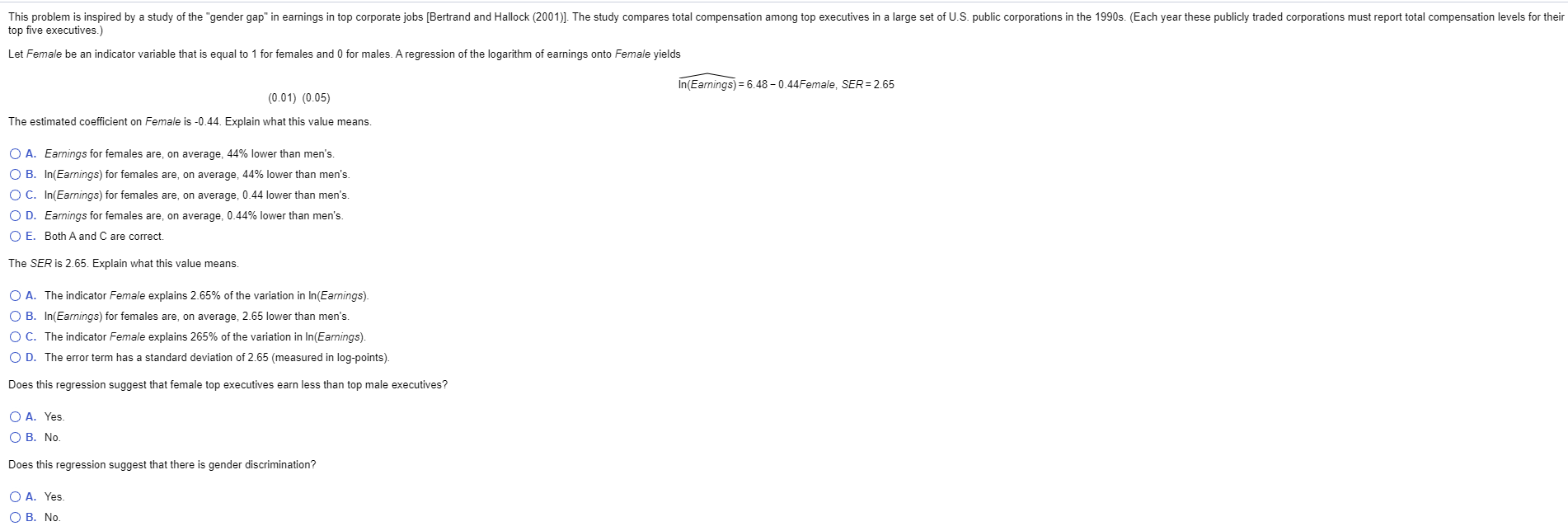
This problem is inspired by a study of the "gender gap" in earnings in top corporate jobs [Bertrand and Hallock (2001)]. The study compares total compensation among top executives in a large set of U.S. public corporations in the 1990s. (Each year these publicly traded corporations must report total compensation levels for their top five executives.) Let Female be an indicator variable that is equal to 1 for females and 0 for males. A regression of the logarithm of earnings onto Female yields (0.01) (0.05) In(Earnings) = 6.48 - 0.44Female, SER = 2.65 The estimated coefficient on Female is -0.44. Explain what this value means. O A. Earnings for females are, on average, 44% lower than men's. O B. In(Earnings) for females are, on average, 44% lower than men's. O C. In(Earnings) for females are, on average, 0.44 lower than men's. O D. Earnings for females are, on average, 0.44% lower than men's O E. Both A and C are correct. The SER is 2.65. Explain what this value means. O A. The indicator Female explains 2.65% of the variation in In(Earnings). O B. In(Earnings) for females are, on average, 2.65 lower than men's O C. The indicator Female explains 265% of the variation in In(Earnings). O D. The error term has a standard deviation of 2.65 (measured in log-points) Does this regression suggest that female top executives earn less than top male executives? O A. Yes. O B. No. Does this regression suggest that there is gender discrimination? O A. Yes. O B. No
Step by Step Solution
There are 3 Steps involved in it

Get step-by-step solutions from verified subject matter experts
 Study Help