







Question: STEP 1 : INFLUENCE LINES Problem Statement: You will need to understand the behavior of each truss to safely define the appropriate member sizes. For
STEP : INFLUENCE LINES
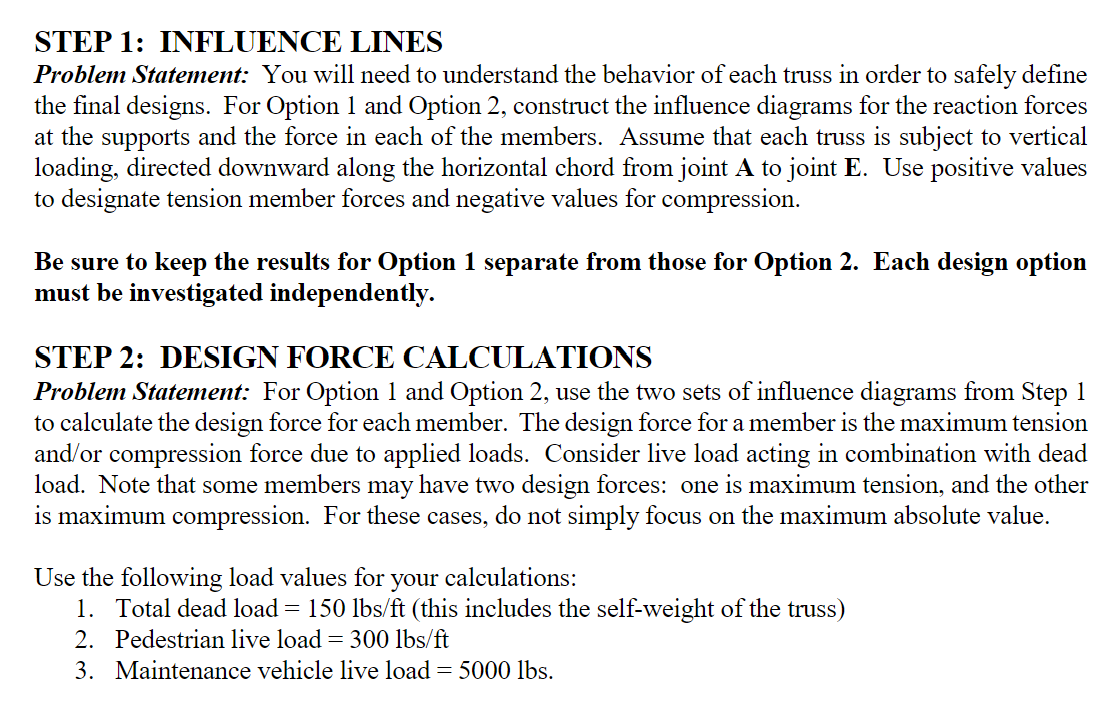
Problem Statement: You will need to understand the behavior of each truss to safely define the
appropriate member sizes. For Option and Option construct the influence diagrams for the
reaction forces at the supports and the force in each of the members. Assume that each truss is subject
to vertical loading, directed downward along the horizontal chord from joint A to joint E Use positive
values to designate tension member forces and negative values for compression.
The influence diagrams for the members on the right side of each truss will be mirror images of those
on the left because of symmetry. Therefore, for Option construct the influence lines for the
following nine members: AB BC AF BF BG CG CH FG and GH And for Option construct
the influence lines for the following eight members: AB BC AF BF BG CG FG and GH
Be sure to keep the results for Option separate from those for Option Each design option
must be investigated independently.
STEP : DESIGN FORCE CALCULATIONS
Problem Statement: For Option and Option use the two sets of influence diagrams from Step
to calculate the design force in each member. For Option calculate the design forces for the
following nine members: AB BC AF BF BG CG CH FG and GH For Option calculate the
design forces for the following eight members: AB BC AF BF BG CG FG and GH
The design force for a member is the maximum tension andor compression force due to applied
loads. Consider live load acting in combination with dead load. Note that some members may have
two design forces: one is maximum tension, and the other is maximum compression. For these cases,
do not simply focus on the maximum absolute value; both values must be retained to determine the
proper member size.
Use the following load values for your calculations:
Total dead load lbsft this includes the selfweight of the truss
Pedestrian live load lbsft
Maintenance vehicle live load lbs
Step by Step Solution
There are 3 Steps involved in it
1 Expert Approved Answer
Step: 1 Unlock

Question Has Been Solved by an Expert!
Get step-by-step solutions from verified subject matter experts
Step: 2 Unlock
Step: 3 Unlock
 Study Help