







Question: Step 1 Using a straightedge, draw an angle. Label the vertex P. Step 2 Using a straightedge, draw a ray that does not appear to
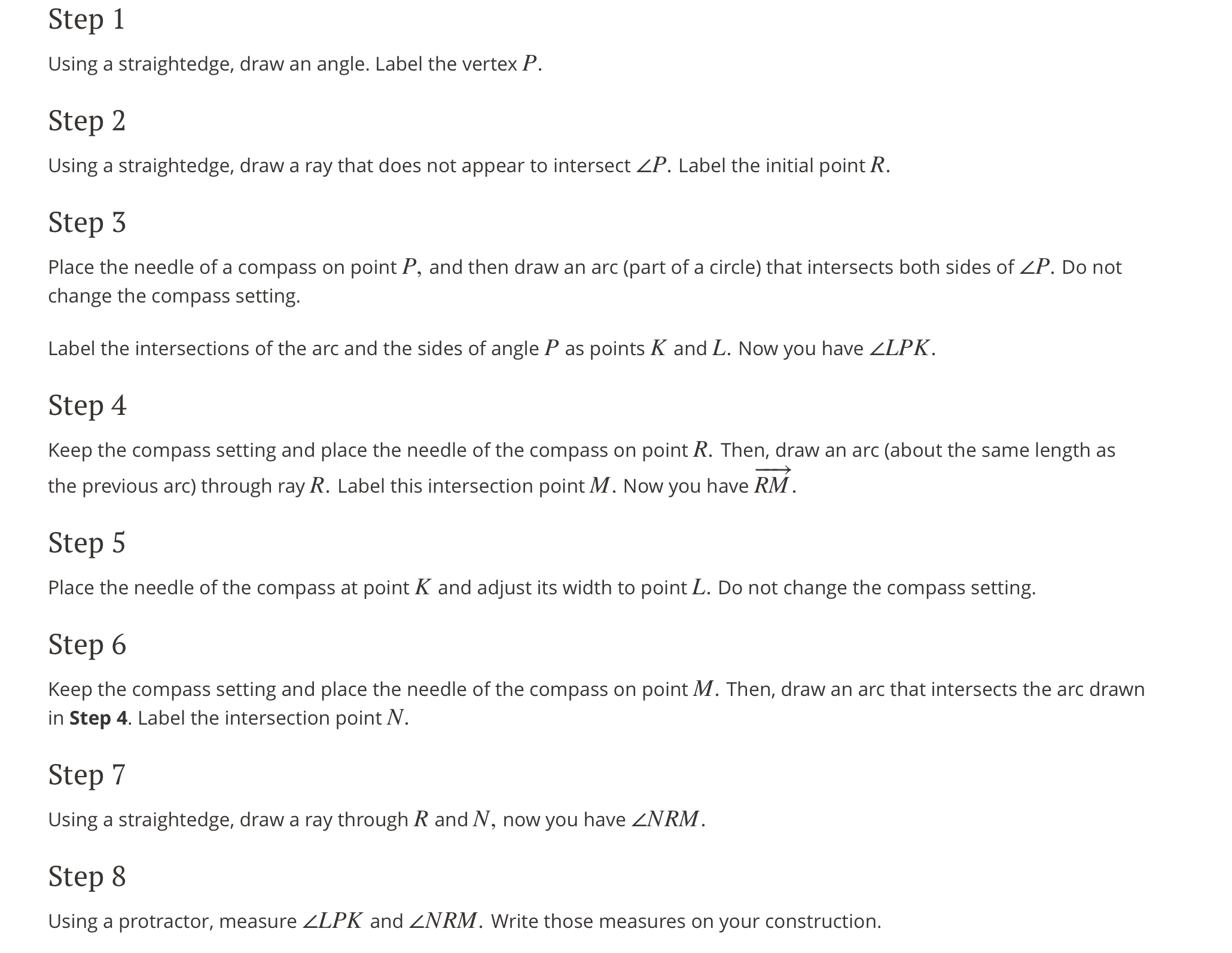
Step 1 Using a straightedge, draw an angle. Label the vertex P. Step 2 Using a straightedge, draw a ray that does not appear to intersect AP. Label the initial point R. Step 3 Place the needle ofa compass on point P, and then draw an arc (part ofa circle)that intersects both sides of AP. Do not change the compass setting. Label the intersections of the arc and the sides of angle P as points K and L. Now you have ALPK. Step 4 Keep the compass setting and place the needle of the compass on point R. Then, draw an arc (about the same length as > the previous arc) through rayR. Label this intersection point M. Now you have RM. Step 5 Place the needle ofthe compass at point K and adjust its width to point L. Do not change the compass setting. Step 6 Keep the compass setting and place the needle of the compass on point M. Then, draw an arc that intersects the arc drawn in Step 4. Label the intersection point N. Step 7 Using a straightedge, draw a ray through R and N, now you have ANRM. Step 8 Using a protractor, measure ALPK and ANRM. Write those measures on your construction
Step by Step Solution
There are 3 Steps involved in it

Get step-by-step solutions from verified subject matter experts
 Study Help