







Question: Step 2: Identify Your Data The FIRST thing that should be included in your submission/document is a list of the data you are using Your
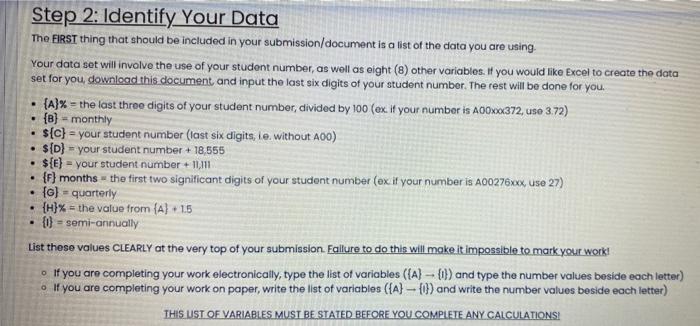
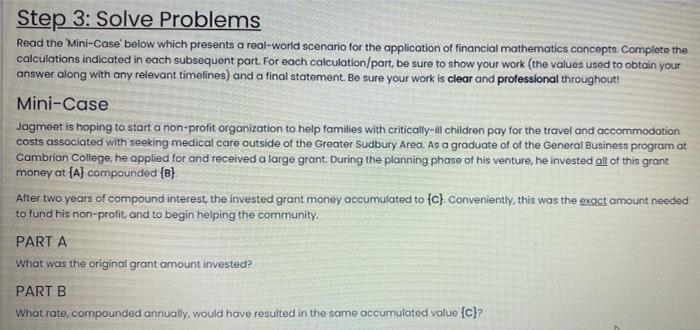
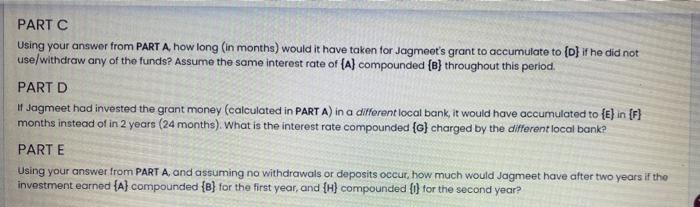
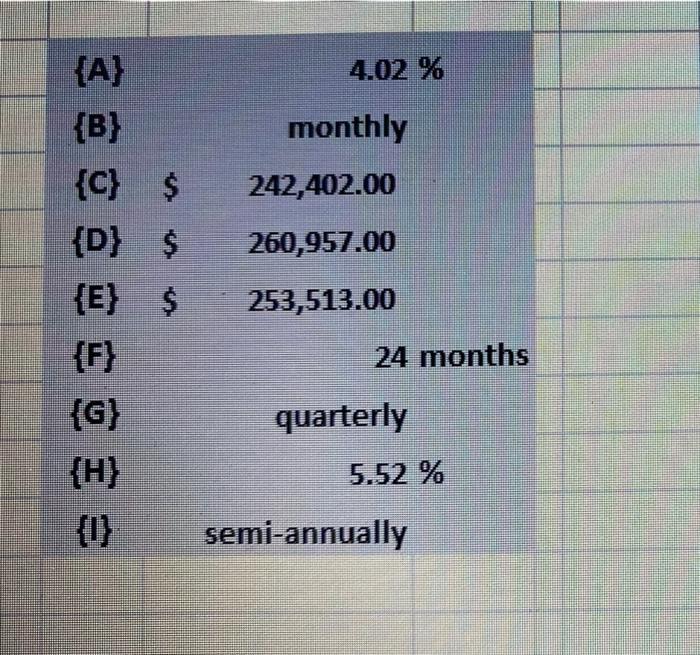
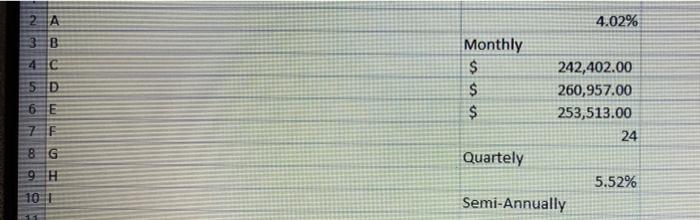
Step 2: Identify Your Data The FIRST thing that should be included in your submission/document is a list of the data you are using Your data set will involve the use of your student number, as well as eight (8) other variables. If you would like Excel to create the data set for you, download this document, and input the last six digits of your student number. The rest will be done for you. . . . . . . . (A)%= the last three digits of your student number, divided by 100 (ex. if your number is A00xxx372, use 3.72) (8)= monthly ${c} = your student number (last six digits, ie. without A00) = ${D) your student number +18,555 ${E} your student number +11,111. (F) months the first two significant digits of your student number (ex if your number is A00276xxx, use 27) (G) = quarterly {H}%= the value from (A) +1.5 {1}-semi-annually List these values CLEARLY at the very top of your submission. Fallure to do this will make it impossible to mark your work! o If you are completing your work electronically, type the list of variables ({A}-{}) and type the number values beside each letter) If you are completing your work on paper, write the list of variables ({A}-{}) and write the number values beside each letter) THIS LIST OF VARIABLES MUST BE STATED BEFORE YOU COMPLETE ANY CALCULATIONS! Step 3: Solve Problems Read the 'Mini-Case' below which presents a real-world scenario for the application of financial mathematics concepts. Complete the calculations indicated in each subsequent part. For each calculation/part, be sure to show your work (the values used to obtain your answer along with any relevant timelines) and a final statement. Be sure your work is clear and professional throughout! Mini-Case Jagmeet is hoping to start a non-profit organization to help families with critically-ill children pay for the travel and accommodation costs associated with seeking medical care outside of the Greater Sudbury Area. As a graduate of of the General Business program at Cambrian College, he applied for and received a large grant. During the planning phase of his venture, he invested all of this grant money at (A) compounded (B) After two years of compound interest, the invested grant money accumulated to {C}. Conveniently, this was the exact amount needed to fund his non-profit, and to begin helping the community. PART A What was the original grant amount invested? PART B What rate, compounded annually, would have resulted in the same accumulated value {C}? PART C Using your answer from PART A, how long (in months) would it have taken for Jagmeet's grant to accumulate to [D] if he did not use/withdraw any of the funds? Assume the same interest rate of (A) compounded [B} throughout this period. PART D If Jagmeet had invested the grant money (calculated in PART A) in a different local bank, it would have accumulated to [E] in {F} months instead of in 2 years (24 months). What is the interest rate compounded ({G} charged by the different local bank? PART E Using your answer from PART A, and assuming no withdrawals or deposits occur, how much would Jagmeet have after two years if the investment earned {A} compounded (B) for the first year, and (H) compounded (1) for the second year? {A} {B} {C} $ {D} $ {E} $ {F} {G} {H} {0} 4.02 % monthly 242,402.00 260,957.00 253,513.00 24 months quarterly 5.52 % semi-annually 2 A 3 B 4 C 5 D 6 E 7 F 8 G 9 H 10 Monthly $ 555 $ $ Quartely 4.02% 242,402.00 260,957.00 253,513.00 Semi-Annually 24 5.52% Step 2: Identify Your Data The FIRST thing that should be included in your submission/document is a list of the data you are using Your data set will involve the use of your student number, as well as eight (8) other variables. If you would like Excel to create the data set for you, download this document, and input the last six digits of your student number. The rest will be done for you. . . . . . . . (A)%= the last three digits of your student number, divided by 100 (ex. if your number is A00xxx372, use 3.72) (8)= monthly ${c} = your student number (last six digits, ie. without A00) = ${D) your student number +18,555 ${E} your student number +11,111. (F) months the first two significant digits of your student number (ex if your number is A00276xxx, use 27) (G) = quarterly {H}%= the value from (A) +1.5 {1}-semi-annually List these values CLEARLY at the very top of your submission. Fallure to do this will make it impossible to mark your work! o If you are completing your work electronically, type the list of variables ({A}-{}) and type the number values beside each letter) If you are completing your work on paper, write the list of variables ({A}-{}) and write the number values beside each letter) THIS LIST OF VARIABLES MUST BE STATED BEFORE YOU COMPLETE ANY CALCULATIONS! Step 3: Solve Problems Read the 'Mini-Case' below which presents a real-world scenario for the application of financial mathematics concepts. Complete the calculations indicated in each subsequent part. For each calculation/part, be sure to show your work (the values used to obtain your answer along with any relevant timelines) and a final statement. Be sure your work is clear and professional throughout! Mini-Case Jagmeet is hoping to start a non-profit organization to help families with critically-ill children pay for the travel and accommodation costs associated with seeking medical care outside of the Greater Sudbury Area. As a graduate of of the General Business program at Cambrian College, he applied for and received a large grant. During the planning phase of his venture, he invested all of this grant money at (A) compounded (B) After two years of compound interest, the invested grant money accumulated to {C}. Conveniently, this was the exact amount needed to fund his non-profit, and to begin helping the community. PART A What was the original grant amount invested? PART B What rate, compounded annually, would have resulted in the same accumulated value {C}? PART C Using your answer from PART A, how long (in months) would it have taken for Jagmeet's grant to accumulate to [D] if he did not use/withdraw any of the funds? Assume the same interest rate of (A) compounded [B} throughout this period. PART D If Jagmeet had invested the grant money (calculated in PART A) in a different local bank, it would have accumulated to [E] in {F} months instead of in 2 years (24 months). What is the interest rate compounded ({G} charged by the different local bank? PART E Using your answer from PART A, and assuming no withdrawals or deposits occur, how much would Jagmeet have after two years if the investment earned {A} compounded (B) for the first year, and (H) compounded (1) for the second year? {A} {B} {C} $ {D} $ {E} $ {F} {G} {H} {0} 4.02 % monthly 242,402.00 260,957.00 253,513.00 24 months quarterly 5.52 % semi-annually 2 A 3 B 4 C 5 D 6 E 7 F 8 G 9 H 10 Monthly $ 555 $ $ Quartely 4.02% 242,402.00 260,957.00 253,513.00 Semi-Annually 24 5.52%
Step by Step Solution
There are 3 Steps involved in it

Get step-by-step solutions from verified subject matter experts
 Study Help