







Question: Step 4 : Pipelined reliability If you've made it this far, you've already built a reliable sender out of an unreliable network! Your task in
Step : Pipelined reliability
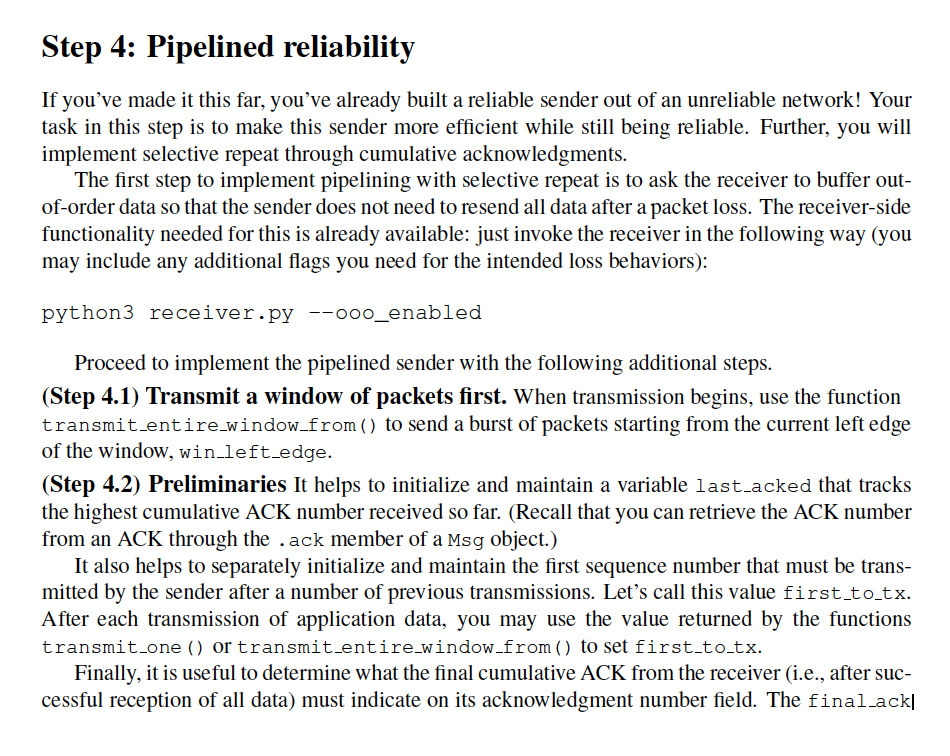
If you've made it this far, you've already built a reliable sender out of an unreliable network! Your task in this step is to make this sender more efficient while still being reliable. Further, you will implement selective repeat through cumulative acknowledgments.
The first step to implement pipelining with selective repeat is to ask the receiver to buffer outoforder data so that the sender does not need to resend all data after a packet loss. The receiverside functionality needed for this is already available: just invoke the receiver in the following way you may include any additional flags you need for the intended loss behaviors:
python receiver.py oooenabled
Proceed to implement the pipelined sender with the following additional steps.
Step Transmit a window of packets first. When transmission begins, use the function transmitentirewindowfrom to send a burst of packets starting from the current left edge of the window, winleftedge.
Step Preliminaries It helps to initialize and maintain a variable lastacked that tracks the highest cumulative ACK number received so far. Recall that you can retrieve the ACK number from an ACK through the ack member of a Msg object.
It also helps to separately initialize and maintain the first sequence number that must be transmitted by the sender after a number of previous transmissions. Let's call this value firsttotx After each transmission of application data, you may use the value returned by the functions transmitone or transmitentirewindowfrom to set firsttotx
Finally, it is useful to determine what the final cumulative ACK from the receiver ie after successful reception of all data must indicate on its acknowledgment number field. The finalack is just INITSEQNO contentlen. We will use finalack to determine when to terminate the sender
Next, enhance your stopandwait implementation with these additional checks whenever you have ACKs after a recvfrom call.
Step If the ACK acknowledges fresh data, slide the window forward. The slide must reflect changes to the variables corresponding to the left window edge winleftedge the right window edge winrightedge and the cumulative ACK number lastacked
Step Is there more data to transmit? If the window has slid forward, the sender now becomes free to transmit more data, assuming that the right edge of the window hasn't gone beyond the set of available sequence numbers to transmit bounded by finalack Call the transmitentirewindowfrom function supplied with the first sequence number that must be transmitted, firsttotx
Step If there is no more fresh data, have all required ACKs been received? This can be determined by checking whether lastacked is the same as finalack. At this point, we can terminate all transmission and reception.
If there is either more fresh data to transmit, or not all ACKs have been received, the sender should wait for ACKs same as it did with stopandwait to help slide its window forward for the subsequent transmissions or finish receiving all ACKs.
Step Handling timeouts. Ensure that you only transmitone after a timeout, since we are using selective repeat, and the receiver is buffering outoforder data to reduce unnecessary transmissions.
In a true pipelined reliable sender there is a distinct timeout for each sequence number in flight. However, the select call implements a timeout on the entire socket. The distinction between a timeout per socket and a timeout per sequence number did not matter in stopandwait, because all sequence numbers in flight will either be ACKed together or none of those sequence numbers will be ACKed at all. However, with pipelined reliability, if you use a select call as you did in step a single lost packet may not trigger a retransmission timeout on the socket if the sender is continuing to receive any data at all usually duplicate ACKs on the socket.
In this project, we will keep things simple and just implement a single RTO on the socket rather than one RTO per sequence number. So you can keep the select implementation from step
Step Test your code. Your code should continue to run correctly with all the test cases in step In addition, you can test multiple window sizes. We suggest testing with three values, the default bytes one medium bytes and one large bytes You can change the senders window size using the winsize flag. A correct pipelined sender should clearly run faster than the corresponding stopandwait sender
Step by Step Solution
There are 3 Steps involved in it
1 Expert Approved Answer
Step: 1 Unlock

Question Has Been Solved by an Expert!
Get step-by-step solutions from verified subject matter experts
Step: 2 Unlock
Step: 3 Unlock
 Study Help