Question: Step by step resolution required, or I will dislike The emergence of smart manufacturing using IoT and cobots will necessitate an integrated approach to cybersecurity
Step by step resolution required, or I will dislike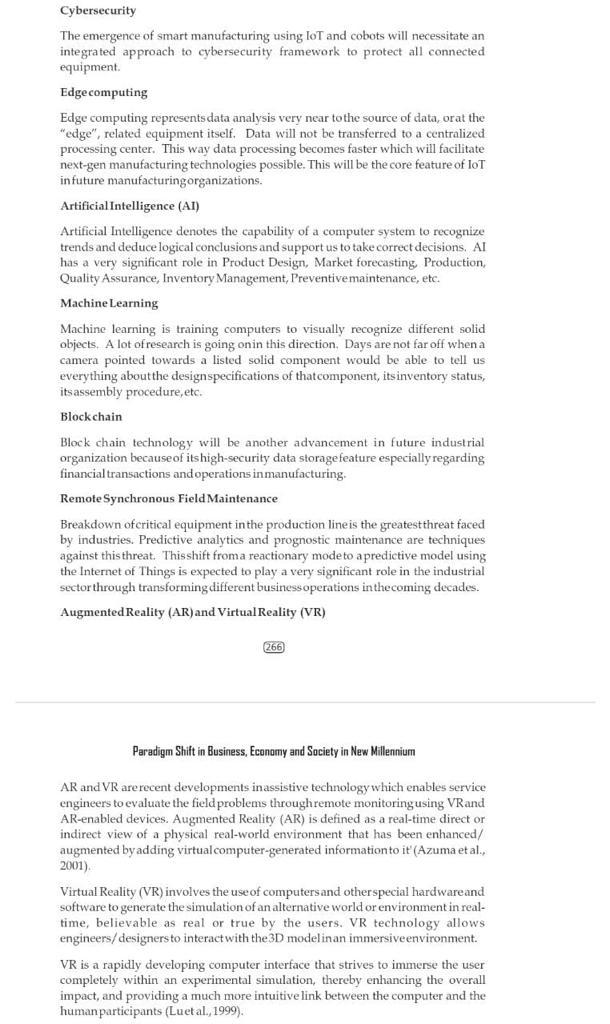
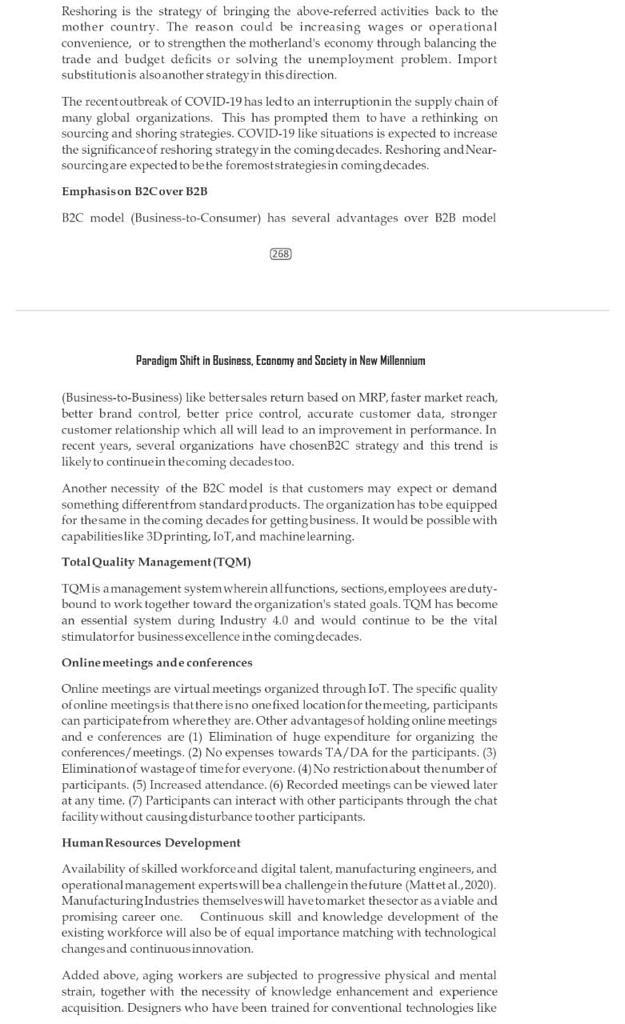
The emergence of smart manufacturing using IoT and cobots will necessitate an integrated approach to cybersecurity framework to protect all connected equipment. Edgecomputing Edge computing represents data analysis very near to the source of data, or at the "edge", related equipment itself. Data will not be transferred to a centralized processing center. This way data processing becomes faster which will facilitate next-gen manufacturing technologies possible. This will be the core feature of IoT in future manufacturingorganizations. Artificial Intelligence (AI) Artificial Intelligence denotes the capability of a computer system to recognize trends and deduce logical conclusions and support us to take correct decisions. AI has a very significant role in Product Design, Market forecasting, Production, Quality Assurance, Inventory Management, Preventivemaintenance, etc. Machine Learning Machine learning is training computers to visually recognize different solid objects. A lot of research is going onin this direction. Days are not far off when a camera pointed towards a listed solid component would be able to tell us everything aboutthe designspecifications of thatcomponent, itsinventory status, itsassembly procedure,etc. Blockchain Block chain technology will be another advancement in future industrial organization because of itshigh-security data storagefeature especially regarding financial transactions and operations in manufacturing. RemoteSynchronous Field Maintenance Breakdown ofcritical equipment in the production lineis the greatest threat faced by industries. Predictive analytics and prognostic maintenance are techniques against this threat. Thisshift froma reactionary modeto apredictive model using the Internet of Things is expected to play a very significant role in the industrial sector through transforming different businessoperations in thecoming decades. Augmented Reality (AR) and Virtual Reality (VR) 266 Paradigm Shift in Business, Economy and Society in New Millennium AR and VR are recent developments inassistive technology which enables service engineers to evaluate the field problems throughremote monitoringusing VRand AR-enabled devices. Augmented Reality (AR) is defined as a real-time direct or indirect view of a physical real-world environment that has been enhanced/ augmented by adding virtual computer-generated information to it' (Azuma et al., 2001). Virtual Reality (VR) involves the use of computersand otherspecial hardwareand software to generate the simulation of an alternative world or environment in realtime, believable as real or true by the users. VR technology allows engineers/designersto interactwith the 3D modelinan immersiveenvironment. VR is a rapidly developing computer interface that strives to immerse the user completely within an experimental simulation, thereby enhancing the overall impact, and providing a much more intuitive link between the computer and the humanparticipants (Luetal., 1999). Reshoring is the strategy of bringing the above-referred activities back to the mother country. The reason could be increasing wages or operational convenience, or to strengthen the motherland's economy through balancing the trade and budget deficits or solving the unemployment problem. Import substitution is also another strategyin this direction. The recent outbreak of COVID-19 has led to an interruption in the supply chain of many global organizations. This has prompted them to have a rethinking on sourcing and shoring strategies. COVID-19 like situations is expected to increase the significance of reshoring strategy in the coming decades. Reshoring and Nearsourcingare expected to be the foremoststrategies in coming decades. Emphasison B2Cover B2B B2C model (Business-to-Consumer) has several advantages over B2B model 268 Paradigm Shift in Business, Economy and Society in New Millennium (Business-to-Business) like bettersales return based on MRP, faster market reach, better brand control, better price control, accurate customer data, stronger customer relationship which all will lead to an improvement in performance. In recent years, several organizations have chosenB2C strategy and this trend is likely to continue in the coming decadestoo. Another necessity of the B2C model is that customers may expect or demand something differentfrom standard products. The organization has to be equipped for the same in the coming decades for gettingbusiness. It would be possible with capabilitieslike 3D printing, loT, and machine learning. TotalQuality Management(TQM) TQM is a management system wherein all functions, sections, employees are dutybound to work together toward the organization's stated goals. TQM has become an essential system during Industry 4.0 and would continue to be the vital stimulatorfor businessexcellence in the comingdecades. Online meetings ande conferences Online meetings are virtual meetings organized through loT. The specific quality of online meetings is that there isno onefixed location for themeeting, participants can participatefrom wherethey are, Other advantages of holding online meetings and e conferences are (1) Elimination of huge expenditure for organizing the conferences/meetings. (2) No expenses towards TA/DA for the participants. (3) Elimination of wastage of time for everyone. (4) No restrictionabout thenumber of participants. (5) Increased attendance. (6) Recorded meetings can be viewed later facility without causing disturbance toother participants. Human Resources Development Availability of skilled workforceand digital talent, manufacturing engineers, and operational management expertswill bea challenge in the future (Mattet al., 2020). Manufacturing Industries themselveswill havetomarket thesector as a viable and promising career one. Continuous skill and knowledge development of the existing workforce will also be of equal importance matching with technological changesand continuousinnovation. Added above, aging workers are subjected to progressive physical and mental strain, together with the necessity of knowledge enhancement and experience acquisition. Designers who have been trained for conventional technologies like The emergence of smart manufacturing using IoT and cobots will necessitate an integrated approach to cybersecurity framework to protect all connected equipment. Edgecomputing Edge computing represents data analysis very near to the source of data, or at the "edge", related equipment itself. Data will not be transferred to a centralized processing center. This way data processing becomes faster which will facilitate next-gen manufacturing technologies possible. This will be the core feature of IoT in future manufacturingorganizations. Artificial Intelligence (AI) Artificial Intelligence denotes the capability of a computer system to recognize trends and deduce logical conclusions and support us to take correct decisions. AI has a very significant role in Product Design, Market forecasting, Production, Quality Assurance, Inventory Management, Preventivemaintenance, etc. Machine Learning Machine learning is training computers to visually recognize different solid objects. A lot of research is going onin this direction. Days are not far off when a camera pointed towards a listed solid component would be able to tell us everything aboutthe designspecifications of thatcomponent, itsinventory status, itsassembly procedure,etc. Blockchain Block chain technology will be another advancement in future industrial organization because of itshigh-security data storagefeature especially regarding financial transactions and operations in manufacturing. RemoteSynchronous Field Maintenance Breakdown ofcritical equipment in the production lineis the greatest threat faced by industries. Predictive analytics and prognostic maintenance are techniques against this threat. Thisshift froma reactionary modeto apredictive model using the Internet of Things is expected to play a very significant role in the industrial sector through transforming different businessoperations in thecoming decades. Augmented Reality (AR) and Virtual Reality (VR) 266 Paradigm Shift in Business, Economy and Society in New Millennium AR and VR are recent developments inassistive technology which enables service engineers to evaluate the field problems throughremote monitoringusing VRand AR-enabled devices. Augmented Reality (AR) is defined as a real-time direct or indirect view of a physical real-world environment that has been enhanced/ augmented by adding virtual computer-generated information to it' (Azuma et al., 2001). Virtual Reality (VR) involves the use of computersand otherspecial hardwareand software to generate the simulation of an alternative world or environment in realtime, believable as real or true by the users. VR technology allows engineers/designersto interactwith the 3D modelinan immersiveenvironment. VR is a rapidly developing computer interface that strives to immerse the user completely within an experimental simulation, thereby enhancing the overall impact, and providing a much more intuitive link between the computer and the humanparticipants (Luetal., 1999). Reshoring is the strategy of bringing the above-referred activities back to the mother country. The reason could be increasing wages or operational convenience, or to strengthen the motherland's economy through balancing the trade and budget deficits or solving the unemployment problem. Import substitution is also another strategyin this direction. The recent outbreak of COVID-19 has led to an interruption in the supply chain of many global organizations. This has prompted them to have a rethinking on sourcing and shoring strategies. COVID-19 like situations is expected to increase the significance of reshoring strategy in the coming decades. Reshoring and Nearsourcingare expected to be the foremoststrategies in coming decades. Emphasison B2Cover B2B B2C model (Business-to-Consumer) has several advantages over B2B model 268 Paradigm Shift in Business, Economy and Society in New Millennium (Business-to-Business) like bettersales return based on MRP, faster market reach, better brand control, better price control, accurate customer data, stronger customer relationship which all will lead to an improvement in performance. In recent years, several organizations have chosenB2C strategy and this trend is likely to continue in the coming decadestoo. Another necessity of the B2C model is that customers may expect or demand something differentfrom standard products. The organization has to be equipped for the same in the coming decades for gettingbusiness. It would be possible with capabilitieslike 3D printing, loT, and machine learning. TotalQuality Management(TQM) TQM is a management system wherein all functions, sections, employees are dutybound to work together toward the organization's stated goals. TQM has become an essential system during Industry 4.0 and would continue to be the vital stimulatorfor businessexcellence in the comingdecades. Online meetings ande conferences Online meetings are virtual meetings organized through loT. The specific quality of online meetings is that there isno onefixed location for themeeting, participants can participatefrom wherethey are, Other advantages of holding online meetings and e conferences are (1) Elimination of huge expenditure for organizing the conferences/meetings. (2) No expenses towards TA/DA for the participants. (3) Elimination of wastage of time for everyone. (4) No restrictionabout thenumber of participants. (5) Increased attendance. (6) Recorded meetings can be viewed later facility without causing disturbance toother participants. Human Resources Development Availability of skilled workforceand digital talent, manufacturing engineers, and operational management expertswill bea challenge in the future (Mattet al., 2020). Manufacturing Industries themselveswill havetomarket thesector as a viable and promising career one. Continuous skill and knowledge development of the existing workforce will also be of equal importance matching with technological changesand continuousinnovation. Added above, aging workers are subjected to progressive physical and mental strain, together with the necessity of knowledge enhancement and experience acquisition. Designers who have been trained for conventional technologies like









 Study Help