Question: Step through the examples shown on pages 1 through 3. Read over the information given on page 4, this will help you complete page 5
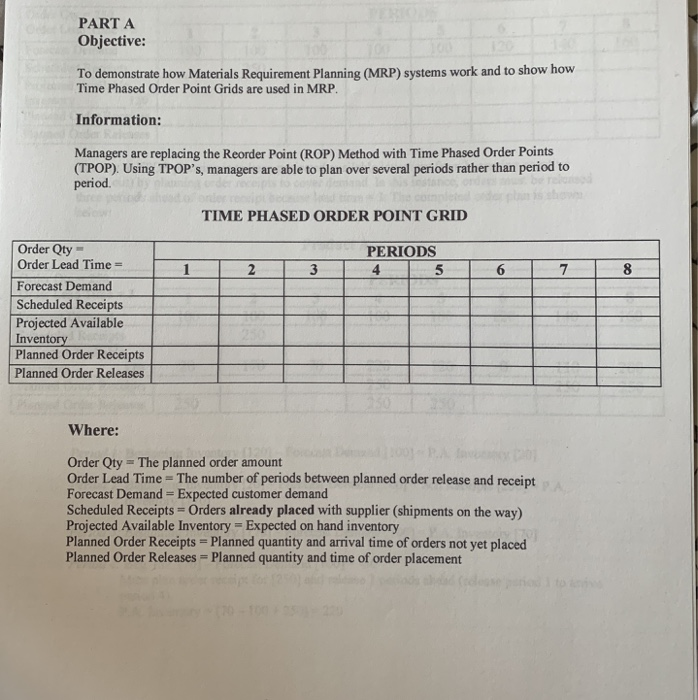
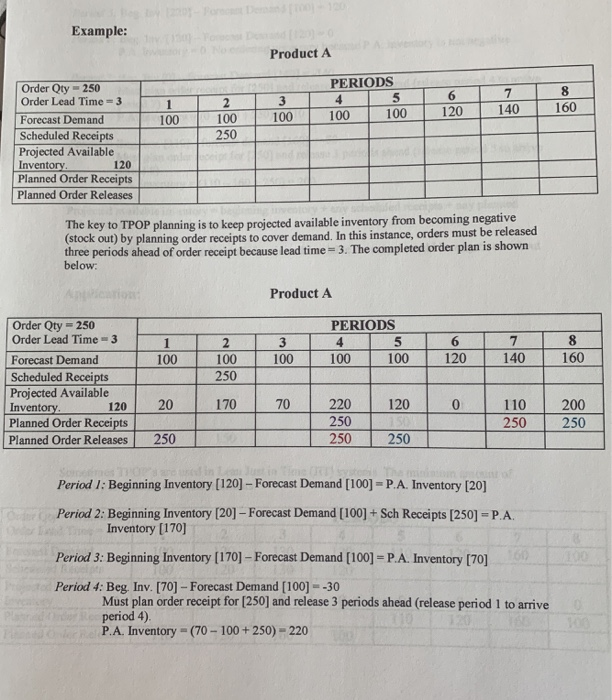
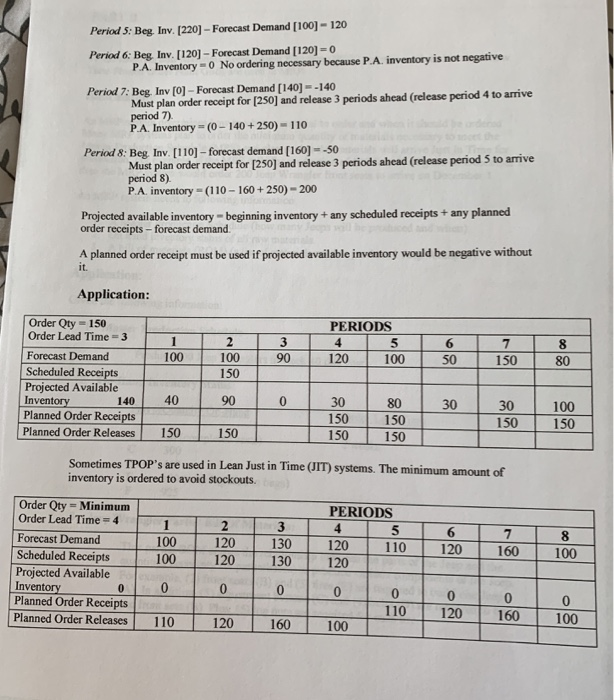
Step through the examples shown on pages 1 through 3.
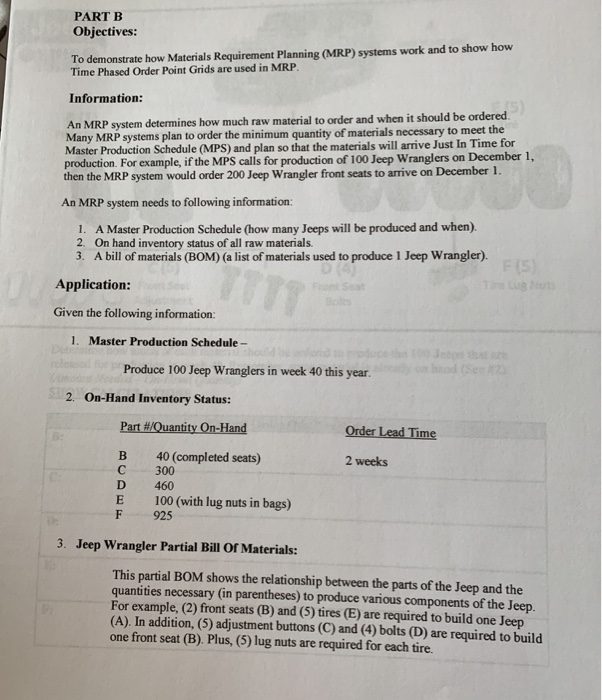
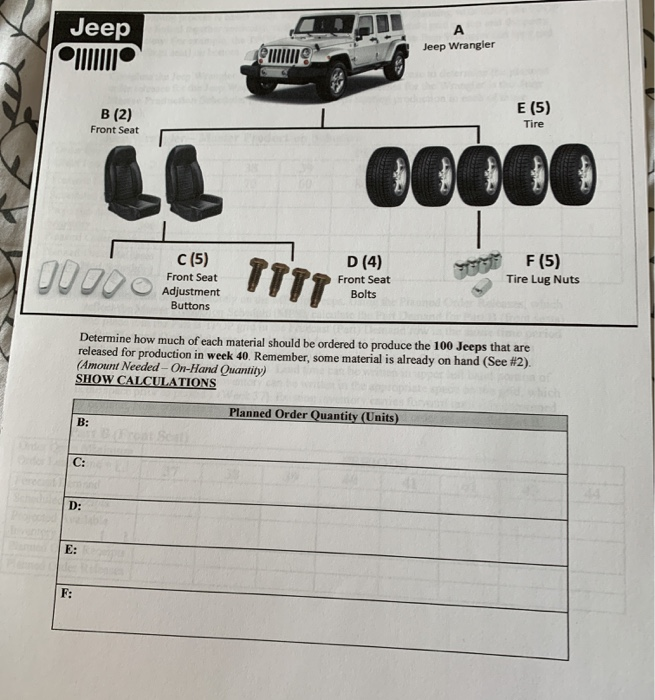
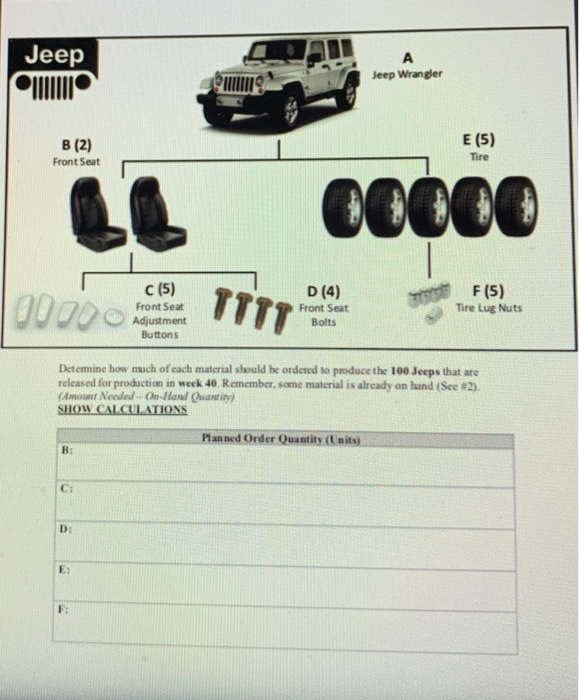
Read over the information given on page 4, this will help you complete page 5 where you need determine how much of each material should be ordered to produce the 100 Jeeps. Find out how much you need but subtract any existing inventory found at the part level (e.g., buttons) and sub-assembly level (e.g., buttons on assembled seats). Youre building 100 Jeeps. So, in the first box (B), you need to find out how many seats you need to meet production. Notice that on the previous page you have some items inventory. After adjusting for inventory, you should be able to determine the number of units left to order. Realize that the completed seats have bolts and buttons already attached. This would be counted as inventory because you wouldnt need to order them. Same for the tires that are in stock that already have lugs. To get you started, theres 40 seats in stock. Each Jeep has 2 front seats, so 100 x 2 = 200 subtract the 40 seats in stock will give you your planned order quantity.
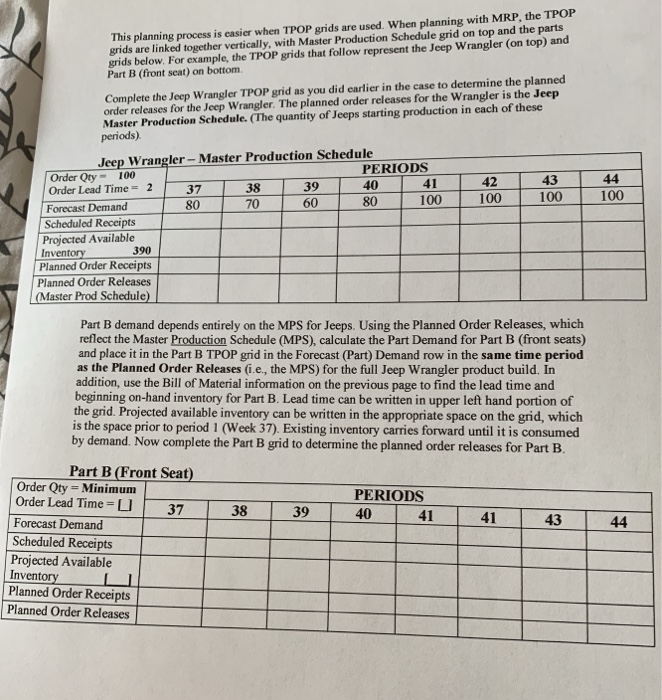
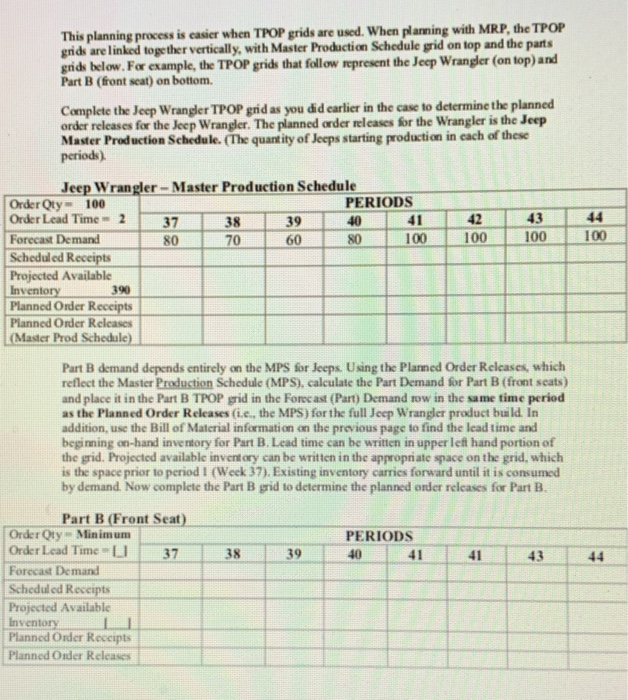
The examples from the previous pages will help you complete the two grids on page 6. When planning with MRP, the TPOP grids are linked together vertically, with Master Production Schedule grid on top and the parts grids below. For example, the TPOP grids on page 6 represent the Jeep Wrangler (on top) and Part B (front seat) on bottom. The top grid has a specified order quantity, while the bottom grid behaves in a Lean/Just in Time manner allowing you to order exactly what you need when you need it using a minimum order quantity. On page 6, youre completing the top grid for finished Jeeps, working through the grid left to right. Anything in the release row, when its all said and done, will cascade down to the bottom grid. So, for example, you should have a Planned Order Release of 100 Jeeps in period 40, which means you now have demand for 200 seats in period 40 that you would enter in the bottom grid. You shouldnt have any demand up to this point because you had plenty of finished jeeps in stock to this point. Check page 4, you will note that you have 40 seats in inventory. You should also note the lead time for seats. You need this information to complete the bottom grid. Your inventory will carry forward over a number of periods until you need it.
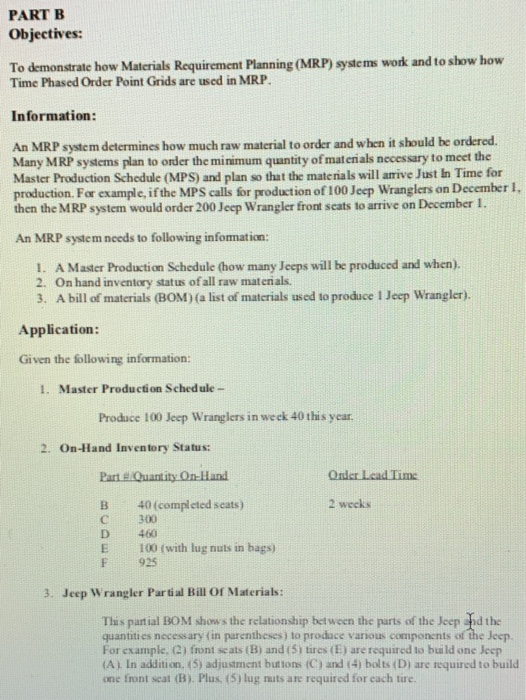
PART B Objectives: To demonstrate how Materials Requirement Planning (MRP) systems work and to show how Time Phased Order Point Grids are used in MRP. Information: An MRP system determines how much raw material to order and when it should be ordered. Many MRP systems plan to order the minimum quantity of materials necessary to meet the Master Production Schedule (MPS) and plan so that the materials will arrive Just In Time for production. For example, if the MPS calls for production of 100 Jeep Wranglers on December 1, then the MRP system would order 200 Jeep Wrangler front seats to arrive on December 1. An MRP system needs to following information: 1. A Master Production Schedule (how many Jeeps will be produced and when). 2. On hand inventory status of all raw materials. 3. A bill of materials (BOM) (a list of materials used to produce 1 Jeep Wrangler). Application: Given the following information: 1. Master Production Schedule - Produce 100 Jeep Wranglers in week 40 this year. Order Lead Time 2. On-Hand Inventory Status Part Quantity On-Hand B 40 (completed seats) 300 D 460 100 (with lug nuts in bags) 925 2 weeks 3. Jeep Wrangler Partial Bill or Materials: This partial BOM shows the relationship between the parts of the Jeep hd the quantities necessary in parentheses) to produce various components of the Jeep. For example, (2) front seats (B) and (5) tires (E) are required to build one Jeep (A). In addition (5) adjustment buttons (C) and (4) bolts (D) are required to build one front seat (B). Plus (5) lug nuts are required for each tire. Jeep Jeep Wrangler B (2) Front Seat E (5) Tire 2 00066 F (5) JUOD c (5) Adjustment Front Seat D (4) Front Seat Bolts Tire Lug Nuts Buttons Determine how much of each material should be ordered to produce the 100 Jeeps that are released for production in week 40. Remember, some material is already on hund (See #2) (Amour Needed - On-Hand Quanti SHOW CALCULATIONS Planned Order Quantity (Units) This planning process is easier when TPOP grids are used. When planning with MRP, the TPOP grids are linked together vertically, with Master Production Schedule grid on top and the parts grids below. For example, the TPOP grids that follow represent the Jeep Wrangler (on top) and Part B (front seat) on bottom. Complete the Jeep Wrangler TPOP grid as you did earlier in the case to determine the planned order releases for the Jeep Wrangler. The planned order releases for the Wrangler is the Jeep Master Production Schedule. (The quantity of Jeeps starting production in cach of these periods). 42 100 43 100 44 100 Jeep Wrangler - Master Production Schedule Order Qly 100 PERIODS Order Lead Time 2 37 38 39 40 41 Forecast Demand 80. 70 60 80 100 Scheduled Receipts Projected Available Inventory 390 Planned Order Receipts Planned Order Releases (Master Prod Schedule) Part B demand depends entirely on the MPS for Jeeps. Using the Planned Order Releases, which reflect the Master Production Schedule (MPS), calculate the Part Demand for Part B (front seats) and place it in the Part B TPOP grid in the Forecast (Part) Demand row in the same time period as the Planned Order Releases (i.e., the MPS) for the full Jeep Wrangler product build. In addition, use the Bill of Material information on the previous page to find the lead time and beginning on-hand inventory for Part B. Lead time can be written in upper left hand portion of the grid. Projected available inventory can be written in the appropriate space on the grid, which is the space prior to period 1 (Week 37). Existing inventory carries forward until it is consumed by demand. Now complete the Part B grid to determine the planned order releases for Part B. 38 PERIODS 40 41 39 42 43 Part B (Front Seat) Order Qty Minimum Order Lead Time- L 3 7 Forecast Demand Scheduled Receipts Projected Available Inventory Planned Order Receipts Planned Onder Releases PART A Objective: To demonstrate how Materials Requirement Planning (MRP) systems work and to show how Time Phased Order Point Grids are used in MRP. Information: Managers are replacing the Reorder Point (ROP) Method with Time Phased Order Points (TPOP). Using TPOP's, managers are able to plan over several periods rather than period to period. TIME PHASED ORDER POINT GRID PERIODS 3 Order Qty - Order Lead Time = Forecast Demand Scheduled Receipts Projected Available Inventory Planned Order Receipts Planned Order Releases Where: Order Qty = The planned order amount Order Lead Time - The number of periods between planned order release and receipt Forecast Demand = Expected customer demand Scheduled Receipts=Orders already placed with supplier (shipments on the way) Projected Available Inventory = Expected on hand inventory Planned Order Receipts = Planned quantity and arrival time of orders not yet placed Planned Order Releases - Planned quantity and time of order placement Example: Product A I I 3 100 7 140 PERIODS 4 5 16 100 100 120 8 160 2 100 250 | 100 Order Qty 250 Order Lead Time = 3 Forecast Demand Scheduled Receipts Projected Available Inventory. 120 Planned Order Receipts Planned Order Releases The key to TPOP planning is to keep projected available inventory from becoming negative (stock out) by planning order receipts to cover demand. In this instance, orders must be released three periods ahead of order receipt because lead time = 3. The completed order plan is shown below: Product A I I PERIODS 4 5 100 100 2 100 250 3 100 100 6 120 7 8 1401 160 Order Qty = 250 Order Lead Time - 3 Forecast Demand Scheduled Receipts Projected Available Inventory. 120 Planned Order Receipts Planned Order Releases 1 20 170 70 220 1200 250 250 1250 110 250 200 250 250 Period 1: Beginning Inventory [120] - Forecast Demand [100] - PA. Inventory (20) Period 2: Beginning Inventory [20] - Forecast Demand [100] + Sch Receipts [250] - P.A. Inventory [170] Period 3: Beginning Inventory [170] - Forecast Demand [100] - P.A. Inventory [70] Period 4: Beg. Inv. [70] - Forecast Demand [100] --30 Must plan order receipt for [250] and release 3 periods ahead (release period 1 to arrive period 4) P.A. Inventory -(70 - 100 + 250) - 220 Period 5. Beg. Inv. [220] - Forecast Demand [100] - 120 Period 6: Beg Inv. (120) - Forecast Demand [120] -0 P.A. Inventory-0 No ordering necessary because P.A. inventory is not negative Period 7: Beg. Inv [0] - Forecast Demand [140] -140 Must plan order receipt for (250) and release 3 periods ahead (release period 4 to arrive period 7). P.A. Inventory - (0 - 140 + 250) - 110 Period 8: Beg. Inv. [110] - forecast demand [160] =-50 Must plan order receipt for [250] and release 3 periods ahead (release period 5 to arrive period 8). P.A. inventory -(110 - 160+250) - 200 Projected available inventory - beginning inventory + any scheduled receipts + any planned order receipts - forecast demand. A planned order receipt must be used if projected available inventory would be negative without Application: Order Qty 150 Order Lead Time - 3 2 100 3 90 PERIODS 4 5 6 12010050 100 | 150 8 80 150 Forecast Demand Scheduled Receipts Projected Available Inventory 140 Planned Order Receipts Planned Order Releases 40 90 0 30 30 1150 150 80 150 150 30 150 100 150 150 150 Sometimes TPOP's are used in Lean Just in Time (JIT) systems. The minimum amount of inventory is ordered to avoid stockouts. PERIODS I 7 1 100 100 2 120 120 3 130 130 Order Qty Minimum Order Lead Time=4 Forecast Demand 1 Scheduled Receipts Projected Available Inventory 0 0 Planned Order Receipts Planned Order Releases 120 120 110 6 120 160 8 100 0 0 0 0 0 0 120 110 120 160 160 100 100 PART B Objectives: To demonstrate how Materials Requirement Planning (MRP) systems work and to show how Time Phased Order Point Grids are used in MRP. Information: An MRP system determines how much raw material to order and when it should be ordered Many MRP systems plan to order the minimum quantity of materials necessary to meet the Master Production Schedule (MPS) and plan so that the materials will arrive Just In Time for production. For example, if the MPS calls for production of 100 Jeep Wranglers on December 1, then the MRP system would order 200 Jeep Wrangler front seats to arrive on December 1. An MRP system needs to following information: 1. A Master Production Schedule (how many Jeeps will be produced and when) 2. On hand inventory status of all raw materials. 3. A bill of materials (BOM) (a list of materials used to produce 1 Jeep Wrangler). F15 Application: Given the following information: 1. Master Production Schedule - Produce 100 Jeep Wranglers in week 40 this year. 2. On-Hand Inventory Status: Part #/Quantity On-Hand Order Lead Time B 2 weeks C D F 40 (completed seats) 300 460 100 (with lug nuts in bags) 925 3. Jeep Wrangler Partial Bill or Materials: This partial BOM shows the relationship between the parts of the Jeep and the quantities necessary (in parentheses) to produce various components of the Jeep. For example, (2) front seats (B) and (5) tires (E) are required to build one Jeep (A). In addition, (5) adjustment buttons (C) and (4) bolts (D) are required to build one front seat (B). Plus, (5) lug nuts are required for each tire. Jeep Wrangler Jeep PIC Ou E (5) B (2) Front Seat 08006 F(5) C(5) Front Seat Adjustment Buttons ITTE DIE Tire Lug Nuts from the D (4) Front Seat Bolts UUD Determine how much of each material should be ordered to produce the 100 Jeeps that are released for production in week 40. Remember, some material is already on hand (See #2) (Amount Needed - On-Hand Quantity) SHOW CALCULATIONS Planned Order Quantity (Units) This planning process is easier when TPOP grids are used. When planning with MRP, the TPOP grids are linked together vertically, with Master Production Schedule grid on top and the parts grids below. For example, the TPOP grids that follow represent the Jeep Wrangler (on top) and Part B (front seat) on bottom Complete the Jeep Wrangler TPOP grid as you did earlier in the case to determine the planned order releases for the Jeep Wrangler. The planned order releases for the Wrangler is the Jeep Master Production Schedule. (The quantity of Jeeps starting production in each of these periods). 42 100 43 100 44 100 Jeep Wrangler - Master Production Schedule Order Qty - 100 PERIODS Order Lead Time - 2 37 38 39 40 Forecast Demand I 80 70 60 80 100 Scheduled Receipts Projected Available Inventory 390 Planned Order Receipts Planned Order Releases (Master Prod Schedule) Part B demand depends entirely on the MPS for Jeeps. Using the Planned Order Releases, which reflect the Master Production Schedule (MPS), calculate the Part Demand for Part B (front seats) and place it in the Part B TPOP grid in the Forecast (Part) Demand row in the same time period as the Planned Order Releases (ie., the MPS) for the full Jeep Wrangler product build. In addition, use the Bill of Material information on the previous page to find the lead time and beginning on-hand inventory for Part B. Lead time can be written in upper left hand portion of the grid. Projected available inventory can be written in the appropriate space on the grid, which is the space prior to period 1 (Week 37). Existing inventory carries forward until it is consumed by demand. Now complete the Part B grid to determine the planned order releases for Part B. 38 39 PERIODS 40 41 Part B (Front Seat) Order Oty = Minimum Order Lead Time-O 37 Forecast Demand Scheduled Receipts Projected Available Inventory Planned Order Receipts Planned Order Releases PART B Objectives: To demonstrate how Materials Requirement Planning (MRP) systems work and to show how Time Phased Order Point Grids are used in MRP. Information: An MRP system determines how much raw material to order and when it should be ordered. Many MRP systems plan to order the minimum quantity of materials necessary to meet the Master Production Schedule (MPS) and plan so that the materials will arrive Just In Time for production. For example, if the MPS calls for production of 100 Jeep Wranglers on December 1, then the MRP system would order 200 Jeep Wrangler front seats to arrive on December 1. An MRP system needs to following information: 1. A Master Production Schedule (how many Jeeps will be produced and when). 2. On hand inventory status of all raw materials. 3. A bill of materials (BOM) (a list of materials used to produce 1 Jeep Wrangler). Application: Given the following information: 1. Master Production Schedule - Produce 100 Jeep Wranglers in week 40 this year. Order Lead Time 2. On-Hand Inventory Status Part Quantity On-Hand B 40 (completed seats) 300 D 460 100 (with lug nuts in bags) 925 2 weeks 3. Jeep Wrangler Partial Bill or Materials: This partial BOM shows the relationship between the parts of the Jeep hd the quantities necessary in parentheses) to produce various components of the Jeep. For example, (2) front seats (B) and (5) tires (E) are required to build one Jeep (A). In addition (5) adjustment buttons (C) and (4) bolts (D) are required to build one front seat (B). Plus (5) lug nuts are required for each tire. Jeep Jeep Wrangler B (2) Front Seat E (5) Tire 2 00066 F (5) JUOD c (5) Adjustment Front Seat D (4) Front Seat Bolts Tire Lug Nuts Buttons Determine how much of each material should be ordered to produce the 100 Jeeps that are released for production in week 40. Remember, some material is already on hund (See #2) (Amour Needed - On-Hand Quanti SHOW CALCULATIONS Planned Order Quantity (Units) This planning process is easier when TPOP grids are used. When planning with MRP, the TPOP grids are linked together vertically, with Master Production Schedule grid on top and the parts grids below. For example, the TPOP grids that follow represent the Jeep Wrangler (on top) and Part B (front seat) on bottom. Complete the Jeep Wrangler TPOP grid as you did earlier in the case to determine the planned order releases for the Jeep Wrangler. The planned order releases for the Wrangler is the Jeep Master Production Schedule. (The quantity of Jeeps starting production in cach of these periods). 42 100 43 100 44 100 Jeep Wrangler - Master Production Schedule Order Qly 100 PERIODS Order Lead Time 2 37 38 39 40 41 Forecast Demand 80. 70 60 80 100 Scheduled Receipts Projected Available Inventory 390 Planned Order Receipts Planned Order Releases (Master Prod Schedule) Part B demand depends entirely on the MPS for Jeeps. Using the Planned Order Releases, which reflect the Master Production Schedule (MPS), calculate the Part Demand for Part B (front seats) and place it in the Part B TPOP grid in the Forecast (Part) Demand row in the same time period as the Planned Order Releases (i.e., the MPS) for the full Jeep Wrangler product build. In addition, use the Bill of Material information on the previous page to find the lead time and beginning on-hand inventory for Part B. Lead time can be written in upper left hand portion of the grid. Projected available inventory can be written in the appropriate space on the grid, which is the space prior to period 1 (Week 37). Existing inventory carries forward until it is consumed by demand. Now complete the Part B grid to determine the planned order releases for Part B. 38 PERIODS 40 41 39 42 43 Part B (Front Seat) Order Qty Minimum Order Lead Time- L 3 7 Forecast Demand Scheduled Receipts Projected Available Inventory Planned Order Receipts Planned Onder Releases PART A Objective: To demonstrate how Materials Requirement Planning (MRP) systems work and to show how Time Phased Order Point Grids are used in MRP. Information: Managers are replacing the Reorder Point (ROP) Method with Time Phased Order Points (TPOP). Using TPOP's, managers are able to plan over several periods rather than period to period. TIME PHASED ORDER POINT GRID PERIODS 3 Order Qty - Order Lead Time = Forecast Demand Scheduled Receipts Projected Available Inventory Planned Order Receipts Planned Order Releases Where: Order Qty = The planned order amount Order Lead Time - The number of periods between planned order release and receipt Forecast Demand = Expected customer demand Scheduled Receipts=Orders already placed with supplier (shipments on the way) Projected Available Inventory = Expected on hand inventory Planned Order Receipts = Planned quantity and arrival time of orders not yet placed Planned Order Releases - Planned quantity and time of order placement Example: Product A I I 3 100 7 140 PERIODS 4 5 16 100 100 120 8 160 2 100 250 | 100 Order Qty 250 Order Lead Time = 3 Forecast Demand Scheduled Receipts Projected Available Inventory. 120 Planned Order Receipts Planned Order Releases The key to TPOP planning is to keep projected available inventory from becoming negative (stock out) by planning order receipts to cover demand. In this instance, orders must be released three periods ahead of order receipt because lead time = 3. The completed order plan is shown below: Product A I I PERIODS 4 5 100 100 2 100 250 3 100 100 6 120 7 8 1401 160 Order Qty = 250 Order Lead Time - 3 Forecast Demand Scheduled Receipts Projected Available Inventory. 120 Planned Order Receipts Planned Order Releases 1 20 170 70 220 1200 250 250 1250 110 250 200 250 250 Period 1: Beginning Inventory [120] - Forecast Demand [100] - PA. Inventory (20) Period 2: Beginning Inventory [20] - Forecast Demand [100] + Sch Receipts [250] - P.A. Inventory [170] Period 3: Beginning Inventory [170] - Forecast Demand [100] - P.A. Inventory [70] Period 4: Beg. Inv. [70] - Forecast Demand [100] --30 Must plan order receipt for [250] and release 3 periods ahead (release period 1 to arrive period 4) P.A. Inventory -(70 - 100 + 250) - 220 Period 5. Beg. Inv. [220] - Forecast Demand [100] - 120 Period 6: Beg Inv. (120) - Forecast Demand [120] -0 P.A. Inventory-0 No ordering necessary because P.A. inventory is not negative Period 7: Beg. Inv [0] - Forecast Demand [140] -140 Must plan order receipt for (250) and release 3 periods ahead (release period 4 to arrive period 7). P.A. Inventory - (0 - 140 + 250) - 110 Period 8: Beg. Inv. [110] - forecast demand [160] =-50 Must plan order receipt for [250] and release 3 periods ahead (release period 5 to arrive period 8). P.A. inventory -(110 - 160+250) - 200 Projected available inventory - beginning inventory + any scheduled receipts + any planned order receipts - forecast demand. A planned order receipt must be used if projected available inventory would be negative without Application: Order Qty 150 Order Lead Time - 3 2 100 3 90 PERIODS 4 5 6 12010050 100 | 150 8 80 150 Forecast Demand Scheduled Receipts Projected Available Inventory 140 Planned Order Receipts Planned Order Releases 40 90 0 30 30 1150 150 80 150 150 30 150 100 150 150 150 Sometimes TPOP's are used in Lean Just in Time (JIT) systems. The minimum amount of inventory is ordered to avoid stockouts. PERIODS I 7 1 100 100 2 120 120 3 130 130 Order Qty Minimum Order Lead Time=4 Forecast Demand 1 Scheduled Receipts Projected Available Inventory 0 0 Planned Order Receipts Planned Order Releases 120 120 110 6 120 160 8 100 0 0 0 0 0 0 120 110 120 160 160 100 100 PART B Objectives: To demonstrate how Materials Requirement Planning (MRP) systems work and to show how Time Phased Order Point Grids are used in MRP. Information: An MRP system determines how much raw material to order and when it should be ordered Many MRP systems plan to order the minimum quantity of materials necessary to meet the Master Production Schedule (MPS) and plan so that the materials will arrive Just In Time for production. For example, if the MPS calls for production of 100 Jeep Wranglers on December 1, then the MRP system would order 200 Jeep Wrangler front seats to arrive on December 1. An MRP system needs to following information: 1. A Master Production Schedule (how many Jeeps will be produced and when) 2. On hand inventory status of all raw materials. 3. A bill of materials (BOM) (a list of materials used to produce 1 Jeep Wrangler). F15 Application: Given the following information: 1. Master Production Schedule - Produce 100 Jeep Wranglers in week 40 this year. 2. On-Hand Inventory Status: Part #/Quantity On-Hand Order Lead Time B 2 weeks C D F 40 (completed seats) 300 460 100 (with lug nuts in bags) 925 3. Jeep Wrangler Partial Bill or Materials: This partial BOM shows the relationship between the parts of the Jeep and the quantities necessary (in parentheses) to produce various components of the Jeep. For example, (2) front seats (B) and (5) tires (E) are required to build one Jeep (A). In addition, (5) adjustment buttons (C) and (4) bolts (D) are required to build one front seat (B). Plus, (5) lug nuts are required for each tire. Jeep Wrangler Jeep PIC Ou E (5) B (2) Front Seat 08006 F(5) C(5) Front Seat Adjustment Buttons ITTE DIE Tire Lug Nuts from the D (4) Front Seat Bolts UUD Determine how much of each material should be ordered to produce the 100 Jeeps that are released for production in week 40. Remember, some material is already on hand (See #2) (Amount Needed - On-Hand Quantity) SHOW CALCULATIONS Planned Order Quantity (Units) This planning process is easier when TPOP grids are used. When planning with MRP, the TPOP grids are linked together vertically, with Master Production Schedule grid on top and the parts grids below. For example, the TPOP grids that follow represent the Jeep Wrangler (on top) and Part B (front seat) on bottom Complete the Jeep Wrangler TPOP grid as you did earlier in the case to determine the planned order releases for the Jeep Wrangler. The planned order releases for the Wrangler is the Jeep Master Production Schedule. (The quantity of Jeeps starting production in each of these periods). 42 100 43 100 44 100 Jeep Wrangler - Master Production Schedule Order Qty - 100 PERIODS Order Lead Time - 2 37 38 39 40 Forecast Demand I 80 70 60 80 100 Scheduled Receipts Projected Available Inventory 390 Planned Order Receipts Planned Order Releases (Master Prod Schedule) Part B demand depends entirely on the MPS for Jeeps. Using the Planned Order Releases, which reflect the Master Production Schedule (MPS), calculate the Part Demand for Part B (front seats) and place it in the Part B TPOP grid in the Forecast (Part) Demand row in the same time period as the Planned Order Releases (ie., the MPS) for the full Jeep Wrangler product build. In addition, use the Bill of Material information on the previous page to find the lead time and beginning on-hand inventory for Part B. Lead time can be written in upper left hand portion of the grid. Projected available inventory can be written in the appropriate space on the grid, which is the space prior to period 1 (Week 37). Existing inventory carries forward until it is consumed by demand. Now complete the Part B grid to determine the planned order releases for Part B. 38 39 PERIODS 40 41 Part B (Front Seat) Order Oty = Minimum Order Lead Time-O 37 Forecast Demand Scheduled Receipts Projected Available Inventory Planned Order Receipts Planned Order Releases









 Study Help