







Question: Stochastic Processes, Markov chain 1. The random variables 8, $1, $2, ... are independent and identically distributed with distribution P($ = 0) = 1/4 and
Stochastic Processes, Markov chain
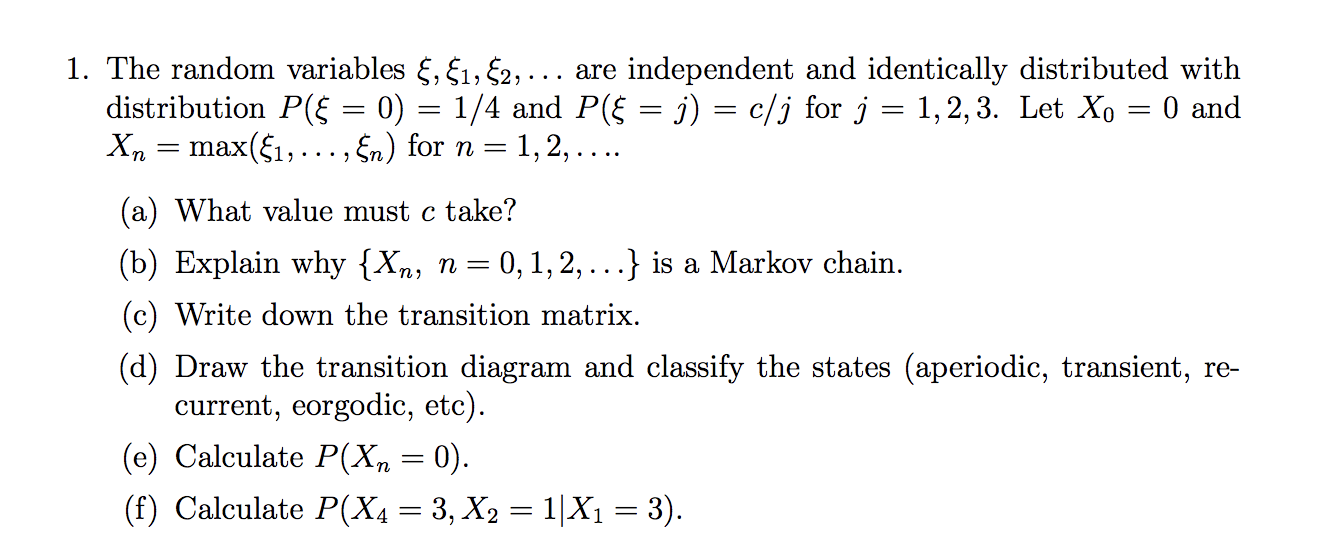
1. The random variables 8, $1, $2, ... are independent and identically distributed with distribution P($ = 0) = 1/4 and P($ = j) = c/j for j = 1, 2,3. Let Xo = 0 and Xn = max($1, . . ., En) for n = 1, 2, .... (a) What value must c take? (b) Explain why {Xn, n = 0, 1, 2, ...} is a Markov chain. (c) Write down the transition matrix. (d) Draw the transition diagram and classify the states (aperiodic, transient, re- current, eorgodic, etc). (e) Calculate P(Xn = 0). (f) Calculate P(X4 = 3, X2 = 1/X1 = 3)
Step by Step Solution
There are 3 Steps involved in it
1 Expert Approved Answer
Step: 1 Unlock

Question Has Been Solved by an Expert!
Get step-by-step solutions from verified subject matter experts
Step: 2 Unlock
Step: 3 Unlock
 Study Help