Question: Dave's Photography Store has the following inventory problem. The store stocks a particular model camera that can be ordered weekly. Let D1,D2, represent the demand
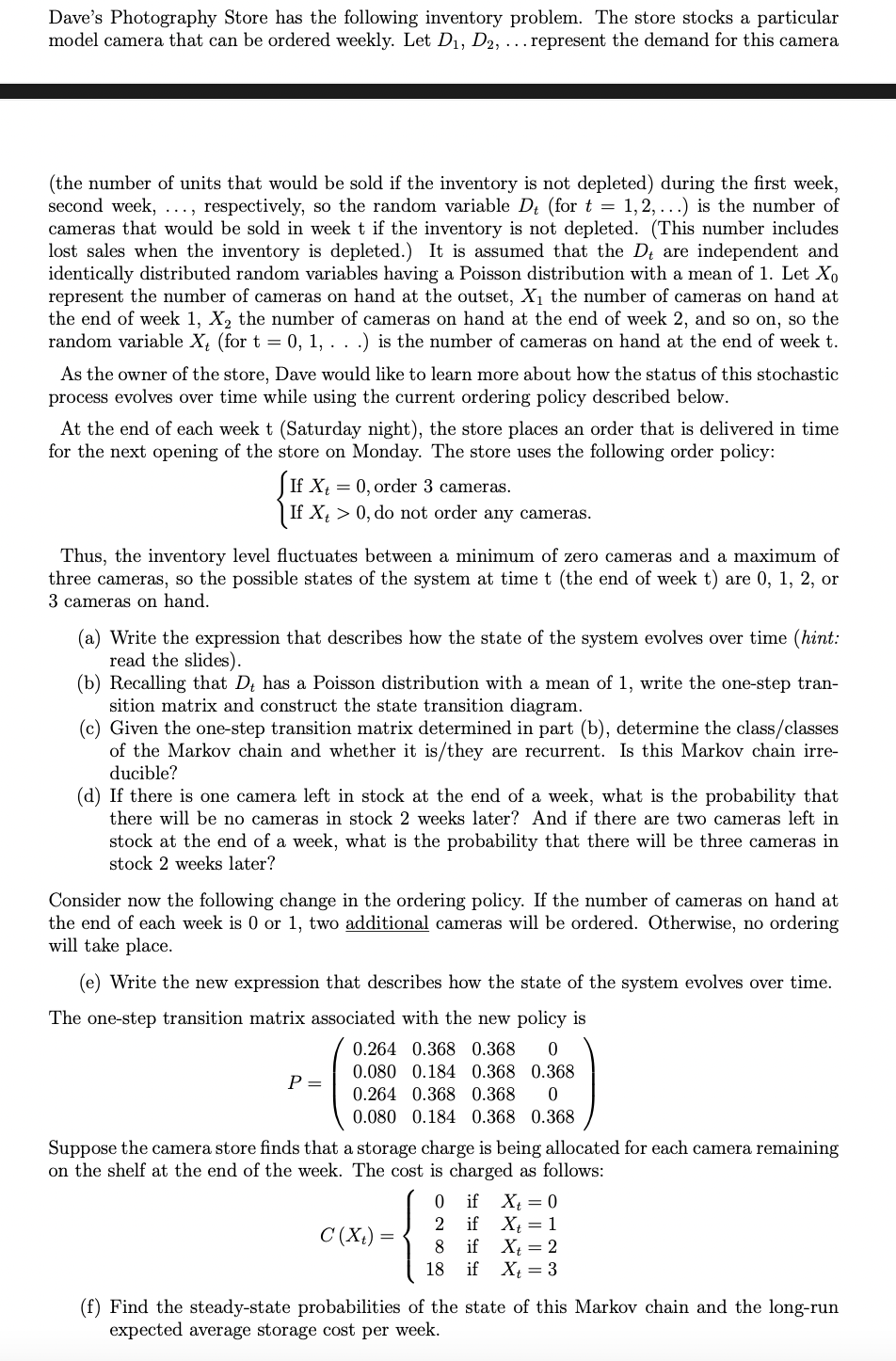
Dave's Photography Store has the following inventory problem. The store stocks a particular model camera that can be ordered weekly. Let D1,D2, represent the demand for this camera (the number of units that would be sold if the inventory is not depleted) during the first week, second week, , respectively, so the random variable Dt (for t=1,2, ) is the number of cameras that would be sold in week t if the inventory is not depleted. (This number includes lost sales when the inventory is depleted.) It is assumed that the Dt are independent and identically distributed random variables having a Poisson distribution with a mean of 1 . Let X0 represent the number of cameras on hand at the outset, X1 the number of cameras on hand at the end of week 1,X2 the number of cameras on hand at the end of week 2 , and so on, so the random variable Xt (for t=0,1, ) is the number of cameras on hand at the end of week t. As the owner of the store, Dave would like to learn more about how the status of this stochastic process evolves over time while using the current ordering policy described below. At the end of each week t (Saturday night), the store places an order that is delivered in time for the next opening of the store on Monday. The store uses the following order policy: {IfXt=0,order3cameras.IfXt>0,donotorderanycameras. Thus, the inventory level fluctuates between a minimum of zero cameras and a maximum of three cameras, so the possible states of the system at time t (the end of week t) are 0,1,2, or 3 cameras on hand. (a) Write the expression that describes how the state of the system evolves over time (hint: read the slides). (b) Recalling that Dt has a Poisson distribution with a mean of 1 , write the one-step transition matrix and construct the state transition diagram. (c) Given the one-step transition matrix determined in part (b), determine the class/classes of the Markov chain and whether it is/they are recurrent. Is this Markov chain irreducible? (d) If there is one camera left in stock at the end of a week, what is the probability that there will be no cameras in stock 2 weeks later? And if there are two cameras left in stock at the end of a week, what is the probability that there will be three cameras in stock 2 weeks later? Consider now the following change in the ordering policy. If the number of cameras on hand at the end of each week is 0 or 1 , two additional cameras will be ordered. Otherwise, no ordering will take place. (e) Write the new expression that describes how the state of the system evolves over time. The one-step transition matrix associated with the new policy is P=0.2640.0800.2640.0800.3680.1840.3680.1840.3680.3680.3680.36800.36800.368 Suppose the camera store finds that a storage charge is being allocated for each camera remaining on the shelf at the end of the week. The cost is charged as follows: C(Xt)=02818ififififXt=0Xt=1Xt=2Xt=3 (f) Find the steady-state probabilities of the state of this Markov chain and the long-run expected average storage cost per week









 Study Help