







Question: Stock Selection Case Study Markowitz won the Nobel Prize for his work in stock portfolio theory. He was the first to measure portfolio risk using
Stock Selection Case Study
Markowitz won the Nobel Prize for his work in stock portfolio theory. He was the
first to measure portfolio risk using the variance of returns. introduced stock
selection based on an "efficient frontier", namely, by picking the stocks that give
the portfolio "with minimum variance for a given return" and "maximum return for
a given variance."
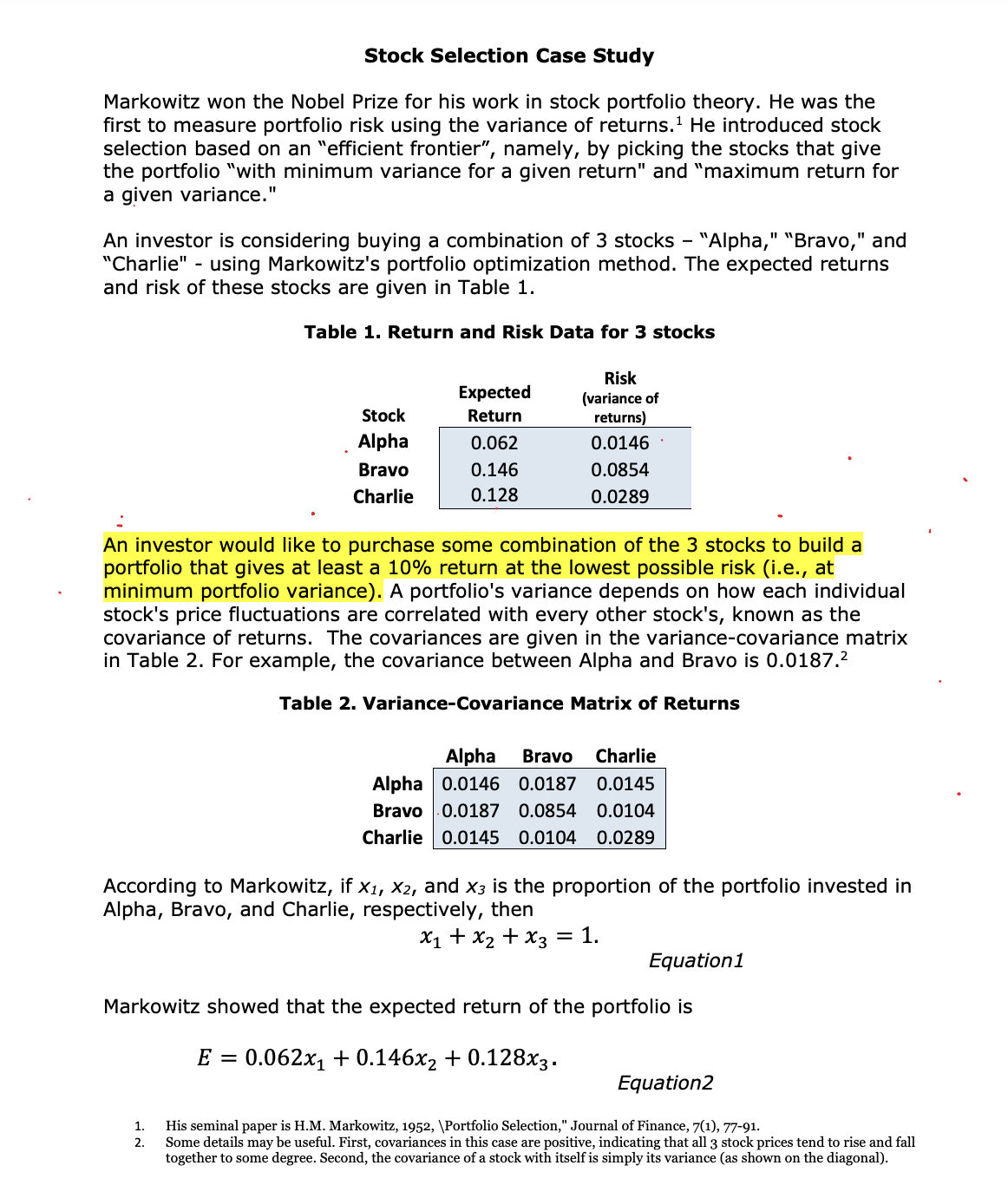
An investor is considering buying a combination of stocks "Alpha," "Bravo," and
"Charlie" using Markowitz's portfolio optimization method. The expected returns
and risk of these stocks are given in Table
Table Return and Risk Data for stocks
An investor would like to purchase some combination of the stocks to build a
portfolio that gives at least a return at the lowest possible risk ie at
minimum portfolio variance A portfolio's variance depends on how each individual
stock's price fluctuations are correlated with every other stock's, known as the
covariance of returns. The covariances are given in the variancecovariance matrix
in Table For example, the covariance between Alpha and Bravo is
Table VarianceCovariance Matrix of Returns
According to Markowitz, if and is the proportion of the portfolio invested in
Alpha, Bravo, and Charlie, respectively, then
Equation
Markowitz showed that the expected return of the portfolio is
Equation
His seminal paper is HM Markowitz, Portfolio Selection," Journal of Finance,
Some details may be useful. First, covariances in this case are positive, indicating that all stock prices tend to rise and fall
together to some degree. Second, the covariance of a stock with itself is simply its variance as shown on the diagonal Similarly, Markowitz showed that the portfolio's variance is the following function of
covariances:
Equation
You are asked to create a spreadsheet model to develop an optimal feasible
solution of the investment portfolio to present to the investor. Your solution should
inform the investor how she should proportion her investments across the three
stocks in her portfolio.
In your final writeup, please make sure to identify the decision variables, the
objective function, and the constraints. Describe whether any of the constraints are
integer and binary?
Describe the methodology used to develop the solution and identify whether your
solution is an optimal feasible solution or a feasible solution? How did you know
your solution was optimal or not? Did you have to make a Solver selection to
ensure you solution was optimal?
Finally, explain the investment solution you have developed for the investor and
whether your solution meets her portfolio criteria of risk and return.
Step by Step Solution
There are 3 Steps involved in it
1 Expert Approved Answer
Step: 1 Unlock

Question Has Been Solved by an Expert!
Get step-by-step solutions from verified subject matter experts
Step: 2 Unlock
Step: 3 Unlock
 Study Help