







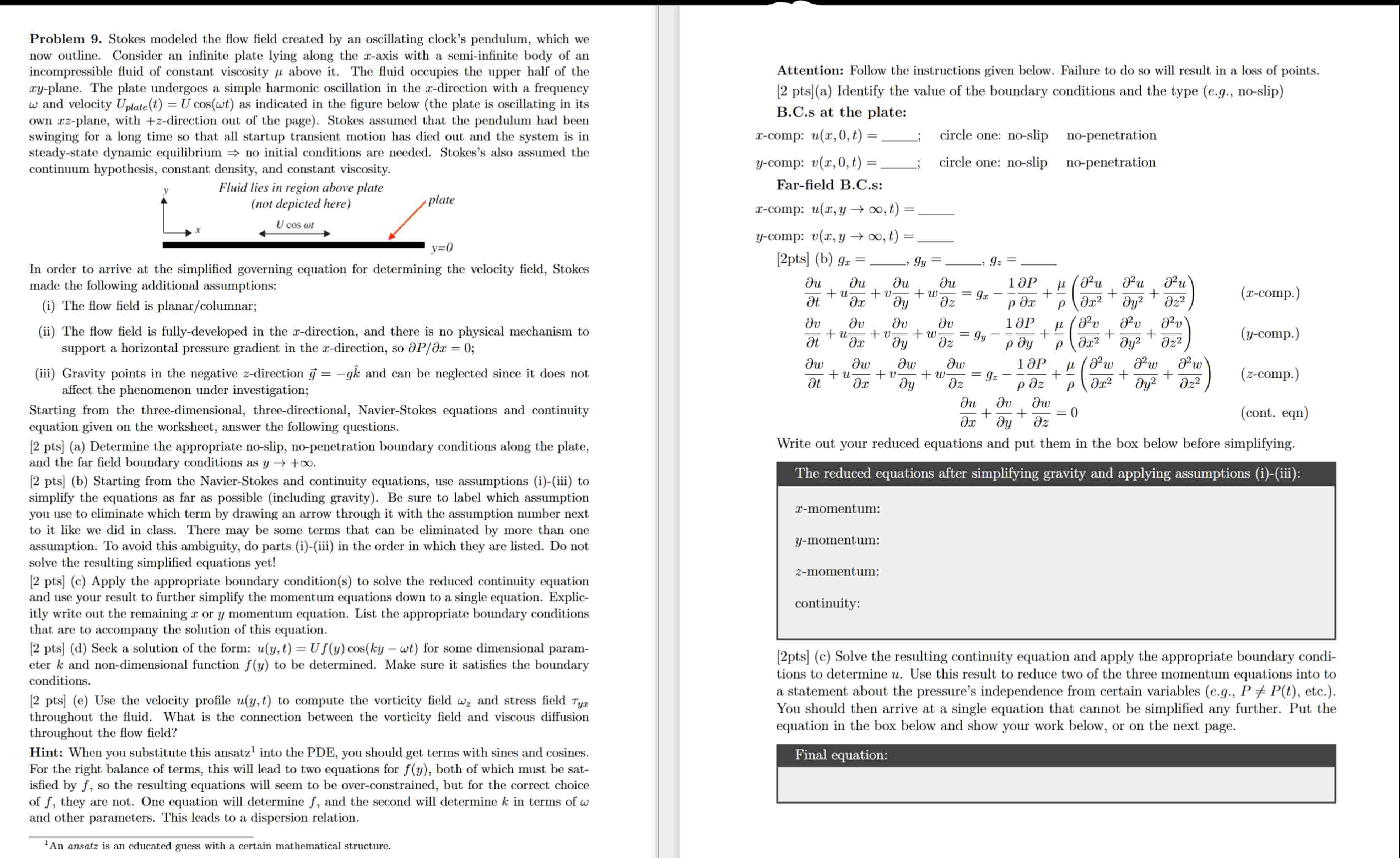
Question: Stokes modeled the flow field created by an oscillating clock s pendulum, which we now outline. Consider an infinite plate lying along the x -
Stokes modeled the flow field created by an oscillating clocks pendulum, which we
now outline. Consider an infinite plate lying along the xaxis with a semiinfinite body of an
incompressible fluid of constant viscosity above it The fluid occupies the upper half of the
xyplane. The plate undergoes a simple harmonic oscillation in the xdirection with a frequency
and velocity Uplatet U cost as indicated in the figure below the plate is oscillating in its
own xzplane, with zdirection out of the page Stokes assumed that the pendulum had been
swinging for a long time so that all startup transient motion has died out and the system is in
steadystate dynamic equilibrium no initial conditions are needed. Stokess also assumed the
continuum hypothesis, constant density, and constant viscosity.
In order to arrive at the simplified governing equation for determining the velocity field, Stokes
made the following additional assumptions:
i The flow field is planarcolumnar;
ii The flow field is fullydeveloped in the xdirection, and there is no physical mechanism to
support a horizontal pressure gradient in the xdirection, so Px ;
iii Gravity points in the negative zdirection g gk and can be neglected since it does not
affect the phenomenon under investigation;
Starting from the threedimensional, threedirectional, NavierStokes equations and continuity
equation given on the worksheet, answer the following questions.
ptsa Determine the appropriate noslip, nopenetration boundary conditions along the plate,
and the far field boundary conditions as y
ptsb Starting from the NavierStokes and continuity equations, use assumptions iiii to
simplify the equations as far as possible including gravity Be sure to label which assumption
you use to eliminate which term by drawing an arrow through it with the assumption number next
to it like we did in class. There may be some terms that can be eliminated by more than one
assumption. To avoid this ambiguity, do parts iiii in the order in which they are listed. Do not
solve the resulting simplified equations yet!
ptsc Apply the appropriate boundary conditions to solve the reduced continuity equation
and use your result to further simplify the momentum equations down to a single equation. Explic
itly write out the remaining x or y momentum equation. List the appropriate boundary conditions
that are to accompany the solution of this equation.
ptsd Seek a solution of the form: uy t U f y cosky t for some dimensional param
eter k and nondimensional function f y to be determined. Make sure it satisfies the boundary
conditions.
ptse Use the velocity profile uy t to compute the vorticity field z and stress field yx
throughout the fluid. What is the connection between the vorticity field and viscous diffusion
throughout the flow field?
Hint: When you substitute this ansatz into the PDE, you should get terms with sines and cosines.
For the right balance of terms, this will lead to two equations for f y both of which must be sat
isfied by f so the resulting equations will seem to be overconstrained, but for the correct choice
of f they are not. One equation will determine f and the second will determine k in terms of
and other parameters. This leads to a dispersion relation.
Step by Step Solution
There are 3 Steps involved in it
1 Expert Approved Answer
Step: 1 Unlock

Question Has Been Solved by an Expert!
Get step-by-step solutions from verified subject matter experts
Step: 2 Unlock
Step: 3 Unlock
 Study Help