







Question: Storm Tracker Portfolio Worksheet PRECALCULUS: PARAMETRIC FUNCTIONS Directions: Meteorologists use sophisticated models to predict the occurrence, duration, and trajectory of weather events. They build their
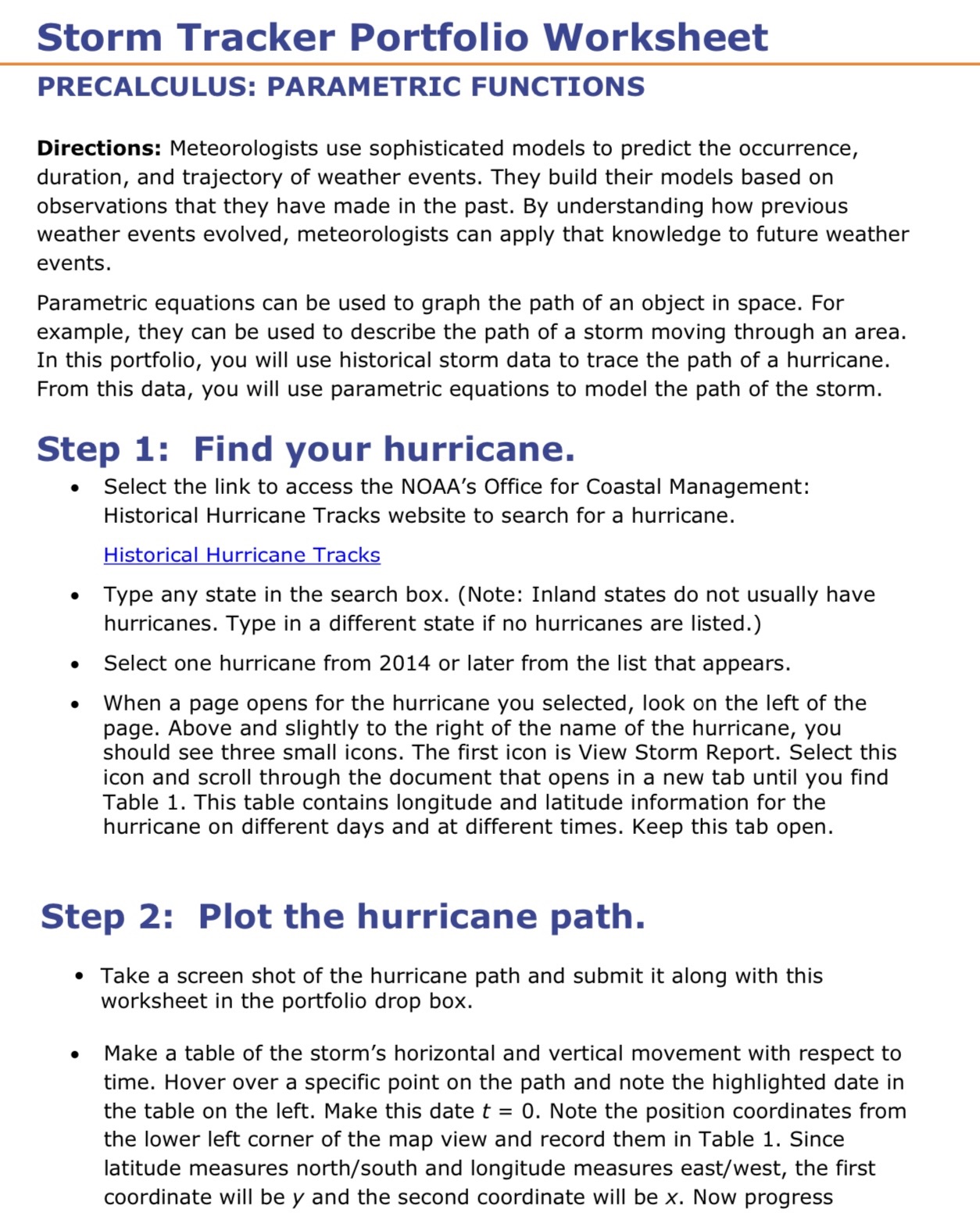
Storm Tracker Portfolio Worksheet PRECALCULUS: PARAMETRIC FUNCTIONS Directions: Meteorologists use sophisticated models to predict the occurrence, duration, and trajectory of weather events. They build their models based on observations that they have made in the past. By understanding how previous weather events evolved, meteorologists can apply that knowledge to future weather events. Parametric equations can be used to graph the path of an object in space. For example, they can be used to describe the path of a storm moving through an area. In this portfolio, you will use historical storm data to trace the path of a hurricane. From this data, you will use parametric equations to model the path of the storm. Step 1: Find your hurricane. . Select the link to access the NOAA's Ofce for Coastal Management: Historical Hurricane Tracks website to search for a hurricane. Historical Hurricane Tracks - Type any state in the search box. (Note: Inland states do not usually have hurricanes. Type in a different state if no hurricanes are listed.) . Select one hurricane from 2014 or later from the list that appears. . When a page opens for the hurricane you selected, look on the left of the page. Above and slightly to the right of the name of the hurricane, you should see three small icons. The first icon is View Storm Report. Select this icon and scroll through the document that opens in a new tab until you nd Table 1. This table contains longitude and latitude information for the hurricane on different days and at different times. Keep this tab open. Step 2: Plot the hurricane path. - Take a screen shot of the hurricane path and submit it along with this worksheet in the portfolio drop box. . Make a table of the storm's horizontal and vertical movement with respect to time. Hover over a specific point on the path and note the highlighted date in the table on the left. Make this date t = 0. Note the position coordinates from the lower left corner of the map view and record them in Table 1. Since latitude measures north/south and longitude measures east/west, the first coordinate will be y and the second coordinate will be x. Now progress
Step by Step Solution
There are 3 Steps involved in it

Get step-by-step solutions from verified subject matter experts
 Study Help