Question: Strategy case study 1- Identify where in their value system) and how IKIA have achieved cost leadership. 2- Identify how IKIA have achieved differentiation from
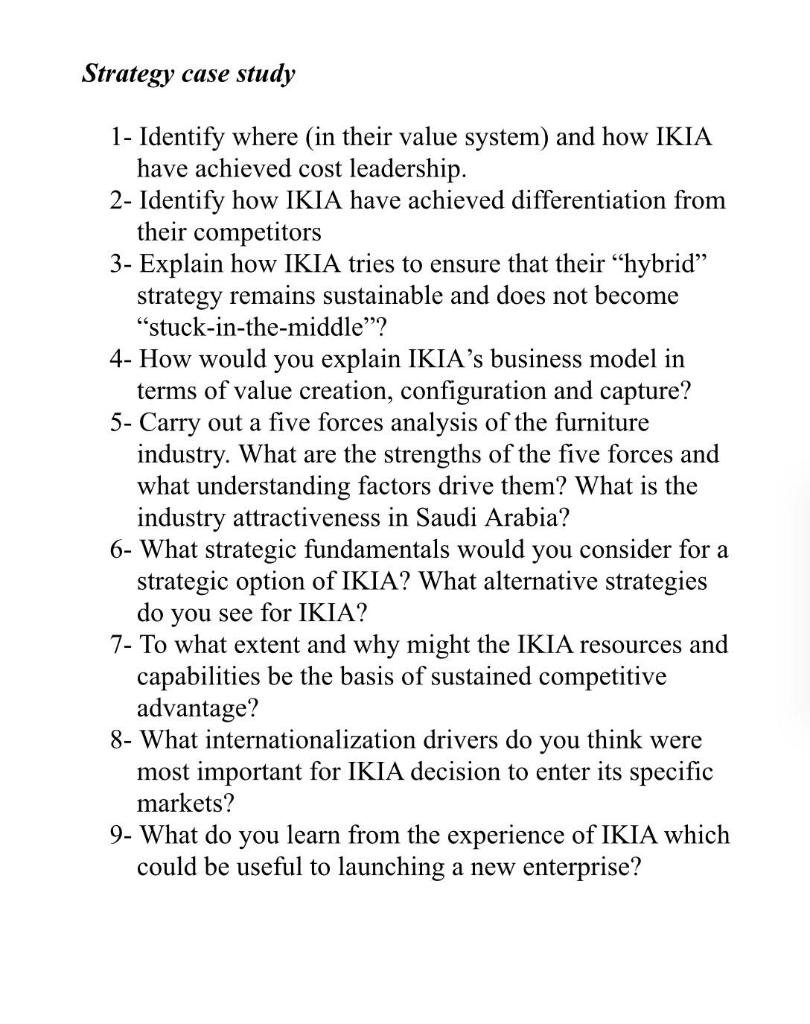
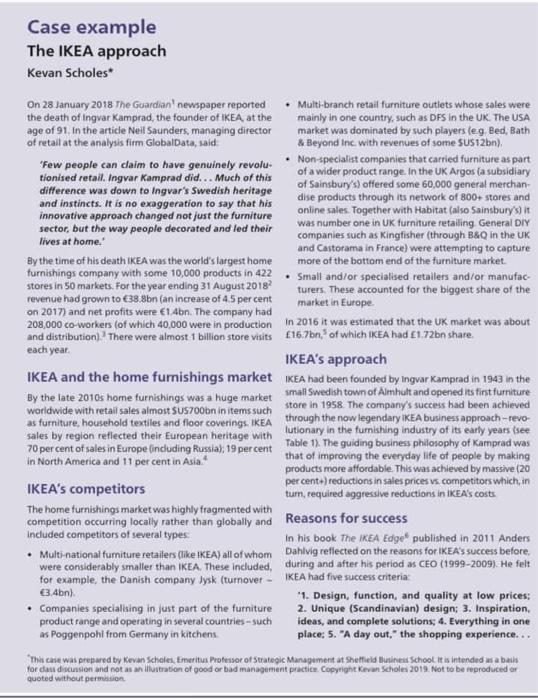
Strategy case study 1- Identify where in their value system) and how IKIA have achieved cost leadership. 2- Identify how IKIA have achieved differentiation from their competitors 3- Explain how IKIA tries to ensure that their "hybrid strategy remains sustainable and does not become "stuck-in-the-middle? 4- How would you explain IKIAs business model in terms of value creation, configuration and capture? 5- Carry out a five forces analysis of the furniture industry. What are the strengths of the five forces and what understanding factors drive them? What is the industry attractiveness in Saudi Arabia? 6- What strategic fundamentals would you consider for a strategic option of IKIA? What alternative strategies do you see for IKIA? 7- To what extent and why might the IKIA resources and capabilities be the basis of sustained competitive advantage? 8- What internationalization drivers do you think were most important for IKIA decision to enter its specific markets? 9- What do you learn from the experience of IKIA which could be useful to launching a new enterprise? Case example The IKEA approach Kevan Scholes On 28 January 2018 The Guardian newspaper reported Multi-branch retail furniture Outlets whose sales were the death of Ingvar Kamprad, the founder of IKEA at the mainly in one country, such as DFS in the UK. The USA age of 91. In the article Nell Saunders, managing director market was dominated by such players leg Bed Bath of retail at the analysis firm GlobalData, said & Beyond Inc. with revenues of some SUS12bn) "Few people can claim to have genuinely revolu Non-specialist companies that carried furniture as part tionised retail. Ingvar Kamprad did... Much of this of a wider product range. In the UK Argos (a subsidiary difference was down to Ingvar's Swedish heritage of Sainsbury's) offered some 60,000 general merchan and instincts. It is no exaggeration to say that his dise products through its network of B00+ stores and innovative approach changed not just the furniture online sales. Together with Habitat (also Sainsbury's) it sector, but the way people decorated and led their was number one in UK furniture retailing General DIY lives at home. companies such as Kingfisher (through B&Q in the UK and Castorama in France) were attempting to capture By the time of his death IKEA was the world's largest home more of the bottom end of the furniture market furnishings company with some 10,000 products in 422 . Small and/or specialised retailers and/or manufac stores in 50 markets. For the year ending 31 August 2018? turers. These accounted for the biggest share of the revenue had grown to 38.8bn (an increase of 4 5 percent market in Europe on 2017) and net profits were 14bn. The company had 208,000 co-workers (of which 40,000 were in production in 2016 it was estimated that the UK market was about and distribution). There were almost 1 billion store visits 16.7bn of which IKEA had 1.72bn share. each year IKEA's approach IKEA and the home furnishings market IKEA had been founded by Ingvar Kamprad in 1943 in the By the late 2010s home furnishings was a huge market smalt Swedish town of Almhult and opened its first furniture worldwide with retail sales almost suS700bn in items such store in 1958. The company's success had been achieved as furniture, household textiles and floor coverings, IKEA through the now legendary IKEA business approach - revo sales by region reflected their European heritage with lutionary in the furnishing industry of its early years (see 70 per cent of sales in Europe (including Russia), 19 percent Table 1). The guiding business philosophy of Kamprad was in North America and 11 per cent in Asia. that of improving the everyday life of people by making products more affordable. This was achieved by massive (20 per cent+) reductions in sales prices vs. competitors which, in IKEA's competitors turn, required aggressive reductions in IKEA's costs The home furnishings market was highly fragmented with competition occurring locally rather than globally and Reasons for success Included competitors of several types. In his book The IKEA Edge published in 2011 Anders Multi-national furniture retailers (like IKEA) all of whom Dahlvig reflected on the reasons for IKEA's success before, were considerably smaller than IKEA. These included, during and after his period as CEO (1999-2009). He felt for example, the Danish company dysk (turnover - IKEA had five success criteria: 63.4bn) *1. Design, function, and quality at low prices: Companies specialising in just part of the furniture 2. Unique (Scandinavian) design; 3. Inspiration, product range and operating in several countries such ideas, and complete solutions; 4. Everything in one as Poggenpohl from Germany in kitchens place; 5. "A day out the shopping experience... This case was prepared by Kevan Scholes Emeritus Professor of Strategic Management at Sheffield Business School is intended as a basis for class discussion and not as an illustration of good or bad management practice. Copyright Kevan Scholes 2019. Not to be reproduced or quoted without permission









 Study Help