


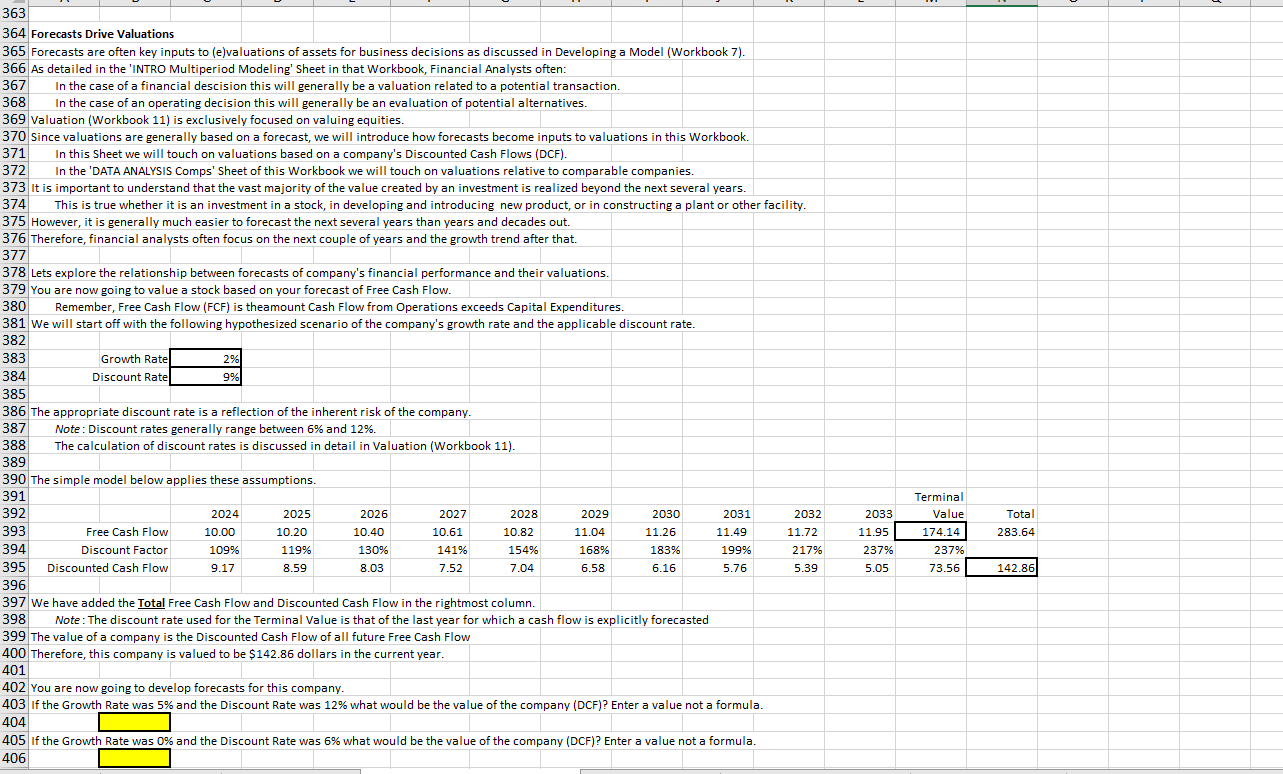
Question: strictly dont use CHATGPT.Please type the answer with good explanation.Thank You PLEASE ANSWER THE TWO BLANK CELLS. THANK YOU 363 364 365 366 367 368
strictly dont use CHATGPT.Please type the answer with good explanation.Thank You

PLEASE ANSWER THE TWO BLANK CELLS. THANK YOU

strictly dont use CHATGPT.Please type the answer
363 364 365 366 367 368 369 370 371 372 373 374 375 376 377 378 379 380 381 382 383 384 385 386 387 388 389 390 391 392 393 394 395 396 397 398 399 400 401 402 403 404 405 406 Forecasts Drive Valuations Forecasts are often key inputs to [e]va|uations of assets for business decisions as discussed in Developing a Model [Workbook 7]. As detailed in the 'INTRD Multiperiod Modeling' Sheet in that Workbook, Financial Analysts often' In the case of a financial descision this will generally be a valuation related to a potential transaction. In the case of an operating decision this will generally be an evaluation of potential alternatives. Valuation [Workbook 11] is exclusively focused on valuing equities. Since valuations are generally based on a forecast, we will introduce how forec asE become inputs to valuations in this Workbook. In this Sheetwe will touch on valuations based on a company's Discounted Cash Flows [DCF]. In the 'DATA ANALYSIS Com ps' Sheet of this Workbook we will touch on valuations relative to comparable companies. It is important to understand that the vast majority of the value created by an investment is realized beyond the next several yea rs This is true whether it is an investment in a stock, in developing and introducing new product, or in constructing a plant or other facility. However, it is generally much easier to forecast the next several yea rs than yea rs and decades out. Therefore, financial analysts often focus on the next couple of yea rs and the growth trend after that. Lets explore the relationship between forecasts of company's financial performance and their valuations You are now going to value a stock based on yourforecast of Free Cash Flow Remember, Free Cash Flow [FCF] is theamount Cash Flow from Operations exceeds Capital Expenditures We will start off with the following hypothesized scenario of the company's growth rate and the applicable discount rate Growth Rate 1 Dis c ount Rate The appropriate discount rate is a reflection of the inherent risk of the company. Note Discount rates generally range between 6% and 12%. The calculation of discount rates is discussed in detail in Valuation [Workbook 11]. Thesimple model below applies these assumptions. 2024- 2025 2026 2027 2028 2029 2030 2031 2032 Free Cash Flow 10.00 10.20 10 4-0 10.61 10.82 11.04 11.26 11.49 11.72 Discount Factor 109% 11996 130% 141% 154% 168% 183% 199% 217% Discounted Cash Flow 9.17 8.59 8 03 7.52 7.04 6.58 6.16 5.76 5.39 We have added the To_lal Free Cash Flow and Discounted Cash Flow in the rightmost column Note The discount rate used for the Terminal Value is that of the last year for which a cash flow is explicitly forecasted The value of a company is the Discounted Cash Flow of all future Free Cash Flow Therefore, this company is valued to be $142.86 dollars in the current year. You are now going to develop forecasts for this company If the Growth Rate was 596 and the Discount Rate was 12% what would be the value of the company [DCF]? Enter a value not a formula. l:l If the Growth Rate was 096 and the Discount Rate was 5% what would be the value of the company [DCFF Enter a value not a formula l:l 2033 Terminal Value Total 11.95 174.14 283 64 23796 5.05 23796 73.56 142 86

Step by Step Solution

There are 3 Steps involved in it

1 Expert Approved Answer
Step: 1 Unlock blur-text-image

Question Has Been Solved by an Expert!

Get step-by-step solutions from verified subject matter experts

Step: 2 Unlock
Step: 3 Unlock

Students Have Also Explored These Related Finance Questions!