







Question: STRONGLY CONNECTED COMPONENT(SSC) Given a directed graph, a strongly connected component (SSC) is any subgraph where there exists a path connected any vertex in that
STRONGLY CONNECTED COMPONENT(SSC)
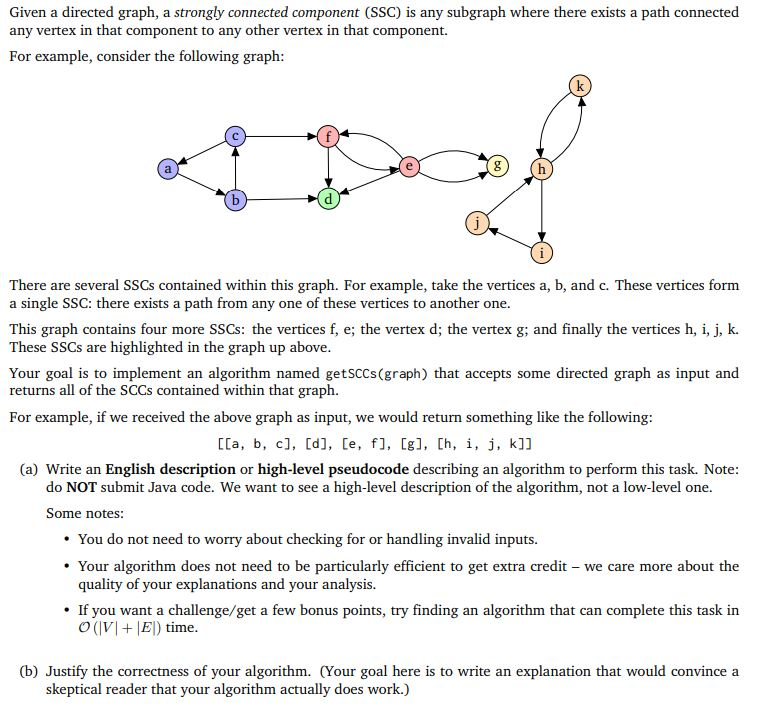
Given a directed graph, a strongly connected component (SSC) is any subgraph where there exists a path connected any vertex in that component to any other vertex in that component. For example, consider the following graph There are several SSCs contained within this graph. For example, take the vertices a, b, and c. These vertices form a single SSC: there exists a path from any one of these vertices to another one. This graph contains four more SSCs: the vertices f, e; the vertex d; the vertex g; and finally the vertices h, i, j, k. These SSCs are highlighted in the graph up above Your goal is to implement an algorithm named getSCCs(graph) that accepts some directed graph as input and returns all of the SCCs contained within that graph. For example, if we received the above graph as input, we would return something like the following (a) Write an English description or high-level pseudocode describing an algorithm to perform this task. Note do NOT submit Java code. We want to see a high-level description of the algorithm, not a low-level one. Some notes: You do not need to worry about checking for or handling invalid inputs. Your algorithm does not need to be particularly efficient to get extra credit - we care more about the quality of your explanations and your analysis. . If you want a challenge/get a few bonus points, try finding an algorithm that can complete this task in o (VI+E|) time (b) Justify the correctness of your algorithm. (Your goal here is to write an explanation that would convince a skeptical reader that your algorithm actually does work.) Given a directed graph, a strongly connected component (SSC) is any subgraph where there exists a path connected any vertex in that component to any other vertex in that component. For example, consider the following graph There are several SSCs contained within this graph. For example, take the vertices a, b, and c. These vertices form a single SSC: there exists a path from any one of these vertices to another one. This graph contains four more SSCs: the vertices f, e; the vertex d; the vertex g; and finally the vertices h, i, j, k. These SSCs are highlighted in the graph up above Your goal is to implement an algorithm named getSCCs(graph) that accepts some directed graph as input and returns all of the SCCs contained within that graph. For example, if we received the above graph as input, we would return something like the following (a) Write an English description or high-level pseudocode describing an algorithm to perform this task. Note do NOT submit Java code. We want to see a high-level description of the algorithm, not a low-level one. Some notes: You do not need to worry about checking for or handling invalid inputs. Your algorithm does not need to be particularly efficient to get extra credit - we care more about the quality of your explanations and your analysis. . If you want a challenge/get a few bonus points, try finding an algorithm that can complete this task in o (VI+E|) time (b) Justify the correctness of your algorithm. (Your goal here is to write an explanation that would convince a skeptical reader that your algorithm actually does work.)
Step by Step Solution
There are 3 Steps involved in it

Get step-by-step solutions from verified subject matter experts
 Study Help