







Question: Student Support Contact US 21 Case Studies, MKT1540-Case Study 1-Kickstart - D2L - Winter 2021-Case Template Case Study 1-Kickstart - D2L - Winter e Template
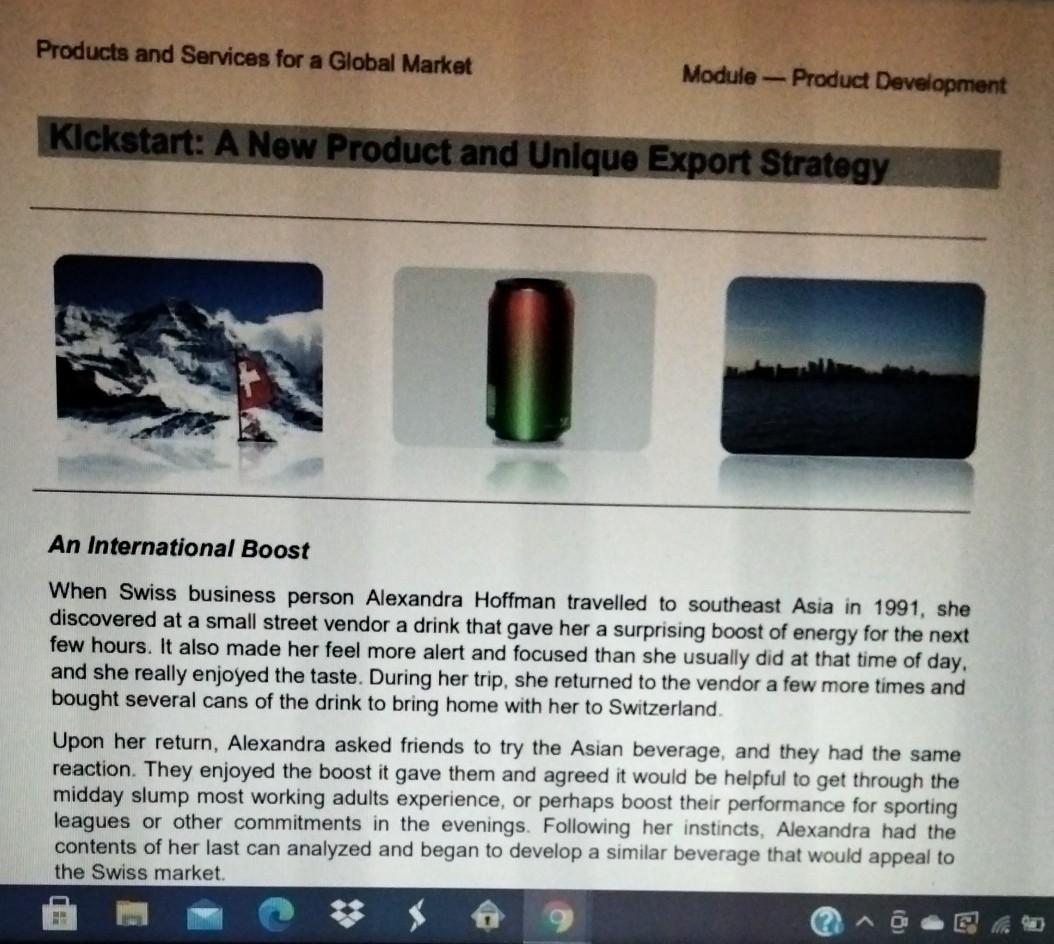
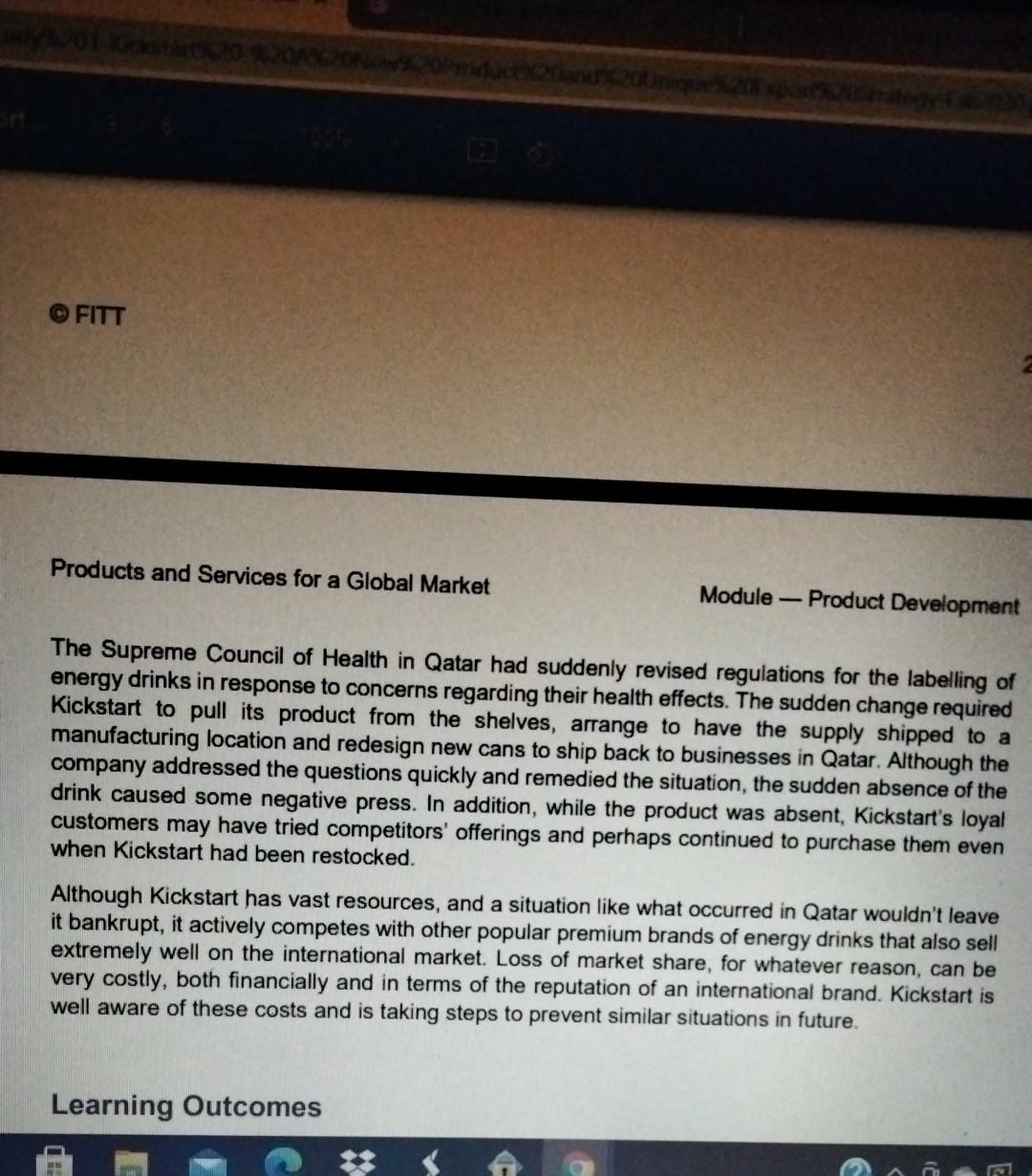
Student Support Contact US 21 Case Studies, MKT1540-Case Study 1-Kickstart - D2L - Winter 2021-Case Template Case Study 1-Kickstart - D2L - Winter e Template Products and Services for a Global Market Module - Product Developmer Case Study Questions 1. As described in the case study, a sudden change in regulations can have costly effects on an exporter. What steps could Kickstart have taken before and after its products were removed from shelves to decrease its risk or avoid it altogether? 2. Kickstart doesn't follow a traditional sales and marketing model. It brings the consumer to the product through "buzz marketing" achieved by hosting extreme sporting events and sponsoring athletes. Why does this strategy work so well for the company? 3. What are some of the advantages Kickstart reaps from marketing and exporting a standard domestic version of its product to all markets internationally, customizing only the outer package? Products and Services for a Global Market Module - Product Development Kickstart: A New Product and Unique Export Strategy An International Boost When Swiss business person Alexandra Hoffman travelled to southeast Asia in 1991, she discovered at a small street vendor a drink that gave her a surprising boost of energy for the next few hours. It also made her feel more alert and focused than she usually did at that time of day. and she really enjoyed the taste. During her trip, she returned to the vendor a few more times and bought several cans of the drink to bring home with her to Switzerland. Upon her return, Alexandra asked friends to try the Asian beverage, and they had the same reaction. They enjoyed the boost it gave them and agreed it would be helpful to get through the midday slump most working adults experience, or perhaps boost their performance for sporting leagues or other commitments in the evenings. Following her instincts, Alexandra had the contents of her last can analyzed and began to develop a similar beverage that would appeal to the Swiss market. FE and she really enjoyed the taste. During her trip, she returned to the vendor a few more times and bought several cans of the drink to bring home with her to Switzerland. Upon her return, Alexandra asked friends to try the Asian beverage, and they had the same reaction. They enjoyed the boost it gave them and agreed it would be helpful to get through the midday slump most working adults experience, or perhaps boost their performance for sporting leagues or other commitments in the evenings. Following her instincts, Alexandra had the contents of her last can analyzed and began to develop a similar beverage that would appeal to the Swiss market. Since the launch of Kickstart in 1993, the company has gone on to sell over ten billion cans worldwide. After a successful launch in Switzerland, Kickstart entered other European markets, and the drink become wildly popular. The key to the company's success was smart marketing and a unique market entry strategy. To increase the drink's profile in Europe and to emphasize Kickstart's benefits to athletes, each country's launch was tied to a sporting event, hosted by the energy drink company. The events always involved extreme sports such as car-racing, motocross games and air races. As these events grew in popularity, the Kickstart marketing team began to create sponsorships for amateur athletes, through these sponsorships, the momentum for both the energy drink and the events increased until sales across Europe had skyrocketed. Following the European rollout, Alexandra and her business development team decided it was time to expand to North America, using the same model of hosting and sponsoring extreme sporting events and athletes. The energy drink had even greater success in the United States. What started as a curious experiment following a short business trip turned into a thriving international business. In the years since its inception, the company has expanded into 87 countries, and now employs 4,300 people and has estimated revenues in the billions. O FITT 1 Vitally Important Marketing and sales are critical facets of an international expansion, but products won't reach the shelves without accurate labelling and packaging that abide by the regulations of the destination country. Many international companies approach this issue in one of two ways: they either take their standardized domestic product and create customized packaging as needed for each market or they completely customize the product for the target market, including design, labelling and packaging. Kickstart followed a unique path by doing both. In many target markets, it first launched a locally customized version of the drink, which followed the country's import regulations with regard to labelling and packaging, as well as the cultural preferences of its people with regard to design. As the international branding of the energy drink became more widely known, Kickstart also began selling its standardized version of the drink in international markets, with the original branding that was so familiar in Europe. The company was doing extremely well with this strategy and, therefore, in every target market it had the option to either fully customize a product, offer its standard international product, or both, depending on the specific regulations and cultural preferences. This strategy was of benefit to the company for other reasons, most notably because a number of countries were hesitant to allow energy drinks to be sold within their borders. Countries around the world have differing regulations on food and beverage products, and Kickstart includes a few naturally sourced ingredients that are either restricted or under review in some regions. This affects the labelling and packaging requirements for export to individual markets. In Canada, for example, the ingredients must be listed on the outside of the can and the can must be labelled in both English and French. In other countries, the content of specific additives or chemicals must be explicitly written on the outside of the individual packaging Kickstart employs an entire division dedicated to researching and visiting different target markets in order to remain abreast of regulations and ensure the product is designed, labelled, packaged and shipped accurately to avoid unnecessary costs. Negative Consequences One of the more strictly regulated countries where Kickstart is sold is Qatar. Its import regulations on energy drinks require a warning be printed in red font on each can, stating the beverage is not nermitted to be consumedbvchildren andreanant women among others. Kickstadt entered ning
Step by Step Solution
There are 3 Steps involved in it
1 Expert Approved Answer
Step: 1 Unlock

Question Has Been Solved by an Expert!
Get step-by-step solutions from verified subject matter experts
Step: 2 Unlock
Step: 3 Unlock
 Study Help