







Question: Study Design: Identify the statistical test you conducted to analyze your data. Was it left-tailed, right-tailed, or two-tailed? State the null and alternative hypotheses, both
Study Design: Identify the statistical test you conducted to analyze your data. Was it left-tailed, right-tailed, or two-tailed? State the null and alternative hypotheses, both in words and in appropriate symbols.
Results: Statistical Analysis: Report the results of your test. Include the test statistic, degrees of freedom, and the p-value of the significance test.
Findings: Interpret the results in the context of your original research question. Do your analyses support your expected findings? Explain. Interpret the p-value and compare it to an alpha level of .05 (draw a conclusion on the test).
Discussion: What conclusions, if any, do you believe you can draw as a result of your study? If the results were not what you expected, what factors might explain your results? What did you learn from the project about the populations you studied? What did you learn about the research variable? What did you learn about the specific statistical test you conducted?
Use the table below:
Hypothesis: The number of women getting hip replacements will increase much faster than men.
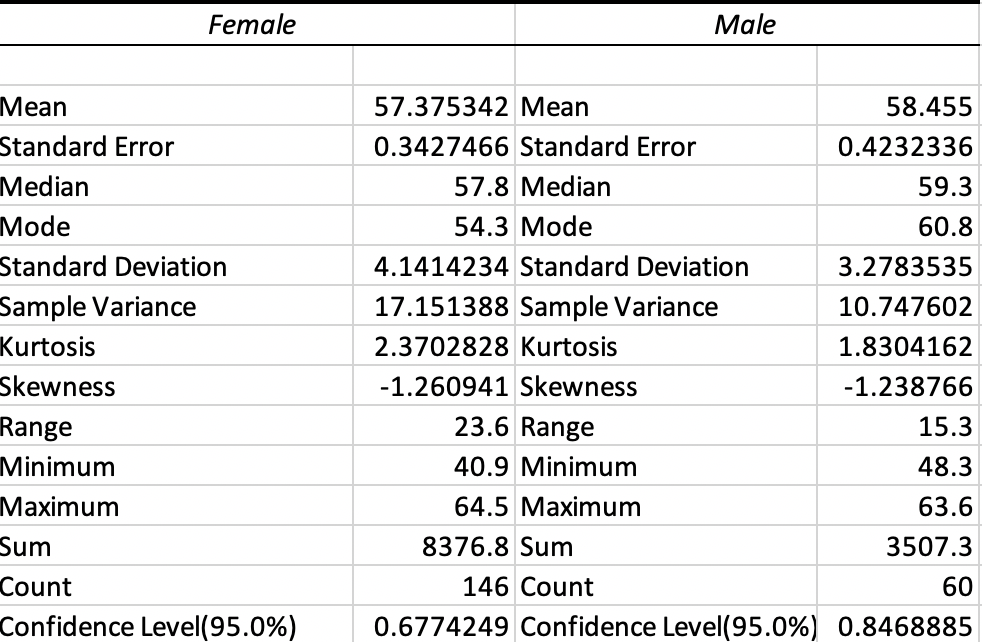
Female Mean Standard Error Median Mode Standard Deviation Sample Variance Kurtosis Skewness Range Minimum Maximum Sum Count Confidence Level(95.0%) Male 57.375342 Mean 58.455 0.3427466 Standard Error 0.4232336 57.8 Median 59.3 54.3 Mode 60.8 4.1414234 Standard Deviation 3.2783535 17.151388 Sample Variance 10.747602 2.3702828 Kurtosis 1.8304162 -1.260941 Skewness -1.238766 23.6 Range 15.3 40.9 Minimum 48.3 64.5 Maximum 63.6 8376.8 Sum 3507.3 146 Count 60 0.6774249 Confidence Level(95.0%] 0.8468885
Step by Step Solution
There are 3 Steps involved in it

Get step-by-step solutions from verified subject matter experts
 Study Help