







Question: Study the Case Study How Walmart managed its value chain to achieve a low-cost advantage over rival supermarket chains Comment on the current competitive strategy
Study the Case Study How Walmart managed its value chain to achieve a low-cost advantage over rival supermarket chains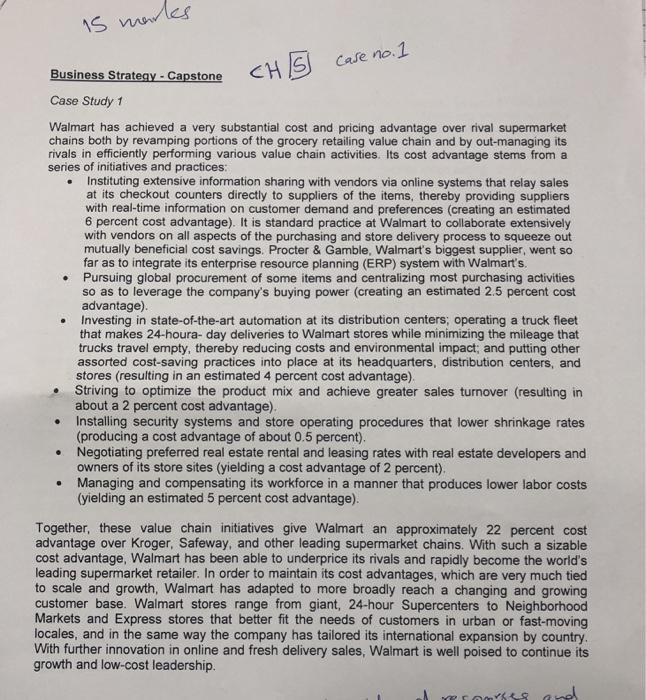
Comment on the current competitive strategy of Albert Heijn Netherlands.
15 marles Case no. 1 CH5 Business Strategy - Capstone Case Study 1 Walmart has achieved a very substantial cost and pricing advantage over rival supermarket chains both by revamping portions of the grocery retailing value chain and by out-managing its rivals in efficiently performing various value chain activities. Its cost advantage stems from a series of initiatives and practices: Instituting extensive information sharing with vendors via online systems that relay sales at its checkout counters directly to suppliers of the items, thereby providing suppliers with real-time information on customer demand and preferences (creating an estimated 6 percent cost advantage). It is standard practice at Walmart to collaborate extensively with vendors on all aspects of the purchasing and store delivery process to squeeze out mutually beneficial cost savings. Procter & Gamble, Walmart's biggest supplier, went so far as to integrate its enterprise resource planning (ERP) system with Walmart's. Pursuing global procurement of some items and centralizing most purchasing activities so as to leverage the company's buying power (creating an estimated 2.5 percent cost advantage) Investing in state-of-the-art automation at its distribution centers, operating a truck fleet that makes 24-houra- day deliveries to Walmart stores while minimizing the mileage that trucks travel empty, thereby reducing costs and environmental impact; and putting other assorted cost-saving practices into place at its headquarters, distribution centers, and stores (resulting in an estimated 4 percent cost advantage) Striving to optimize the product mix and achieve greater sales turnover (resulting in about a 2 percent cost advantage). Installing security systems and store operating procedures that lower shrinkage rates (producing a cost advantage of about 0.5 percent), Negotiating preferred real estate rental and leasing rates with real estate developers and owners of its store sites (yielding a cost advantage of 2 percent). Managing and compensating its workforce in a manner that produces lower labor costs (yielding an estimated 5 percent cost advantage). Together, these value chain initiatives give Walmart an approximately 22 percent cost advantage over Kroger, Safeway, and other leading supermarket chains. With such a sizable cost advantage, Walmart has been able to underprice its rivals and rapidly become the world's leading supermarket retailer. In order to maintain its cost advantages, which are very much tied to scale and growth, Walmart has adapted to more broadly reach a changing and growing customer base. Walmart stores range from giant, 24-hour Supercenters to Neighborhood Markets and Express stores that better fit the needs of customers in urban or fast-moving locales, and in the same way the company has tailored its international expansion by country, With further innovation in online and fresh delivery sales, Walmart is well poised to continue its growth and low-cost leadership. . Yes andStep by Step Solution
There are 3 Steps involved in it
1 Expert Approved Answer
Step: 1 Unlock

Question Has Been Solved by an Expert!
Get step-by-step solutions from verified subject matter experts
Step: 2 Unlock
Step: 3 Unlock
 Study Help