



Question: Sub Tasks 1 . Design of Dam Shape For this preliminary design the weight of the dam needs to be sufficient to counter all of
Sub Tasks
Design of Dam Shape
For this preliminary design the weight of the dam needs to be sufficient to counter all of the hydrostatic force of the water. You may assume that it will not slide under any conditions. You do not need to worry about how the dam will be anchored into the banks. You also may assume the cross section is uniform across the entire span. However, when designing the dam it must be a minimum of mathrmtmin mathrmHdmathrm~m thick at all vertical locations for structural reasons.
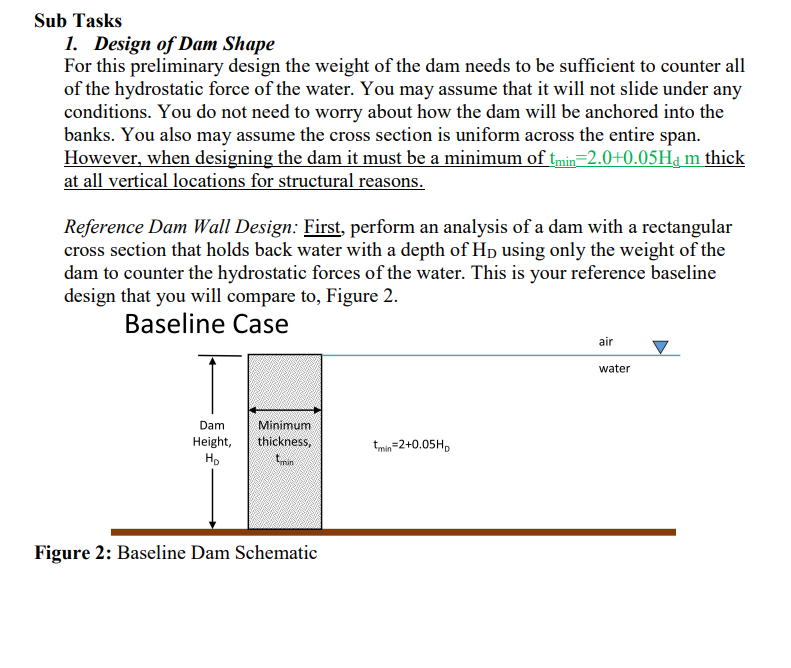
Reference Dam Wall Design: First, perform an analysis of a dam with a rectangular cross section that holds back water with a depth of mathrmHmathrmD using only the weight of the dam to counter the hydrostatic forces of the water. This is your reference baseline design that you will compare to Figure
Baseline Case
Figure Alternate Dam Design: underlinetext Second, provide at least one additional design with a different cross sectional shape. The design can include either curved or planar surfaces. The surfaces can be placed upstream, downstream or both of the water. The added shapes can extend partially or fully up the height of the wall, see Figure The minimum thickness must still meet the mathrmttext min mathrmHmathrmD requirement at all vertical locations. You should describe why you were examining the cross sectional shape you picked. Meaning, clearly state why you thought technical reasons your alternative design was going to be better than the baseline case. Alternate Cases
Figure : Alternate Design Cross Sectional Schematic Site Scenarios
You should investigate three potential site scenarios. A "site scenario" is a unique location and height combination. Meaning you can look at the same location with three different heights, three heights with different locations or some combination of those. Dam Analysis: This is just a fluid statics submerged gate problem. For the two cases you can solve a generic problem in terms of variables only. That gives you the "model" of a generic situation. Then you can explore your model by putting in different heights and spans when you are looking at specific "site scenarios". Use good problem solving technique for both of these tasks. Start by drawing a cartoon of the problem. Draw Free Body Diagrams and Control Volumes as appropriate. Apply the correct equations and develop your specific solution in variable form. Do not forget to list the assumptions you are making. See what information you need in order to solve it Remember a variable form solution means that you have developed a generic model that it is easy to change parameters in I highly recommend a spreadsheet or Matlab script to do the actual number calculations.
Step by Step Solution
There are 3 Steps involved in it
1 Expert Approved Answer
Step: 1 Unlock

Question Has Been Solved by an Expert!
Get step-by-step solutions from verified subject matter experts
Step: 2 Unlock
Step: 3 Unlock