





Question: Subject: Business law I need only correct answer not to explain. Please answer all the questions. Thanks 49. Today's antitrust laws are direct descendants of
Subject: Business law

I need only correct answer not to explain. Please answer all the questions. Thanks
Subject: Business law I need only correct answer

Subject: Business law I need only correct answer

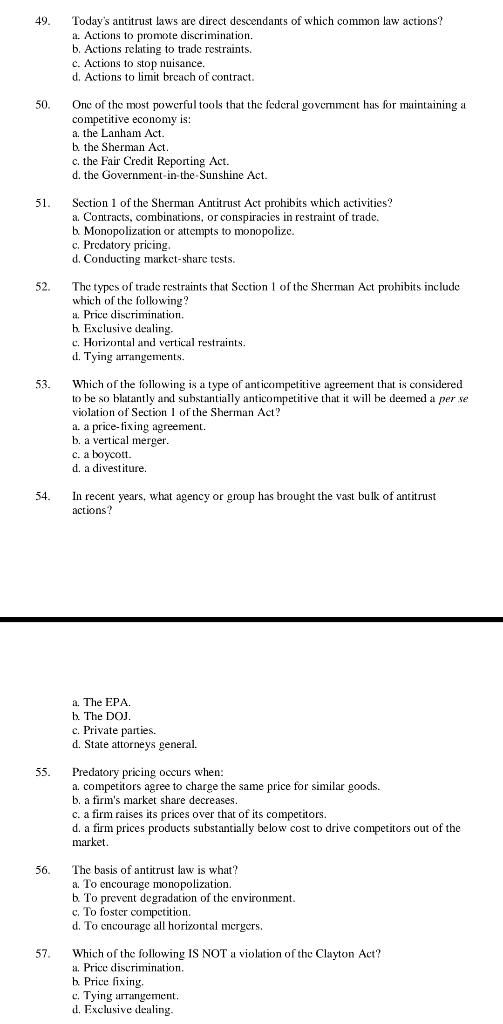
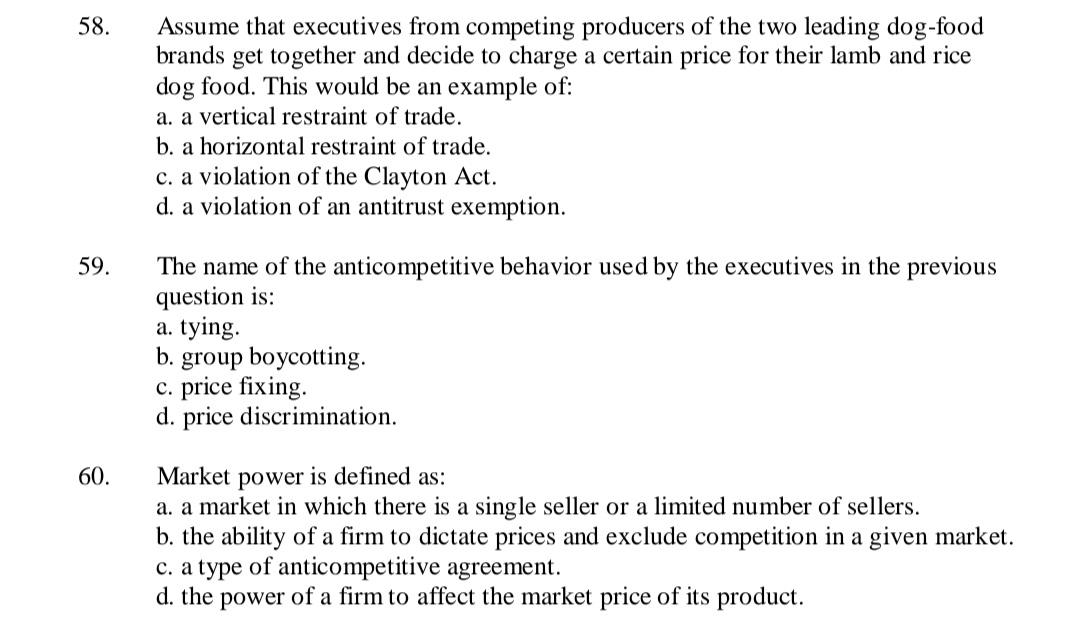
49. Today's antitrust laws are direct descendants of which common law actions? a. Actions to promote discrimination. b. Actions relating to trade restraints. c. Actions to stop nuisance. d. Actions to limit breach of contract 50. Onc of the most powerful tools that the federal government has for maintaining a competitive economy is: a. the Lanham Act. b. the Sherman Act. c. the Fair Credit Reporting Act. d. the Government in the Sunshine Act. 51. Section 1 of the Sherman Antitrust Act prohibits which activities? a Contracts, combinations, or conspiracies in restraint of trade. b Monopolization or attempts to monopolize. c. Predatory pricing d. Conducting market share tests. 52 The types of trade restraints that Section 1 of the Sherman Act prohibits include which of the following? a. Price discrimination, b. Exclusive dealing c. Horizontal and vertical restraints. 1. Tying arrangements. Which of the following is a type of anticompetitive agreement that is considered to be so blatantly and substantially anticompetitive that it will be deemed a per se violation of Section of the Sherman Act? a. a price-fixing agreement. b. a vertical merger. c. a boycott. d. a divestiture 53. 54 In recent years, what agency or group has brought the vast bulk of antitrust actions? a. The EPA. b. The DOJ. c. Private parties. d. State attorneys general. 55. Predatory pricing occurs when: a competitors agree to charge the same price for similar goods. b. a firm's market share decreases. c. a firm raises its prices over that of its competitors. d. a firm prices products substantially below cost to drive competitors out of the market 56. The basis of antitrust law is what? a. To encourage monopolization b. To prevent degradation of the environment. c. To foster competition. d. To encourage all horizontal mergers. Which of the following IS NOT a violation of the Clayton Act? a. Price discrimination. b. Price fixing c. Tying arrangement. d. Exclusive dealing 57. 58. Assume that executives from competing producers of the two leading dog-food brands get together and decide to charge a certain price for their lamb and rice dog food. This would be an example of: a. a vertical restraint of trade. b. a horizontal restraint of trade. c. a violation of the Clayton Act. d. a violation of an antitrust exemption. 59. The name of the anticompetitive behavior used by the executives in the previous question is: a. tying. b. group boycotting. c. price fixing. d. price discrimination. 60. Market power is defined as: a. a market in which there is a single seller or a limited number of sellers. b. the ability of a firm to dictate prices and exclude competition in a given market. c. a type of anticompetitive agreement. d. the power of a firm to affect the market price of its product

Step by Step Solution

There are 3 Steps involved in it

1 Expert Approved Answer
Step: 1 Unlock blur-text-image

Question Has Been Solved by an Expert!

Get step-by-step solutions from verified subject matter experts

Step: 2 Unlock
Step: 3 Unlock

Students Have Also Explored These Related General Management Questions!