







Question: subject computer architecture and organization section digital logic design QUESTION 2: I (a) Design a combinational circuit with three inputs, A, B, and C, and
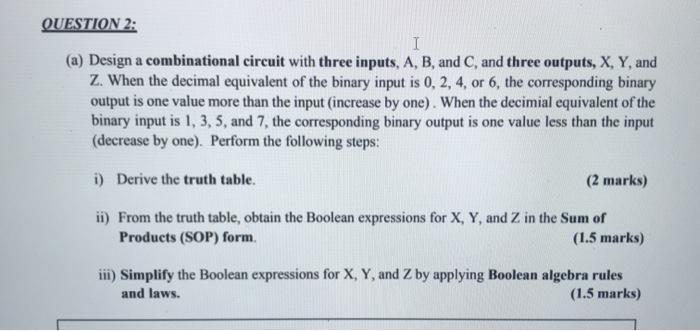
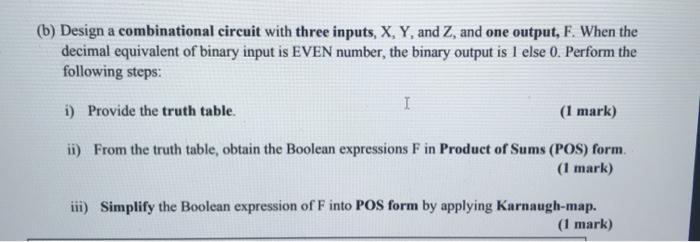
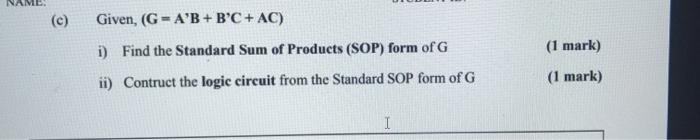
QUESTION 2: I (a) Design a combinational circuit with three inputs, A, B, and C, and three outputs, X, Y, and Z. When the decimal equivalent of the binary input is 0, 2, 4, or 6, the corresponding binary output is one value more than the input (increase by one). When the decimial equivalent of the binary input is 1, 3, 5, and 7, the corresponding binary output is one value less than the input (decrease by one). Perform the following steps: i) Derive the truth table. (2 marks) ii) From the truth table, obtain the Boolean expressions for X, Y, and Z in the Sum of Products (SOP) form (1.5 marks) ii) Simplify the Boolean expressions for X, Y, and Z by applying Boolean algebra rules and laws. (1.5 marks) (b) Design a combinational circuit with three inputs, X, Y, and Z, and one output, F. When the decimal equivalent of binary input is EVEN number, the binary output is 1 else 0. Perform the following steps: i) Provide the truth table. 1 (1 mark) ii) From the truth table, obtain the Boolean expressions F in Product of Sums (POS) form. (1 mark) iii) Simplify the Boolean expression of F into POS form by applying Karnaugh-map. (1 mark) Given, (G=A'B+BC + AC) i) Find the Standard Sum of Products (SOP) form of (1 mark) ii) Contruct the logic circuit from the Standard SOP form of G (1 mark)
Step by Step Solution
There are 3 Steps involved in it

Get step-by-step solutions from verified subject matter experts
 Study Help