



Question: SUBJECT: E-commerce Summary this following case study. Thank you. A kamai Tech nologies: Attempting to Keep Supply Ahead of Demand Tn 2020, the amount of
SUBJECT: E-commerce
A kamai Tech nologies: Attempting to Keep Supply Ahead of Demand Tn 2020, the amount of Internet traffic generated by YouTube alone is greater than the amount of traffic on the entire Internet in 2000 . Because of video streaming and the explosion in mobile devices demanding high-bandwidth applications, Internet traffic has more than quadrupled since 2011 and is predicted to double from 2019 to 2022 (see Figure 3.18). Internet video is now a majority of Internet traffic and will reach over 82% by 2022 , according to Cisco. Mobile platform traffic is expected to grow sevenfold between 2017 and 2022. Cisco estimates that annual global Internet traffic will be around 4.8 zettabytes in 2022: that's 4,800 exabytes, or, in other words, 48 with 19 zeroes behind it! In today's broadband environment, the threshold of patience is very low, Over 50% of mobile users will leave a page that takes more than three seconds to load. Increased video and audio customer expectations are bad news for anyone secking to use the Web for delivery of high-quality multimedia content and high-definition video. Akamai is one of the Web's major helpers, and an owerwhelming majority of the Web's top comparies use Akamai's services to speed delivery of content. Slow-loading web pages and content sometimes result from poor design, but more often than not, the problem stems from the underlying infrastructure of the Internet. The Internet is a collection of networks that has to pass information from one network to another. Sometimes the handoff is not smooth. Every 1,500-byte packet of information sent over the Internet must be verified by the receiving server and an acknowledgment sent to the sender. This slows down not only the distribution of content such as music, but also slows down interactive requests, such as purchases, that fequise the client computer to interact with an online shopping cart. Moreover, each packet may go through many different servers on its wary to its final destination, multiplying by several orders of magnitude the number of aclinowledgments required to move a packet from New York to San Francisco. The Internet today spends much of its time and capacity verifying packets, contributing to a problem called "latency +or delay, For this reason, a single e-mail with a 1-megabyte attached PDF file can create more than 50 megabytes of Internet traffic and data storage on servers, client hand drives, and network backup drives. Load times have also increased significantly as pages become laden with more content of various types, further complicating content distribution. Akamai Technologies was founded by Tom Leighton, an MIT professor of applied mathematics, and Daniel Lewin, an MrT grad student, with the idea of expediting Internet traffic to overcome these limitations. Lewin's master's thesis was the theoretical starting point for the company. It described storing copies of web content such as pictures or video clips at many different locations around the lnternet so that one could always retrieve a nearby copy, making web pages load faster. This is the idea behind edge computing: locating computing and data storage in servers as close to the location where they are needed to reduce latency, improve response time, and save bandwidth. Officially launched in August 1998, Akamai's current products are based on its Akamai Intelligent Edge Platform, a cloud platform made up of approximately 275,000 servers in 136 countries within nearly 1,500 networks around the world, and all within a single network hop of 89% of all Internet users. Akamai software on these servers allows the platform to identify and block security threats and provide comprehensive knowledge of network conditions, as well as instant derice-level detection and optimization. Akamais site performance products allow customers to move theirontine content closer to end users so someone in New York City who visits the L.L. Bean website, for instance, will be served L. L. Bean pages from the New York metro area Akamai servers, while users of the L.L. Bean site who live in San Francisco will be served pages from Akamai servers in San Francisco. Akamai has a wide range of large corporate and government clients: 50% of the Fortune Global 500 companies, 19 of the top 20 U.S. e-commerce retailers, all of the top 5 travel websites, all of the top 25 U.S. banks, 4 of the top 5 U.S. life and health insurance carriers, and so on. In 2020, Akamai typically delivers more than 50 terabits per second (Tbps) in daily web traffic. In October 2019, it announced that traffic on E.comtetce. Infrastructute: The fatetnet. Web.and Mobile Platforai its network had hit a new peak of 107 Tbps. During 2019 , it also supported more than 25 miltion concurrent vievers of the 2019 Cricket World Cup, a new world record for live streaming. Accomplishing thisdaunting task requires that Akamai monitor the entire Internet. locating potential sluggish areas and devising faster routes for information to travel. Frequently used portions of a client's website, or large video or audio files that would be difficult to send to users quickly, are stored on Akamai's servers. When a user requests a song or a video file, his or her request is redirected to an Akamai server nearby and the content is served from this local server. Ahamaiss servers are placed in Tier I backbone supplier networks, large ISPs, wniversities, and other networks. Akamaits software determines which server is optimal for the user and then transmits the content locally. Websites that are "Akamaized" can be delivered anywhere from 4 to 10 times as fast as non-Mkamaired content. An Akamai Image Manager tool, developed as part of a partnership with the BigCommerce e-commerce platform, automates image conversion of large image files to speed load times on image-heavy web pages. Akamai also has developed a number of other business services based on its faternet savvy, including targeted advertising based on user location and zip code, content security, business intelligence, disaster recovery, on -demand bandwidth and computing capacity during spaikes in Internet traffic, storage, global traffic management, and streaming services. In 2019. Akamai announced it would launch a blockchain-based payment network for credit cands and other financial transactions. The network is expected to perform I million transactions per second at latencies of less than twoseconds, which compares very favorably to Bitcoin's seven transactions per second and latency of sixty minutes pes transactaon. The shift toward cloud computing and the mobile platform as well as the growing popularity of streaming video have provided Akamai with new growth opportunities. As mare businesses and business models have moved online, Akamai has seen its client base grow as well. However, the growth of streaming video has also created new challenges for Akamai, including increased competition from Coatcast and Amayon, which have built competing coatent delivery services. Many of Akamai's largest clients, including Apple, Tacebook, Google, Microsoft, and Netfix, are also increasingly shifting their content delivery operations away from Akamat's platforms and onto in-house content delivery networks. Other competitors in content defivery, such as Cloudflare, Fastly, and StackPath, also represent threats to Akamai's continued dominance. Akamai is also acutely aware of the increate in cybercrime as more traffic migrates to the internet. Growth in Internet traffic is good news for Akamai, but the company must also now deal with politically motivated cyberattacks, otganized crime onlize, and state-sponsored cyberwarfare, not just against its clients, but against CDNs tike Akamai itself. With Distributed Denial of Service (DDoS) attacks against CDNs on the rise, Akamai has taken precautions to ensure that it can withstand an attack against its infrastructure. Akamai also has continued to improve its Kona Site Defender tool, which offers a variety of security measures for Akamai clients. The tool protects against DDoS attacks and includes a firewall for web applications. Akamai has also rolled out improventents to Kona's ability to autornate app security. Wich so many businesses now dependent on the uninterrupted flow of content over the Internet, Alamai is in a very strong position to Summary this following case study.
Thank you. 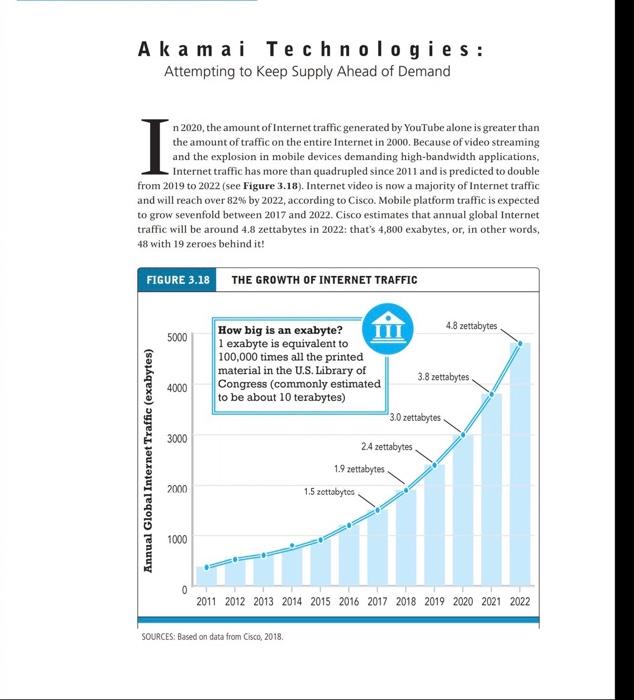



Step by Step Solution
There are 3 Steps involved in it
1 Expert Approved Answer
Step: 1 Unlock

Question Has Been Solved by an Expert!
Get step-by-step solutions from verified subject matter experts
Step: 2 Unlock
Step: 3 Unlock