SUBJECT : ETHICS IN BUSINESS ! PLEASE ANSWER THE QUESTIONS . NO COPY PASTE
NB : 1000 words
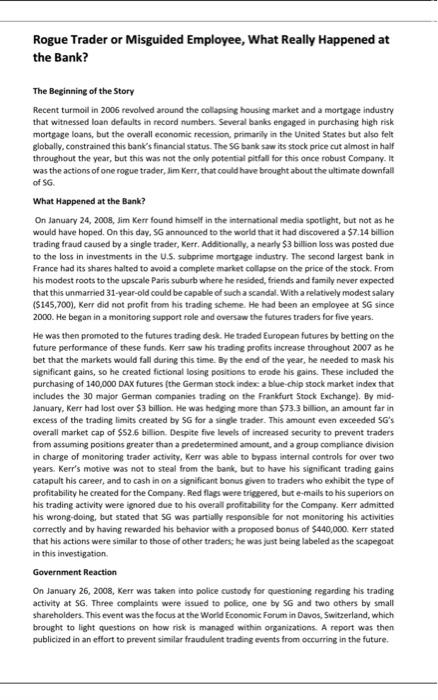
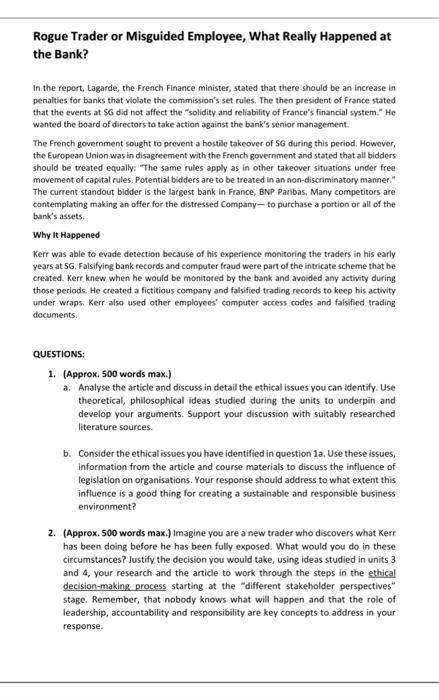
Rogue Trader or Misguided Employee, What Really Happened at the Bank? The Beginning of the Story Recent turmoil in 2006 revolved around the collapsing housing market and a mortgage industry that witnessed loan defaults in record numbers. Several baniss engaged in purchasing high risk mortgage loans, but the overall economic recession, primarily in the United States but also felt globally, constrained this bank's financial status. The SG bank saw its stock price cut almost in half throughout the year, but this was not the only potential pitfall for this once robust Company. It was the actions of one rogue trader, lim Kerr, that could have brought about the ultimate downfall of 56. What Happened at the Bank? On January 24, 2008, Jim Kerr found himself in the international media spotlight, but not as he would have hoped, On this day, $G announced to the world that it had discovered a $7.14 billion trading fraud caused by a single trader, Kerr, Additionally, a nearly $3 billion loss was posted due to the loss in investments in the U.S. subprime mortgage industry. The second largest bank in France had its shares halted to avoid a complete market collapse on the price of the stock. From his modest roots to the upscale Paris suburb where he resided, friends and family never expected that this unmarried 31-year-old could be capable of sach a scandal. With a relatively modest salary (\$145,700), Kerr did not profit from his trading scheme. He had been an employee at 56 since 2000. He began in a monitoring support role and oversaw the futures traders for five years. He was then promoted to the futures trading desk. He traded furopean futures by betting on the future performance of these funds. Kerr saw his trading profits increase throughout 2007 as he bet that the markets would fall during this time. By the end of the year, he needed to mask his significant gains, so he created fictional losing positions to erode his gains. These included the purchasing of 140,000 DAX futures (the German stock index a blue-chip stock market index that includes the 30 major German companies trading on the Franifurt 5 tock Exchange). By midJanuary, Kerr had lost over $3 billion. He was hedging more than $73.3 billion, an amount far in excess of the trading limits created by SG for a yingle trader. This amount even exceeded SG's overall market cap of $2.6 billion. Despite five levels of increased security to prevent traders from assuming positions greater than a predetermined amount, and a group compliance division. in charge of monitoring trader activity, Kerr was able to bypass internal controls for over two years. Kerr's motive was not to steal from the bank, but to have his significant trading gains catapult his career, and to cash in on a significant bonas given to traders who exhibit the type of profitability he created for the Company. Red flags were triggered, but e-mails to his superiors on his trading activity were ignored due to his overall profirability for the Company. Kerr admitted his wrong-doing, but stated that 56 was partially responsible for not monitoring his activities correctly and by having rewarded his behavior with a proposed bonus of $440,000. Kerr stated that his actions were similar to those of other traders; he was just being labeled as the scapegoat in this investigation. Government Reaction On January 26, 2008, Kerr was taken into police custody for questioning regarding his trading activity at 5G. Three complaints were issued to police, one by 5G and two others by small shareholders. This event was the focus at the World Economic Forum in Davos, Switzeriand, which brought to light questions on how risk is managed within organizations. A report was then publicized in an effort to prevent similar fraudulent trading events from occurring in the future. Rogue Trader or Misguided Employee, What Really Happened at the Bank? In the report, Lagarde, the French Finance minister, stated that there should be an increase in penalties for banks that violate the commission's set rules. The then president of France stated that the events at SG did not affect the "solidity and reliability of France's financial system." He Wanted the board of directors to take action against the bank's senior management. The French government sought to prevent a hostile takeover of SG during this period. However, the European Union was in disagreement with the French government and stated that all bidders should be treated equally: "The same rules apply as in other takeover situations under free movement of capital rules. Potential bidders are to be treated in an non-discriminatory manner." The current standout bidder is the largest bank in France, BNP Paribas, Many competitors are contemplating making an offer for the distressed Company- to purchase a portion or all of the bank's assets. Why it Happened Kerr was able to evade detection because of his experience monitoring the traders in his early years at SG. Falsifying bank records and computer fraud were part of the intricate scheme that he created. Kerr knew when he would be monitored by the bank and avoided any activity during those periods. He created a fictitious company and falsified trading records to keep his activity under wraps. Kerr also used other employees' computer access codes and falsified trading documents. QUESTIONS: 1. (Approx. 500 words max.) a. Analyse the article and discuss in detail the ethical issues you can identify. Use theoretical, philosophical ideas studied during the units to underpin and develop your arguments. Support your discussion with suitably researched literature sources. b. Consider the ethical issues you have identified in question 1a. Use these issues, information from the article and course materials to discuss the influence of legislation on organisations. Your response should address to what extent this influence is a good thing for creating a sustainable and responsible business environment? 2. (Approx. 500 words max.) imagine you are a new trader who discovers what Kerr has been doing before he has been fully exposed. What would you do in these circumstances? Justify the decision you would take, using ideas studied in units 3 and 4 , your research and the article to work through the steps in the ethical decision-making process starting at the "different stakeholder perspectives" stage. Remember, that nobody knows what will happen and that the role of leadership, accountability and responsibility are key concepts to address in your response