



Question: subject project management please assist me with the question please. thank you Question 4 (26) Case Study: Sydney Opera House construction: A case of project
subject project management
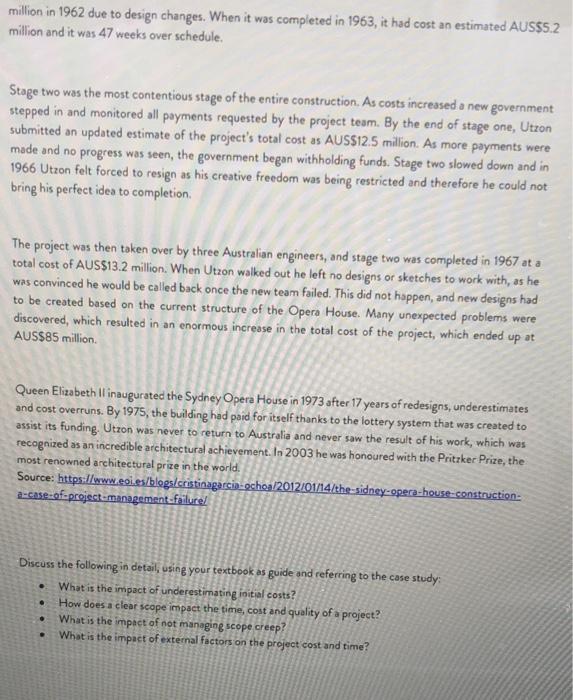
Question 4 (26) Case Study: Sydney Opera House construction: A case of project management failure The Sydney Opera House is an iconic structure recognized as a global symbol of Australia around the world, The architect, Jorn Utron, won the competition to design the building in 1957. Construction commenced in 1959. The construction period was originally scheduled for four years with an allocated budget of AUS$7 million. The project took 14 years to complete at a cost of AUSS102 million. It could be one of the most disastrous construction projects in history, not only financially but also a management plan. At the beginning of any project goals and objectives must be clearly defined by the client. There are three main factors: time, cost, and quality. In the case of the Sydney Opera House the last was the most important, as it was an almost unrestricted goal and the reason why it was launched. No indications of time or cost limits were provided for the competition, so the architects were slowed total freedom in their designs After Utzon was selected, he presented his "Red Book", the Sydney National Opera House report, in March 1958. It gave some indications such as plans, sections, reports by consultants, etc. The funds came almost entirely from a dedicated lottery, so the project was not a financial burden for the government. The goal was to complete construction at the end of 1962 and have the grand opening at the start of 1963. The project should have losted four years. The main stakeholder was the architect, but Utzon was much more concerned with design than with time and cost objectives, which proved challenging During the project, Utzon join forces with Ove Arup, who oversaw the structure and the engineering with other subcontractors the team oversaw mechanics, electrics, heating and ventilating lighting and acoustics. There was no real project manager, but collaboration between Utron and Arup. The other main stakeholder was the client, the State of New South Wales. This included the Australian government, who launched the competition for the project, and the Labour Premier Joe Cahill. A part-time executive committee was created to provide project supervision, but its members had no real technical skills. The government eventually became an obstacle to the project team by inhibising changes during operations and thus contributing to cost overruns and delays. Finally, the public was an indirect stakeholder because they were concerned with the project's success. There were problems from the start of the project, which was divided into three stages: stage 1 was the podium, stage 2 was the outer shells, and stage 3 was the interiors and windows. Utzon remonstrated that he had not completed the designs for the structure. The government maintained that the construction must begin. In addition, the client changed the requirements of the design after construction had started, moving from two theatres to four. This meant that plans and designs had to be modified during construction The initial project's budget estimation was based on unfinished design drawings and site surveys, which later lead to disagreements. The contractors for the first stage successfully claimed additional costs of AUS$1.2 million in 1962 due to design changes. When it was completed in 1963, it had cost an estimated AUS$5.2 million and it was 47 weeks over schedule. Stage two was the most contentious stage of the entire construction. As costs increased a new government stepped in and monitored all payments requested by the project team. By the end of stage one, Utzon submitted an updated estimate of the project's total cost as AUS$12.5 million. As more payments were made and no progress was seen, the government began withholding funds. Stage two slowed down and in 1966 Utzon felt forced to resign as his creative freedom was being restricted and therefore he could not bring his perfect idea to completion. The project was then taken over by three Australian engineers, and stage two was completed in 1967 at a total cost of AUS$13.2 million. When Utzon walked out he left no designs or sketches to work with, as he was convinced he would be called back once the new team failed. This did not happen, and new designs had to be created based on the current structure of the Opera House. Many unexpected problems were discovered, which resulted in an enormous increase in the total cost of the project, which ended AUS$85 million at Queen Elizabeth Il inaugurated the Sydney Opera House in 1973 after 17 years of redesigns, underestimates and cost overruns. By 1975, the building had paid for itself thanks to the lottery system that was created to assist its funding. Utzon was never to return to Australia and never saw the result of his work, which was recognized as an incredible architectural achievement. In 2003 he was honoured with the Pritzker Prize, the most renowned architectural prize in the world. Source: https://www.eo.es/blogs/cristinagarcia-echos/2012/01/14/the-sidney-opera-house-construction: a-case-of-project-management-failure/ Discuss the following in detail, using your textbook as guide and referring to the case study: What is the impact of underestimating initial costs? How does a clear scope impact the time, cost and quality of a project? What is the impact of not managing scope creep? What is the impact of external factors on the project cost and time
please assist me with the question please. thank you 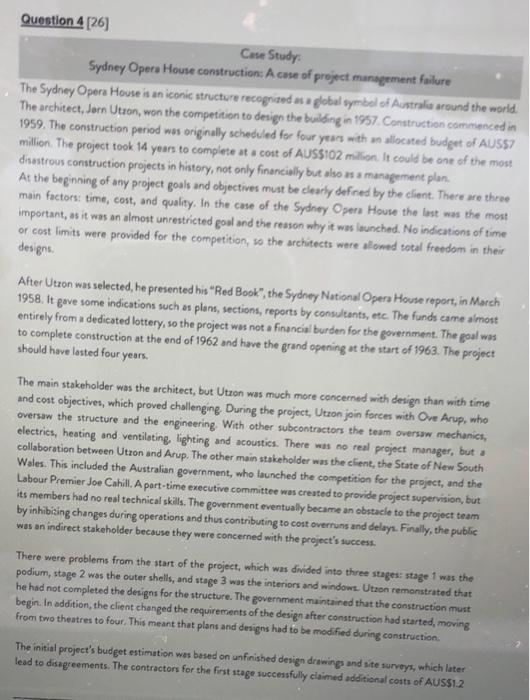
Step by Step Solution
There are 3 Steps involved in it
1 Expert Approved Answer
Step: 1 Unlock

Question Has Been Solved by an Expert!
Get step-by-step solutions from verified subject matter experts
Step: 2 Unlock
Step: 3 Unlock