







Question: Subject:data communication and computer networking Plz i need this in 2 hour at least . Suppose a new TCP congestion protocol TCPN is developed. It
 Subject:data communication and computer networking
Plz i need this in 2 hour at least .
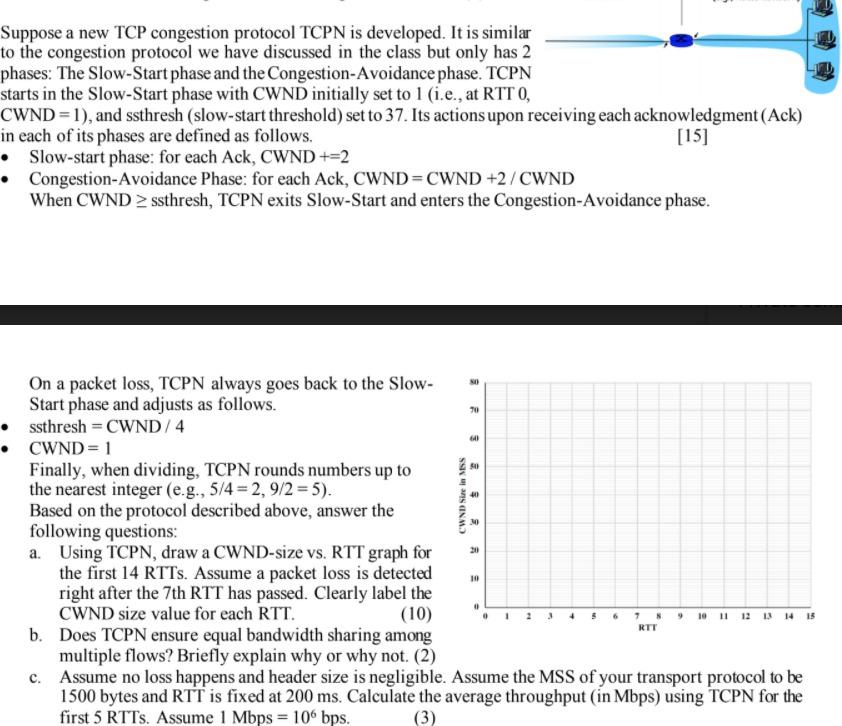
Suppose a new TCP congestion protocol TCPN is developed. It is similar to the congestion protocol we have discussed in the class but only has 2 phases: The Slow-Start phase and the Congestion-Avoidance phase. TCPN starts in the Slow-Start phase with CWND initially set to 1 (i.e., at RTT 0, CWND=1), and ssthresh (slow-start threshold) set to 37. Its actions upon receiving each acknowledgment (Ack) in each of its phases are defined as follows. [15] Slow-start phase: for each Ack, CWND +=2 Congestion-Avoidance Phase: for each Ack, CWND=CWND +2/CWND When CWND > ssthresh, TCPN exits Slow-Start and enters the Congestion-Avoidance phase. 0 70 GAI CWND Sin in MSS 20 On a packet loss, TCPN always goes back to the Slow- Start phase and adjusts as follows. ssthresh = CWND/4 CWND= 1 Finally, when dividing, TCPN rounds numbers up to the nearest integer (e.g., 5/4 = 2, 9/2 = 5). Based on the protocol described above, answer the following questions: a. Using TCPN, draw a CWND-size vs. RTT graph for the first 14 RTTs. Assume a packet loss is detected right after the 7th RTT has passed. Clearly label the CWND size value for each RTT. (10) b. Does TCPN ensure equal bandwidth sharing among multiple flows? Briefly explain why or why not. (2) c. Assume no loss happens and header size is negligible. Assume the MSS of your transport protocol to be 1500 bytes and RTT is fixed at 200 ms. Calculate the average throughput (in Mbps) using TCPN for the first 5 RTTs. Assume 1 Mbps = 106 bps. (3) 30 10 RIT Suppose a new TCP congestion protocol TCPN is developed. It is similar to the congestion protocol we have discussed in the class but only has 2 phases: The Slow-Start phase and the Congestion-Avoidance phase. TCPN starts in the Slow-Start phase with CWND initially set to 1 (i.e., at RTT 0, CWND=1), and ssthresh (slow-start threshold) set to 37. Its actions upon receiving each acknowledgment (Ack) in each of its phases are defined as follows. [15] Slow-start phase: for each Ack, CWND +=2 Congestion-Avoidance Phase: for each Ack, CWND=CWND +2/CWND When CWND > ssthresh, TCPN exits Slow-Start and enters the Congestion-Avoidance phase. 0 70 GAI CWND Sin in MSS 20 On a packet loss, TCPN always goes back to the Slow- Start phase and adjusts as follows. ssthresh = CWND/4 CWND= 1 Finally, when dividing, TCPN rounds numbers up to the nearest integer (e.g., 5/4 = 2, 9/2 = 5). Based on the protocol described above, answer the following questions: a. Using TCPN, draw a CWND-size vs. RTT graph for the first 14 RTTs. Assume a packet loss is detected right after the 7th RTT has passed. Clearly label the CWND size value for each RTT. (10) b. Does TCPN ensure equal bandwidth sharing among multiple flows? Briefly explain why or why not. (2) c. Assume no loss happens and header size is negligible. Assume the MSS of your transport protocol to be 1500 bytes and RTT is fixed at 200 ms. Calculate the average throughput (in Mbps) using TCPN for the first 5 RTTs. Assume 1 Mbps = 106 bps. (3) 30 10 RIT
Step by Step Solution
There are 3 Steps involved in it

Get step-by-step solutions from verified subject matter experts
 Study Help