



Question: Subjects are to be randomly allocated to low-intensity exercise (LIE; 50% APMHR) or high-intensity exercise (HIE; 95% APMHR). Subjects will be exercised on a cycle
- Subjects are to be randomly allocated to low-intensity exercise (LIE; 50% APMHR) or high-intensity exercise (HIE; 95% APMHR). Subjects will be exercised on a cycle ergometer for 3 minutes at either 50% APMHR (LIE) or 95% APMHR (HIE). After a 3-day recovery period, subjects will perform the other exercise type. Prior to beginning the exercise, a finger-stick blood sample will be obtained to determine blood lactate concentration at rest and then immediately upon termination of the exercise bout. All significant differences will be determined using a level of significance of 0.05.
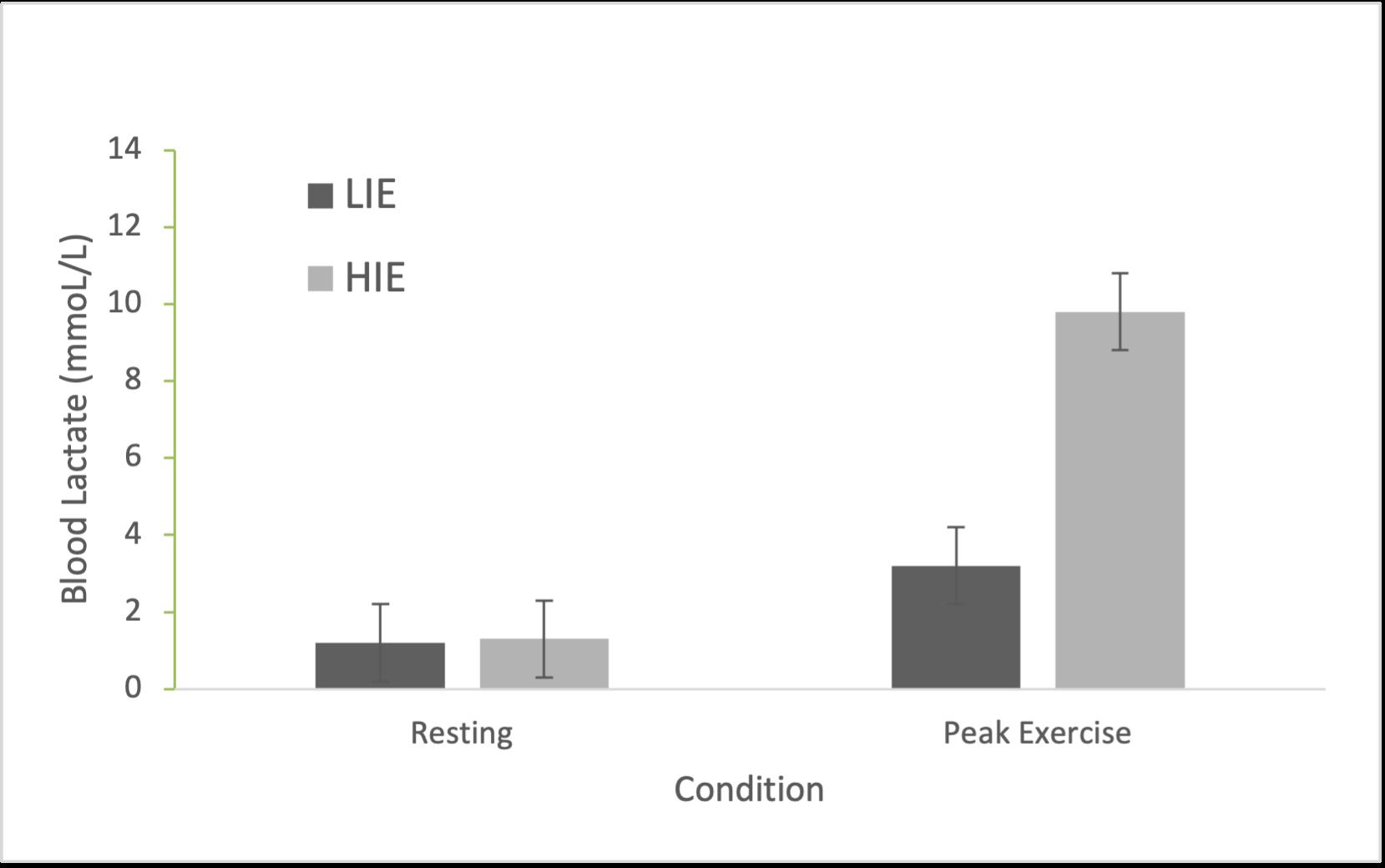
Figure 1. Blood lactate concentration before and after LIE or HIE. Data are reported as means +/- standard deviation. n = 20 per group.
The statistical analysis revealed the following findings:
- LIE vs. HIE Resting: p= 0.878
- LIE Peak Exercise vs. LIE Resting: p=0.043
- HIE Peak Exercise vs. HIE Resting: p=0.005
- HIE Peak Exercise vs. HIE Peak Exercise: p=0.015
- Which of the comparisons above are statistically meaningful, based on the a-priori alpha level? Why? (1 point)
Comparison number 1
- What is the probability that the statistically significant differences found are due to chance? (1 point)
- The statistical analysis of the data revealed that the power of the test performed was 0.821.
- Provide a written interpretation of this power value. What does this 0.821 value mean? Is this value acceptable? High? Low? (1 point)
- What was the associated beta rate for the test? Be sure to provide a brief interpretation of this value. (1 point)
- How many total subjects were in the study? (1 point)
Blood Lactate (mmol/L) 14 12 10 8 2 0 LIE HIE Resting Condition Peak Exercise
Step by Step Solution
★★★★★
3.47 Rating (157 Votes )
There are 3 Steps involved in it
1 Expert Approved Answer
Step: 1 Unlock

The answer provided below has been developed in a clear step by step manner Step 1 a The comparisons ... View full answer
Question Has Been Solved by an Expert!
Get step-by-step solutions from verified subject matter experts
Step: 2 Unlock
Step: 3 Unlock