



Question: Submit a Word document with IPCONFIG deliverables and PING deliverables with screenshots. Part 1 1. Use the ipconfig/all command on your computer. What is the
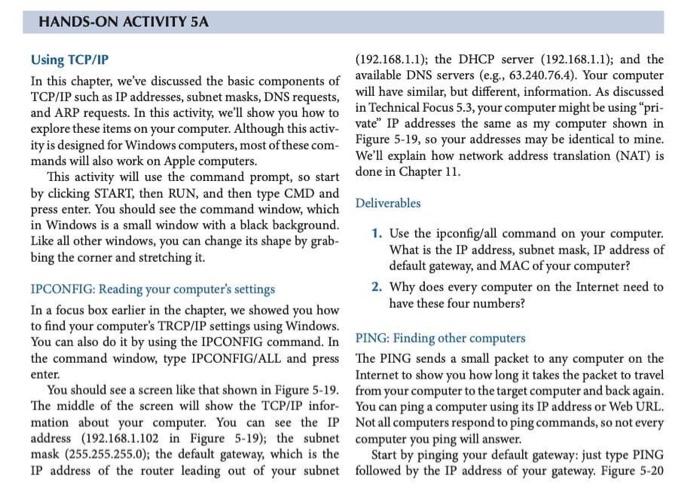
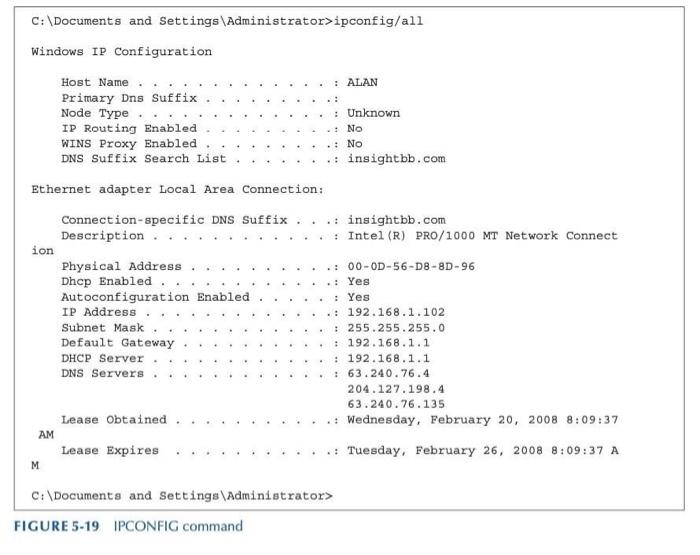
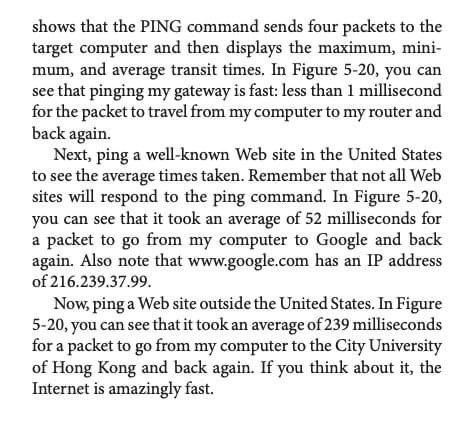
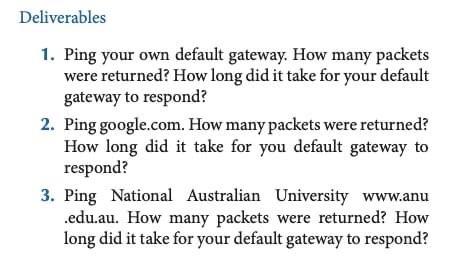
HANDS-ON ACTIVITY 5A Using TCP/IP (192.168.1.1); the DHCP server (192.168.1.1); and the In this chapter, we've discussed the basic components of available DNS servers (eg, 63.240.76.4). Your computer TCP/IP such as IP addresses, subnet masks, DNS requests, will have similar, but different, information. As discussed and ARP requests. In this activity, we'll show you how to in Technical Focus 5.3, your computer might be using pri- explore these items on your computer. Although this activ. vate" IP addresses the same as my computer shown in ity is designed for Windows computers, most of these com- Figure 5-19, so your addresses may be identical to mine. mands will also work on Apple computers. We'll explain how network address translation (NAT) is This activity will use the command prompt, so start done in Chapter 11. by clicking START, then RUN, and then type CMD and press enter. You should see the command window, which Deliverables in Windows is a small window with a black background. Like all other windows, you can change its shape by grab- 1. Use the ipconfig/all command on your computer. bing the corner and stretching it. What is the IP address, subnet mask, IP address of default gateway, and MAC of your computer? IPCONFIG: Reading your computer's settings 2. Why does every computer on the Internet need to In a focus box earlier in the chapter, we showed you how have these four numbers? to find your computer's TRCP/IP settings using Windows. You can also do it by using the IPCONFIG command. In PING: Finding other computers the command window, type IPCONFIG/ALL and press The PING sends a small packet to any computer on the enter Internet to show you how long it takes the packet to travel You should see a screen like that shown in Figure 5-19. from your computer to the target computer and back again. The middle of the screen will show the TCP/IP infor- You can ping a computer using its IP address or Web URL. mation about your computer. You can see the IP Not all computers respond to ping commands, so not every address (192.168.1.102 in Figure 5-19); the subnet computer you ping will answer. mask (255.255.255.0); the default gateway, which is the Start by pinging your default gateway: just type PING IP address of the router leading out of your subnet followed by the IP address of your gateway. Figure 5-20 C:\Documents and Settings\Administrator>ipconfig/all Windows IP Configuration .: No : No Host Name : ALAN Primary Dns Suffix Node Type .. : Unknown IP Routing Enabled WINS Proxy Enabled DNS Suffix Search List .: insightbb.com Ethernet adapter Local Area Connection: Connection-specific DNS Suffix . . .: insightbb.com Description. : Intel(R) PRO/1000 MT Network Connect ion Physical Address .: 00-OD-56-D8-8D-96 Dhcp Enabled Autoconfiguration Enabled IP Address .: 192.168.1.102 Subnet Mask .. : 255.255.255.0 Default Gateway : 192.168.1.1 DHCP Server : 192.168.1.1 DNS Servers : 63.240.76.4 204.127.198.4 63.240.76.135 Lease Obtained .: Wednesday, February 20, 2008 8:09:37 AM Lease Expires .: Tuesday, February 26, 2008 8:09:37 A .: Yes : Yes M C:\Documents and Settings\Administrator> FIGURE 5-19 IPCONFIG command shows that the PING command sends four packets to the target computer and then displays the maximum, mini- mum, and average transit times. In Figure 5-20, you can see that pinging my gateway is fast: less than 1 millisecond for the packet to travel from my computer to my router and back again. Next, ping a well-known Web site in the United States to see the average times taken. Remember that not all Web sites will respond to the ping command. In Figure 5-20, you can see that it took an average of 52 milliseconds for a packet to go from my computer to Google and back again. Also note that www.google.com has an IP address of 216.239.37.99. Now, ping a Web site outside the United States. In Figure 5-20, you can see that it took an average of 239 milliseconds for a packet to go from my computer to the City University of Hong Kong and back again. If you think about it, the Internet is amazingly fast. Deliverables 1. Ping your own default gateway. How many packets were returned? How long did it take for your default gateway to respond? 2. Ping google.com. How many packets were returned? How long did it take for you default gateway to respond? 3. Ping National Australian University www.anu .edu.au. How many packets were returned? How long did it take for your default gateway to respond
Step by Step Solution
There are 3 Steps involved in it

Get step-by-step solutions from verified subject matter experts