







Question: Submit source code files ( main . c , slist.c , slist.h ) to Gradescope. Implementation The program will be written in C . You
Submit source code files mainc slist.c slist.h to Gradescope. Implementation
The program will be written in C You can use any code from the course slides. Try to write your
program incrementally by first creating the overall structure with empty functions stubs and
testing often to see that your program is always working as expected.
Organize your code as follows:
main.c
void pushbackDeque q char data
void pushfrontDeque q char data
char popbackDeque q
char popfrontDeque q
int mainint argc, char argv
slist.c slist.h
void insertHeadSList list, char data
char removeHeadSList list
void insertTailSList list, char data
char remove TailSList list Each deque function in main.c is just a wrapper for one of the functions in slist.c
In main you can declare a deque, which is just a typedef of a singly linked list:
Deque ;
Then you can read the file and create a buffer for each name with something like:
Bool done F;
while done
char name mallocMAXNAMELEN;
if fscanffps name
else
pushback&q name;
done T;
Testing
When testing, you are checking to see that the program satisfies the requirements. Test to see
that you can cycle through all the names from the file in both directions.
Here is an example 'names.txt file that you should use:
Andrew
Betty
Candace
Dennis
Edward
After reading the file the resulting deque should be:
Andrew
Betty
Candace
Dennis
Edward
front
back Here is an example run of the program:
To scroll through the names type
f: forwards, b: backwards, q: quit
f
Andrew
f
Betty
f
Candace
f
Dennis
f
Edward
f
Andrew
f
Betty
f
Candace
b
Candace
b
Betty
b
Andrew
b
Edward
b
Dennis
b
Candace
b
Betty
b
Andrew
b
Edward
q
Bye!
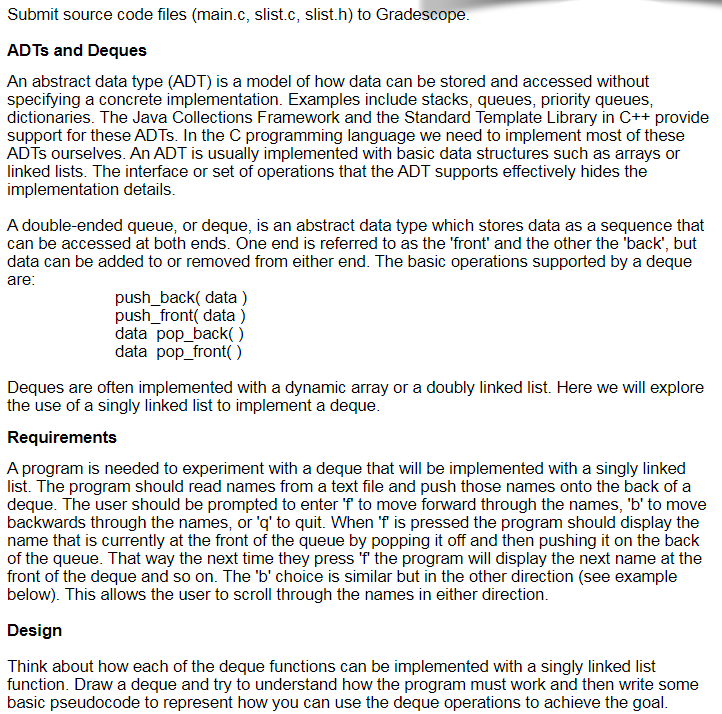
ADTs and Deques
An abstract data type ADT is a model of how data can be stored and accessed without
specifying a concrete implementation. Examples include stacks, queues, priority queues,
dictionaries. The Java Collections Framework and the Standard Template Library in C provide
support for these ADTs. In the C programming language we need to implement most of these
ADTs ourselves. An ADT is usually implemented with basic data structures such as arrays or
linked lists. The interface or set of operations that the ADT supports effectively hides the
implementation details.
A doubleended queue, or deque, is an abstract data type which stores data as a sequence that
can be accessed at both ends. One end is referred to as the 'front' and the other the 'back', but
data can be added to or removed from either end. The basic operations supported by a deque
are:
ack
ront
data ack
data ront
Deques are often implemented with a dynamic array or a doubly linked list. Here we will explore
the use of a singly linked list to implement a deque.
Requirements
A program is needed to experiment with a deque that will be implemented with a singly linked
list. The program should read names from a text file and push those names onto the back of a
deque. The user should be prompted to enter to move forward through the names, b to move
backwards through the names, or to quit. When is pressed the program should display the
name that is currently at the front of the queue by popping it off and then pushing it on the back
of the queue. That way the next time they press f the program will display the next name at the
front of the deque and so on The b choice is similar but in the other direction see example
below This allows the user to scroll through the names in either direction.
Design
Think about how each of the deque functions can be implemented with a singly linked list
function. Draw a deque and try to understand how the program must work and then write some
basic pseudocode to represent how you can use the deque operations to achieve the goal.
Step by Step Solution
There are 3 Steps involved in it
1 Expert Approved Answer
Step: 1 Unlock

Question Has Been Solved by an Expert!
Get step-by-step solutions from verified subject matter experts
Step: 2 Unlock
Step: 3 Unlock
 Study Help