



Question: Subnet the given address space without VLSM You are asked to subnet the given network such that each network segment (subnet) has a block of
Subnet the given address space without VLSM
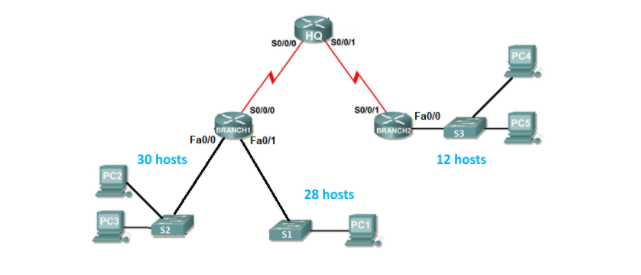
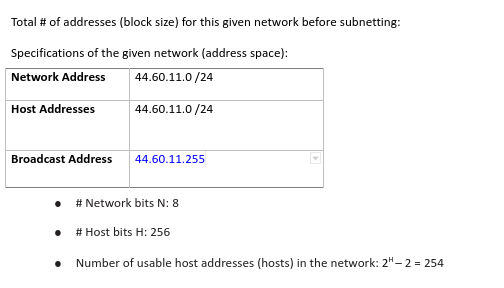
You are asked to subnet the given network such that each network segment (subnet) has a block of IPs that are on different networks. Routers separate subnets and are used to connect devices on different subnets.
Determine the #of subnets and custom subnet mask
-
How many bits to borrow to create the required # of subnets? (subnet bits, S):
-
Number of resulting subnets (max. # of subnets possible) = 2S =
-
After borrowing, each of the resulting subnets has:
-
# Network bits N = network bits + subnet bits =
-
# host bits H =
-
Number of usable hosts (host addresses) per subnet = 2H 2 =
-
Custom subnet mask (of resulting subnets):
You will now subnet the given address space and allocate to the different network segments (subnets) in the topology. For convenience, you can name the network segments (subnets) as netA, netBetc. You can also choose numbers to identify the subnets, such as 1, 2, 3etc.
IP addressing scheme
Now that we have determined the subnet mark, the IP addressing mask, the network addressing scheme can be created. The addressing scheme includes the subnet numbers, the subnet broadcast address, and the range of IP addresses assignable to hosts.
Divide the address space in to the required number of subnets and complete the table below to show the address boundaries of each subnet.
You are asked to subnet the given network such that each network segment (subnet) has a block of IPs that are on different networks. Routers separate subnets and are used to connect devices on different subnets.
Determine the #of subnets and custom subnet mask
-
How many bits to borrow to create the required # of subnets? (subnet bits, S):
-
Number of resulting subnets (max. # of subnets possible) = 2S =
-
After borrowing, each of the resulting subnets has:
-
# Network bits N = network bits + subnet bits =
-
# host bits H =
-
Number of usable hosts (host addresses) per subnet = 2H 2 =
-
Custom subnet mask (of resulting subnets):
You will now subnet the given address space and allocate to the different network segments (subnets) in the topology. For convenience, you can name the network segments (subnets) as netA, netBetc. You can also choose numbers to identify the subnets, such as 1, 2, 3etc.
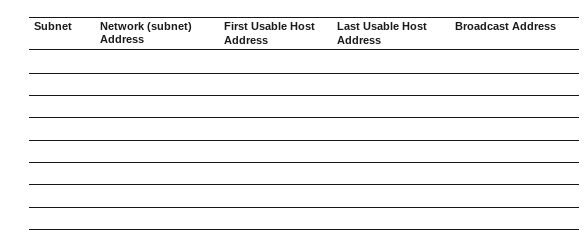
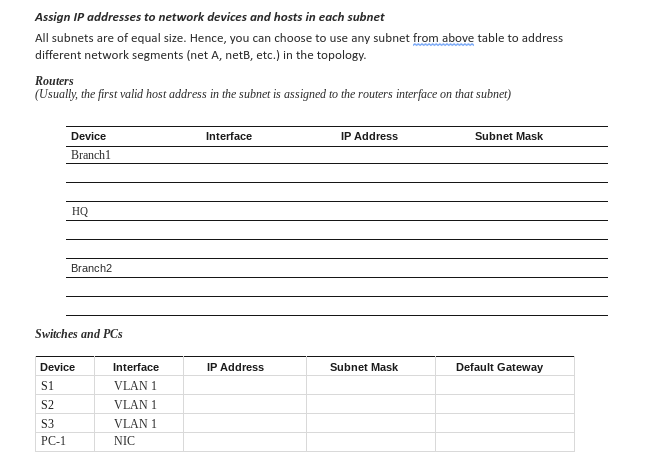

SO/0/0 HQ SOOM SO/0/0 SO/01 Fabio PCS BRANCHE BRANCHI Fabio Fa0/1 30 hosts 12 hosts 28 hosts PC3 S2 PC1 SI Total # of addresses (block size) for this given network before subnetting: Specifications of the given network (address space): Network Address 44.60.11.0/24 Host Addresses 44.60.11.0/24 Broadcast Address 44.60.11.255 # Network bits N: 8 # Host bits H: 256 Number of usable host addresses (hosts) in the network: 242 = 254 Subnet Broadcast Address Network (subnet) Address First Usable Host Address Last Usable Host Address Assign IP addresses to network devices and hosts in each subnet All subnets are of equal size. Hence, you can choose to use any subnet from above table to address different network segments (net A, nets, etc.) in the topology Routers (Usually, the first valid host address in the subnet is assigned to the routers interface on that subnet) Device Interface IP Address Subnet Mask Branch1 HQ Branch2 Switches and PCs IP Address Subnet Mask Default Gateway Device S1 S2 Interface VLAN 1 VLAN 1 VLAN 1 NIC S3 PC-1 PC-2 PC-3 PC-4 PC-5 NIC NIC NIC NIC SO/0/0 HQ SOOM SO/0/0 SO/01 Fabio PCS BRANCHE BRANCHI Fabio Fa0/1 30 hosts 12 hosts 28 hosts PC3 S2 PC1 SI Total # of addresses (block size) for this given network before subnetting: Specifications of the given network (address space): Network Address 44.60.11.0/24 Host Addresses 44.60.11.0/24 Broadcast Address 44.60.11.255 # Network bits N: 8 # Host bits H: 256 Number of usable host addresses (hosts) in the network: 242 = 254 Subnet Broadcast Address Network (subnet) Address First Usable Host Address Last Usable Host Address Assign IP addresses to network devices and hosts in each subnet All subnets are of equal size. Hence, you can choose to use any subnet from above table to address different network segments (net A, nets, etc.) in the topology Routers (Usually, the first valid host address in the subnet is assigned to the routers interface on that subnet) Device Interface IP Address Subnet Mask Branch1 HQ Branch2 Switches and PCs IP Address Subnet Mask Default Gateway Device S1 S2 Interface VLAN 1 VLAN 1 VLAN 1 NIC S3 PC-1 PC-2 PC-3 PC-4 PC-5 NIC NIC NIC NIC
Step by Step Solution
There are 3 Steps involved in it

Get step-by-step solutions from verified subject matter experts