Question: Summarize and relate to a real world event. Using key terms relevant to topic ? 5-1b Individual Factors When people need to resolve issues in
Summarize and relate to a real world event. Using key terms relevant to topic ?
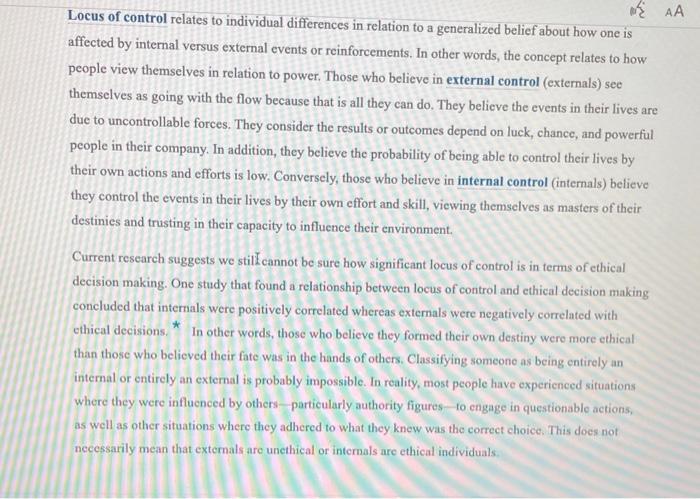
5-1b Individual Factors When people need to resolve issues in their daily lives, they often base their decisions on their own values and morals of right or wrong. They generally learn these through the socialization process, interacting with family members, social groups, religion, and in their formal education. Good personal values or morals have been found to decrease unethical practices and increase positive work behavior. The moral philosophies of individuals, discussed in detail in Chapter 6, provide principles, values, and rules people use to decide what is moral or immoral from a personal perspective. Values of individuals can be derived from moral philosophics that are applied to daily decisions. However, these values can be subjective and vary a great deal across different cultures. For example, some individuals might place greater importance on keeping their promises and commitments than others would. Values applied to business can also be used in negative rationalizations, such as "Everyone does it," or "We have to do what it takes to get the business."* Research demonstrates that individuals with certain personalities will violate basic core values, causing a work group to suffer a performance loss of 30 to 40 percent compared to groups without employees with such personalities. The actions of specific individuals in scandal-plagued financial companies such as JP Morgan often raise questions about those individuals' personal character and integrity. They appear to operate in their own self-interest or in total disregard for the law and the interests of society Although an individual's intention to engage in ethical behavior relates to individual values, organizational and social forces also play a vital role. An individual's attitudes as well as social norms help create behavioral intentions that shape his or her decision making process. While an individual may intend to do the right thing, organizational or social forces can alter this intent. For example, an individunl may intend to report the misconduct of a coworker but when faced with the social or financial consequences of doing so, may decide to remain complacent. In this case, social forces overcome a person's individual values or morals when it comes to taking appropriate action. * At the same time, individual values strongly influence how people assume ethical responsibilities in the work environment, In turn, individual decisions can be heavily dependent on company policy and corporate culture. The way the public perceives business ethics generally varies according to the profession in question. Financial institutions, car salespersons, advertising practitioners, and stockbrokers are often perceived as having the lowest ethics. Research regarding individual factors that affect ethical awareness. judgment intent, and behavior include gender, education, work experience, nationality, age, and locus of control, Extensive research regarding the link between gender and ethical decision making shows that in many aspects there are no differences between men and women. However, when differences are found women are generally more ethical than men. * By "more ethical" we mean women seem to be more sensitive to ethical scenarios and less tolerant of unethical actions. One study found that women and men had different foundations for making ethical decisions: women rely on relationships, men rely on justice or cquity. In another study on gender and intentions for fraudulent financial reporting, females reported higher intentions to report than male participants. As more and more women work in managerial positions, these findings may become increasingly significant Education is also a significant factor in the ethical decision making process. The important point to remember is that education does not reflect experience. Work experience is defined as the number of years in a specific job, occupation, and/or industry. Generally, the more education or work experience people have, the better they are at making ethical decisions. The type of education someone receives has little or no effect on ethics. For example, it doesti't matter if you are a business student or a liberal arts student you are similar in terms of ethical business decision making. Current research, however, shows students are less ethical than those in business which is logical because businesspeople have been exposed to more ethically challenging situations than students. * Additionally, those well versed in business ethics knowledge, including regulatory officials and ethics researchers, are likely to take more time and raise more concerns going through the ethical decision making process than novices such as graduate students. * This implies that those more familiarized with the ethical decision making process due to oducation or experience are likely to spend more time examining and selecting different alternatives to an ethics issue Nationality is the legal relationship between a person and the country in which he or she is bom. In the twenty-first century, nationality is redefined by regional cconomic integration such as the European Union (EU). When Europcan students are asked their nationality, they are less likely to state where they were born than where they currently live. The same thing is happening in the United States, as people born in Florida but living in New York might consider themselves to be New Yorkers. Research about nationality and ethics appears to be significant in how it affects ethical decision making; however, just how nationality affects ethics is somewhat hard to interpret. * Because of cultural differences, it is impossible to state that ethical decision making in an organizational context will differ significantly among individuals of different nationalities. The reality of today is that multinational companies look for businesspeople that make good decisions regardless of nationality. Perhaps in 20 years, nationality will no longer be an issue because the multinational individual's culture will replace national status as the most significant factor in ethical decision making. Age is another individual factor within business ethics. Several decades ago, we believed age was positively correlated with ethical decision making. In other words, the older you are, the more ethical you are. A survey of millennials found that many bring their "me first" attitude to the workplace. Based on a global survey, 73 percent of Generation Y (born in the 1980s and early 1990s) foel unethical behavior can be justified to help an organization survive. In addition, 20 percent said they could justify paying bribes. We believe older employees with more experience have greater knowledge to deal with complex industry-specific ethical issues. Younger managers are far more influenced by organizational culture than older managers. WE AA Locus of control relates to individual differences in relation to a generalized belief about how one is affected by internal versus external events or reinforcements. In other words, the concept relates to how people view themselves in relation to power. Those who believe in external control (externals) see themselves as going with the flow because that is all they can do. They believe the events in their lives are due to uncontrollable forces. They consider the results or outcomes depend on luck, chance, and powerful people in their company. In addition, they believe the probability of being able to control their lives by their own actions and efforts is low. Conversely, those who believe in internal control (internals) believe they control the events in their lives by their own effort and skill, viewing themselves as masters of their destinies and trusting in their capacity to influence their environment. Current research suggests we still cannot be sure how significant locus of control is in terms of ethical decision making. One study that found a relationship between locus of control and ethical decision making concluded that internals were positively correlated whereas externals were negatively correlated with ethical decisions In other words, those who believe they formed their own destiny were more ethical than those who believed their fate was in the hands of others. Classifying someone as being entirely an internal or entirely an external is probably impossible. In reality, most people have experienced situations where they were influenced by others particularly authority figures to engage in questionable actions, as well as other situations where they adhered to what they knew was the correct choice. This does not necessarily mean that extemals are unethical or interals are ethical individuals









 Study Help