



Question: summarize in 50 words. use transitional phrases to link them together. COMPETITON Competition by its very nature is always unhealthy. Rivalry of any kind is
summarize in 50 words. use transitional phrases to link them together.
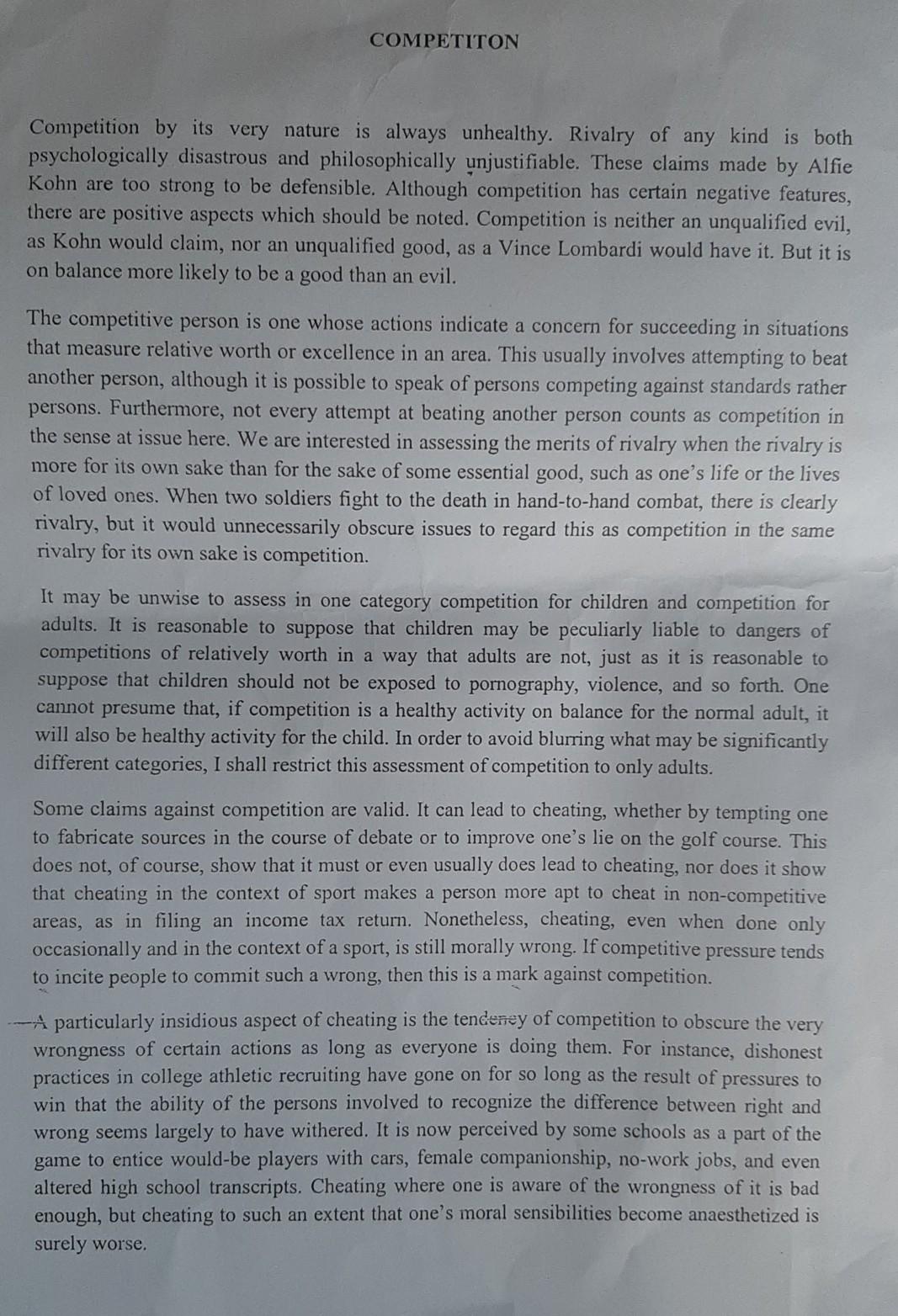
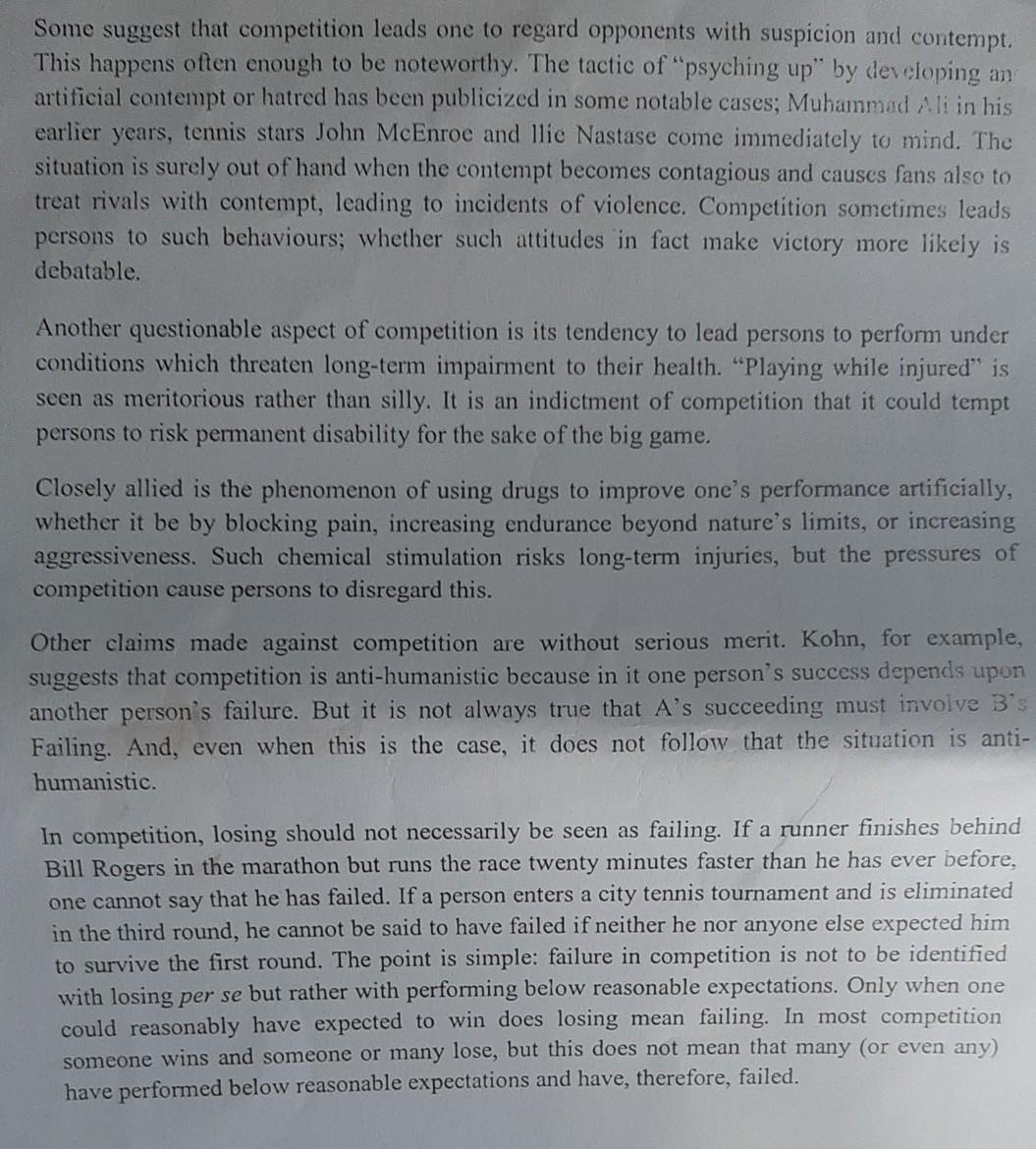
COMPETITON Competition by its very nature is always unhealthy. Rivalry of any kind is both psychologically disastrous and philosophically unjustifiable. These claims made by Alfie Kohn are too strong to be defensible. Although competition has certain negative features, there are positive aspects which should be noted. Competition is neither an unqualified evil, as Kohn would claim, nor an unqualified good, as a Vince Lombardi would have it. But it is on balance more likely to be a good than an evil. The competitive person is one whose actions indicate a concern for succeeding in situations that measure relative worth or excellence in an area. This usually involves attempting to beat another person, although it is possible to speak of persons competing against standards rather persons. Furthermore, not every attempt at beating another person counts as competition in the sense at issue here. We are interested in assessing the merits of rivalry when the rivalry is more for its own sake than for the sake of some essential good, such as one's life or the lives of loved ones. When two soldiers fight to the death in hand-to-hand combat, there is clearly rivalry, but it would unnecessarily obscure issues to regard this as competition in the same rivalry for its own sake is competition. It may be unwise to assess in one category competition for children and competition for adults. It is reasonable to suppose that children may be peculiarly liable to dangers of competitions of relatively worth in a way that adults are not, just as it is reasonable to suppose that children should not be exposed to pornography, violence, and so forth. One cannot presume that, if competition is a healthy activity on balance for the normal adult, it will also be healthy activity for the child. In order to avoid blurring what may be significantly different categories, I shall restrict this assessment of competition to only adults. Some claims against competition are valid. It can lead to cheating, whether by tempting one to fabricate sources in the course of debate or to improve one's lie on the golf course. This does not, of course, show that it must or even usually does lead to cheating, nor does it show that cheating in the context of sport makes a person more apt to cheat in non-competitive areas, as in filing an income tax return. Nonetheless, cheating, even when done only occasionally and in the context of a sport, is still morally wrong. If competitive pressure tends to incite people to commit such a wrong, then this is a mark against competition. particularly insidious aspect of cheating is the tendency of competition to obscure the very wrongness of certain actions as long as everyone is doing them. For instance, dishonest practices in college athletic recruiting have gone on for so long as the result of pressures to win that the ability of the persons involved to recognize the difference between right and wrong seems largely to have withered. It is now perceived by some schools as a part of the game to entice would be players with cars, female companionship, no-work jobs, and even altered high school transcripts. Cheating where one is aware of the wrongness of it is bad enough, but cheating to such an extent that one's moral sensibilities become anaesthetized is surely worse. Some suggest that competition leads one to regard opponents with suspicion and contempt. This happens often enough to be noteworthy. The tactic of "psyching up" by developing an artificial contempt or hatred has been publicized in some notable cases; Muhammad Ali in his earlier years, tennis stars John McEnroe and llic Nastase come immediately to mind. The situation is surely out of hand when the contempt becomes contagious and causes fans also to treat rivals with contempt, leading to incidents of violence. Competition sometimes leads persons to such behaviours, whether such attitudes in fact make victory more likely is debatable. Another questionable aspect of competition is its tendency to lead persons to perform under conditions which threaten long-term impairment to their health. "Playing while injured" is seen as meritorious rather than silly. It is an indictment of competition that it could tempt persons to risk permanent disability for the sake of the big game. Closely allied is the phenomenon of using drugs to improve one's performance artificially, whether it be by blocking pain, increasing endurance beyond nature's limits, or increasing aggressiveness. Such chemical stimulation risks long-term injuries, but the pressures of competition cause persons to disregard this. Other claims made against competition are without serious merit. Kohn, for example, suggests that competition is anti-humanistic because in it one person's success depends upon another person's failure. But it is not always true that A's succeeding must involve B's Failing. And, even when this is the case, it does not follow that the situation is anti- humanistic. In competition, losing should not necessarily be seen as failing. If a runner finishes behind Bill Rogers in the marathon but runs the race twenty minutes faster than he has ever before, one cannot say that he has failed. If a person enters a city tennis tournament and is eliminated in the third round, he cannot be said to have failed if neither he nor anyone else expected him to survive the first round. The point is simple: failure in competition is not to be identified with losing per se but rather with performing below reasonable expectations. Only when one could reasonably have expected to win does losing mean failing. In most competition someone wins and someone or many lose, but this does not mean that many (or even any) have performed below reasonable expectations and have, therefore, failed
Step by Step Solution
There are 3 Steps involved in it
1 Expert Approved Answer
Step: 1 Unlock

Question Has Been Solved by an Expert!
Get step-by-step solutions from verified subject matter experts
Step: 2 Unlock
Step: 3 Unlock