







Question: summarize the attached article section Education and training Research studies on education and training as primary preventive strategies mainly stem from disciplines such as pedagogy.
summarize the attached article section 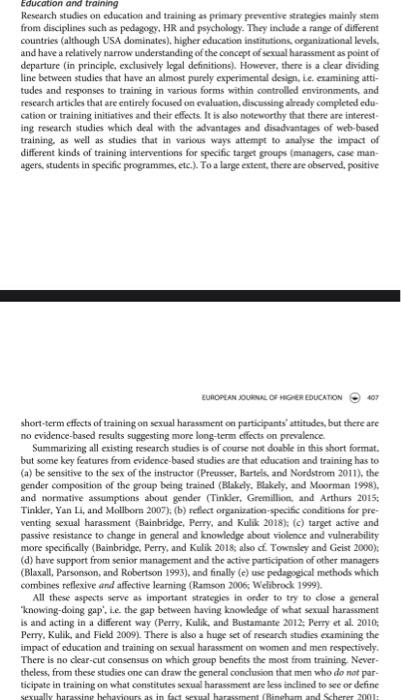
Education and training Research studies on education and training as primary preventive strategies mainly stem from disciplines such as pedagogy. HR and psychology. They include a range of different countries (although USA dominates), higher education institutions organizational levels, and have a relatively narrow understanding of the concept of sexual harassment as point of departure (in principle, exclusively legal definitions). However, there is a clear dividing line between studies that have an almost purely experimental design. Lc. examining atti- tudes and responses to training in various forms within controlled environments, and research articles that are entirely focused on evaluation, discussing already completed edu- cation or training initiatives and their effects. It is also noteworthy that there are interest ing research studies which deal with the advantages and disadvantages of web-based training, as well as studies that in various ways attempt to analyse the impact of different kinds of training interventions for specific target groups (managers, case man- agers, students in specific programmes, etc.). To a large extent, there are observed, positive 407 LUHOPLAN JOURNAL OF HIGHER EDUCATION short-term effects of training on sexual harassment on participants' attitudes, but there are no evidence-based results suggesting more long-term effects on prevalence Summarizing all existing research studies is of course not doable in this short format. but some key features from evidence-based studies are that education and training has to (a) be sensitive to the sex of the instructor (Preusser, Bartels and Nordstrom 2011), the gender composition of the group being trained (Blakely, Blakely, and Moorman 1998). and normative assumptions about gender (Tinker. Gremillion and Arthurs 2015: Tinkler, Yan Li, and Mollbom 2007), (b) reflect organization-specific conditions for pre- venting sexual harassment (Bainbridge, Perry, and Kulik 2018): (c) target active and passive resistance to change in general and knowledge about violence and vulnerability more specifically (Bainbridge. Perry, and Kulik 2018 also & Townsley and Geist 2000) (d) have support from senior management and the active participation of other managers (Blaxall, Parsonson, and Robertson 1993), and finally (e) use pedagogical methods which combines reflexive and affective learning (Ramson 2006 Welbrock 1999). All these aspects serve as important strategies in order to try to close a general "knowing-doing gap. ie the gap between having knowledge of what sexual harassment is and acting in a different way (Perry, Kulik, and Bustamante 2012: Perry et al. 2010, Perry. Kulik, and Field 2009). There is also a huge set of research studies camining the impact of education and training on sexual harassment on women and men respectively. There is no clear-cut consensus on which group benefits the most from training. Never- theless, from these studies one can draw the general conclusion that men who do not par- ticipate in training on what constitutes sexual harassment are less inclined to see or define sexually harassine behaviours as in dual harassment (Rineham and Scherer 2001
Step by Step Solution
There are 3 Steps involved in it
1 Expert Approved Answer
Step: 1 Unlock

Question Has Been Solved by an Expert!
Get step-by-step solutions from verified subject matter experts
Step: 2 Unlock
Step: 3 Unlock
 Study Help