







Question: summarize the attached article section When reviewing studies on prevalence of sexual harassment in higher education we conclude that well-cited, international studies also show a
summarize the attached article section 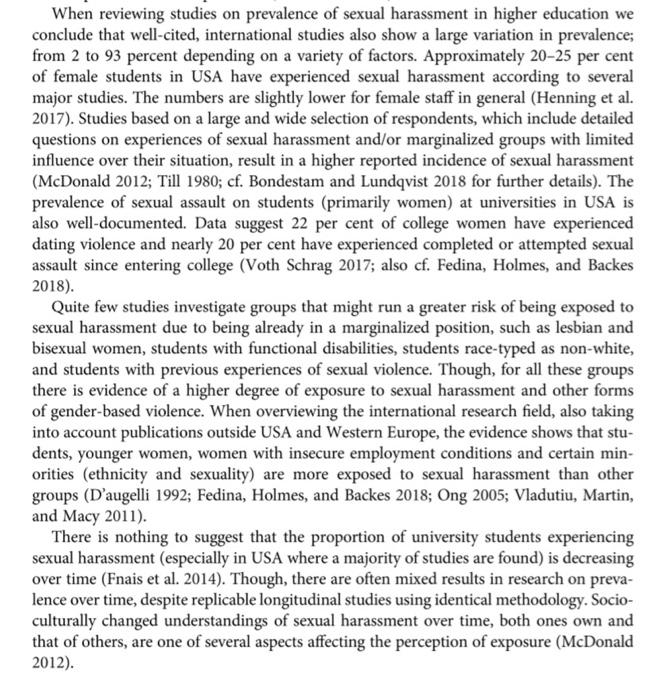
When reviewing studies on prevalence of sexual harassment in higher education we conclude that well-cited, international studies also show a large variation in prevalence; from 2 to 93 percent depending on a variety of factors. Approximately 20-25 per cent of female students in USA have experienced sexual harassment according to several major studies. The numbers are slightly lower for female staff in general (Henning et al. 2017). Studies based on a large and wide selection of respondents, which include detailed questions on experiences of sexual harassment and/or marginalized groups with limited influence over their situation, result in a higher reported incidence of sexual harassment (McDonald 2012; Till 1980; cf. Bondestam and Lundqvist 2018 for further details). The prevalence of sexual assault on students (primarily women) at universities in USA is also well-documented. Data suggest 22 per cent of college women have experienced dating violence and nearly 20 per cent have experienced completed or attempted sexual assault since entering college (Voth Schrag 2017; also cf. Fedina, Holmes, and Backes 2018). Quite few studies investigate groups that might run a greater risk of being exposed to sexual harassment due to being already in a marginalized position, such as lesbian and bisexual women, students with functional disabilities, students race-typed as non-white, and students with previous experiences of sexual violence. Though, for all these groups there is evidence of a higher degree of exposure to sexual harassment and other forms of gender-based violence. When overviewing the international research field, also taking into account publications outside USA and Western Europe, the evidence shows that stu- dents, younger women, women with insecure employment conditions and certain min- orities (ethnicity and sexuality) are more exposed to sexual harassment than other groups (D'augelli 1992; Fedina, Holmes, and Backes 2018; Ong 2005; Vladutiu, Martin, and Macy 2011). There is nothing to suggest that the proportion of university students experiencing sexual harassment (especially in USA where a majority of studies are found) is decreasing over time (Fnais et al. 2014). Though, there are often mixed results in research on preva- lence over time, despite replicable longitudinal studies using identical methodology. Socio- culturally changed understandings of sexual harassment over time, both ones own and that of others, are one of several aspects affecting the perception of exposure (McDonald 2012)
Step by Step Solution
There are 3 Steps involved in it
1 Expert Approved Answer
Step: 1 Unlock

Question Has Been Solved by an Expert!
Get step-by-step solutions from verified subject matter experts
Step: 2 Unlock
Step: 3 Unlock
 Study Help