Question: summary for the case study please INTERACTIVE SESSION: ORGANIZATIONS New Systems and Business Processes Put MoneyGram On the Money If you use PayPal, you may
summary for the case study please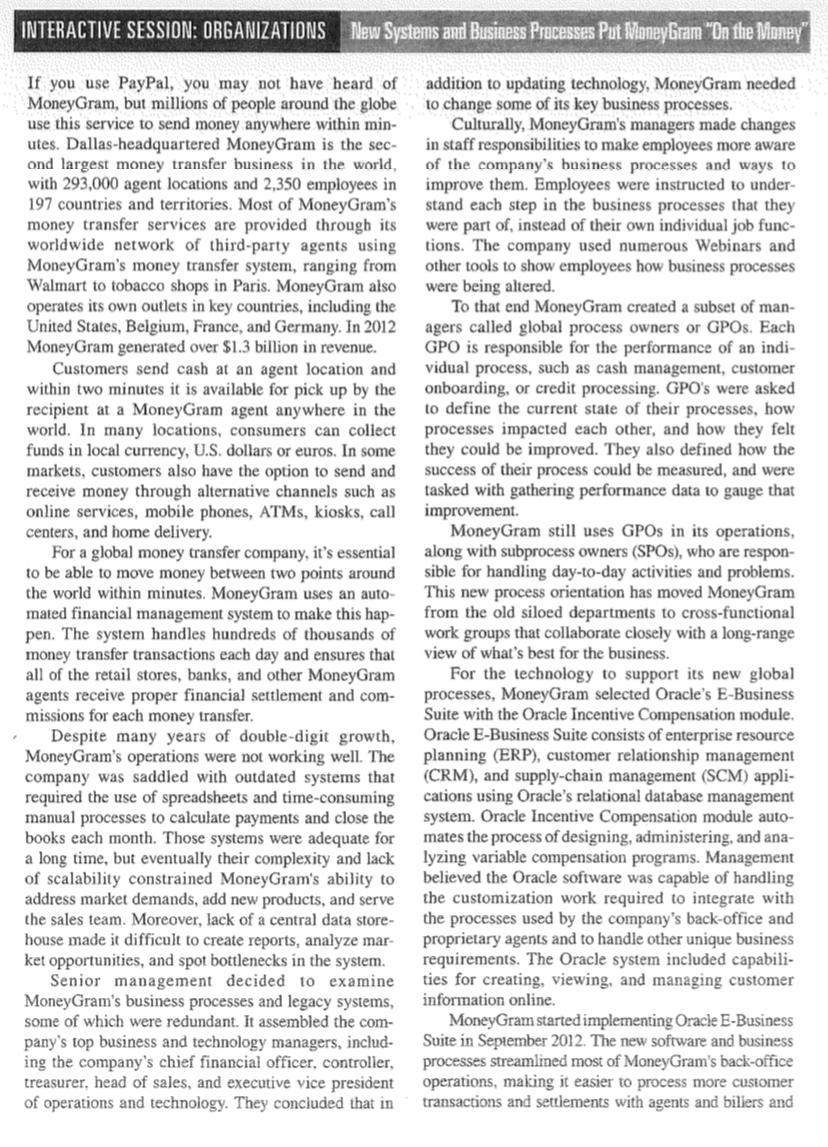
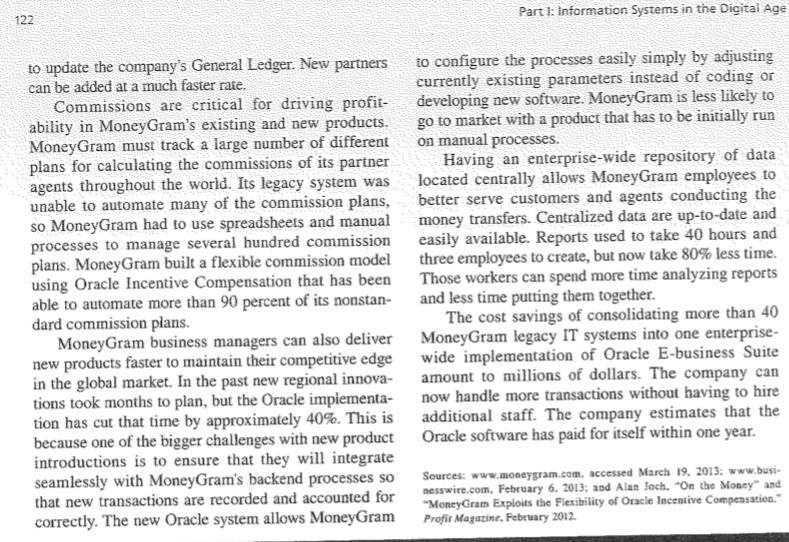
INTERACTIVE SESSION: ORGANIZATIONS New Systems and Business Processes Put MoneyGram "On the Money" If you use PayPal, you may not have heard of MoneyGram, but millions of people around the globe use this service to send money anywhere within min- utes. Dallas-headquartered MoneyGram is the sec- ond largest money transfer business in the world, with 293,000 agent locations and 2,350 employees in 197 countries and territories. Most of MoneyGram's money transfer services are provided through its worldwide network of third-party agents using MoneyGram's money transfer system, ranging from Walmart to tobacco shops in Paris. MoneyGram also operates its own outlets in key countries, including the United States, Belgium, France, and Germany. In 2012 MoneyGram generated over $1.3 billion in revenue. Customers send cash at an agent location and within two minutes it is available for pick up by the recipient at a MoneyGram agent anywhere in the world. In many locations, consumers can collect funds in local currency, U.S. dollars or euros. In some markets, customers also have the option to send and receive money through alternative channels such as online services, mobile phones, ATMs, kiosks, call centers, and home delivery. For a global money transfer company, it's essential to be able to move money between two points around the world within minutes. MoneyGram uses an auto- mated financial management system to make this hap- pen. The system handles hundreds of thousands of money transfer transactions each day and ensures that all of the retail stores, banks, and other MoneyGram agents receive proper financial settlement and com- missions for each money transfer. Despite many years of double-digit growth, MoneyGram's operations were not working well. The company was saddled with outdated systems that required the use of spreadsheets and time-consuming manual processes to calculate payments and close the books each month. Those systems were adequate for a long time, but eventually their complexity and lack of scalability constrained MoneyGram's ability to address market demands, add new products, and serve the sales team. Moreover, lack of a central data store- house made it difficult to create reports, analyze mar- ket opportunities, and spot bottlenecks in the system. Senior management decided to examine MoneyGram's business processes and legacy systems, some of which were redundant. It assembled the com- pany's top business and technology managers, includ. ing the company's chief financial officer, controller, treasurer, head of sales, and executive vice president of operations and technology. They concluded that in addition to updating technology, MoneyGram needed to change some of its key business processes. Culturally, MoneyGram's managers made changes in staff responsibilities to make employees more aware of the company's business processes and ways to improve them. Employees were instructed to under- stand each step in the business processes that they were part of, instead of their own individual job func- tions. The company used numerous Webinars and other tools to show employees how business processes were being altered To that end MoneyGram created a subset of man- agers called global process owners or GPOs. Each GPO is responsible for the performance of an indi- vidual process, such as cash management, customer onboarding, or credit processing. GPO's were asked to define the current state of their processes, how processes impacted each other, and how they felt they could be improved. They also defined how the success of their process could be measured, and were tasked with gathering performance data to gauge that improvement MoneyGram still uses GPOs in its operations, along with subprocess owners (SPOs), who are respon- sible for handling day-to-day activities and problems. This new process orientation has moved MoneyGram from the old siloed departments to cross-functional work groups that collaborate closely with a long-range view of what's best for the business. For the technology to support its new global processes, MoneyGram selected Oracle's E-Business Suite with the Oracle Incentive Compensation module. Oracle E-Business Suite consists of enterprise resource planning (ERP), customer relationship management (CRM), and supply-chain management (SCM) appli- cations using Oracle's relational database management system. Oracle Incentive Compensation module auto- mates the process of designing, administering, and ana- lyzing variable compensation programs. Management believed the Oracle software was capable of handling the customization work required to integrate with the processes used by the company's back-office and proprietary agents and to handle other unique business requirements. The Oracle system included capabili- ties for creating, viewing, and managing customer information online. MoneyGram started implementing Oracle E-Business Suite in September 2012. The new software and business processes streamlined most of MoneyGram's back-office operations, making it easier to process more customer transactions and settlements with agents and billers and Part I: Information Systems in the Digital Age 122 to update the company's General Ledger. New partners can be added at a much faster rate. Commissions are critical for driving profit- ability in MoneyGram's existing and new products. MoneyGram must track a large number of different plans for calculating the commissions of its partner agents throughout the world. Its legacy system was unable to automate many of the commission plans, so MoneyGram had to use spreadsheets and manual processes to manage several hundred commission plans. MoneyGram built a flexible commission model using Oracle Incentive Compensation that has been able to automate more than 90 percent of its nonstan- dard commission plans. MoneyGram business managers can also deliver new products faster to maintain their competitive edge in the global market. In the past new regional innova- tions took months to plan, but the Oracle implementa- tion has cut that time by approximately 40%. This is because one of the bigger challenges with new product introductions is to ensure that they will integrate seamlessly with MoneyGram's backend processes so that new transactions are recorded and accounted for correctly. The new Oracle system allows MoneyGram to configure the processes easily simply by adjusting currently existing parameters instead of coding or developing new software. MoneyGram is less likely to go to market with a product that has to be initially run on manual processes. Having an enterprise-wide repository of data located centrally allows MoneyGram employees to better serve customers and agents conducting the money transfers. Centralized data are up-to-date and easily available. Reports used to take 40 hours and three employees to create, but now take 80% less time. Those workers can spend more time analyzing reports and less time putting them together. The cost savings of consolidating more than 40 MoneyGram legacy IT systems into one enterprise- wide implementation of Oracle E-business Suite amount to millions of dollars. The company can now handle more transactions without having to hire additional staff. The company estimates that the Oracle software has paid for itself within one year. Sources: www.moneygram.com. accessed March 19, 2013: www.busi- nesswire.com, February 6, 2013, and Alan Joch. "On the Money and "MoneyGram Exploits the Flexibility of Oracle Incentive Compensation." Profis Magazine, February 2012









 Study Help