



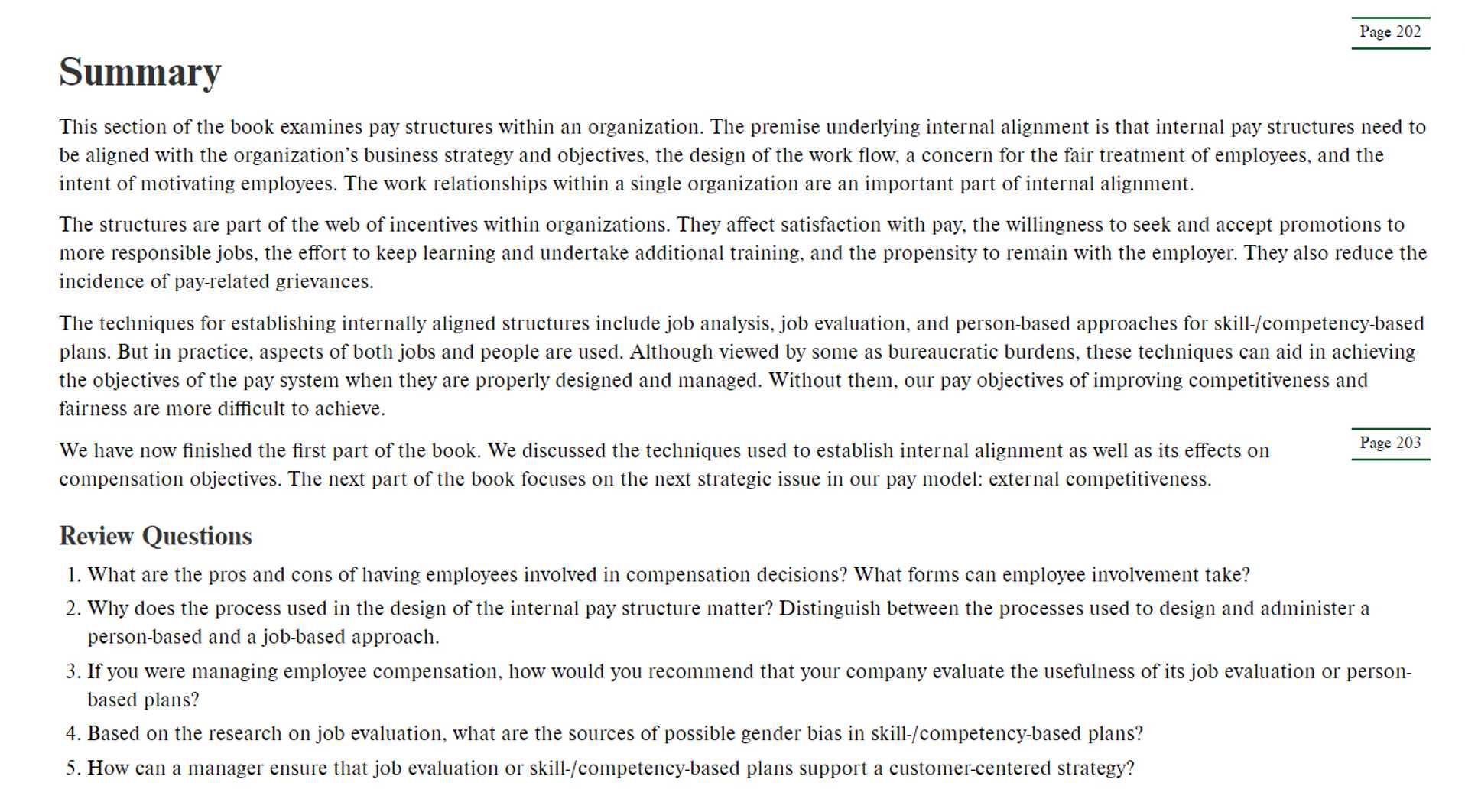
Question: Summary This section of the book examines pay structures within an organization. The premise underlying internal alignment is that internal pay structures need to be
Summary
This section of the book examines pay structures within an organization. The premise underlying internal alignment is that internal pay structures need to
be aligned with the organization's business strategy and objectives, the design of the work flow, a concern for the fair treatment of employees, and the
intent of motivating employees. The work relationships within a single organization are an important part of internal alignment.
The structures are part of the web of incentives within organizations. They affect satisfaction with pay, the willingness to seek and accept promotions to
more responsible jobs, the effort to keep learning and undertake additional training, and the propensity to remain with the employer. They also reduce the
incidence of payrelated grievances.
The techniques for establishing internally aligned structures include job analysis, job evaluation, and personbased approaches for skillcompetencybased
plans. But in practice, aspects of both jobs and people are used. Although viewed by some as bureaucratic burdens, these techniques can aid in achieving
the objectives of the pay system when they are properly designed and managed. Without them, our pay objectives of improving competitiveness and
fairness are more difficult to achieve.
We have now finished the first part of the book. We discussed the techniques used to establish internal alignment as well as its effects on
compensation objectives. The next part of the book focuses on the next strategic issue in our pay model: external competitiveness.
Review Questions
What are the pros and cons of having employees involved in compensation decisions? What forms can employee involvement take?
Why does the process used in the design of the internal pay structure matter? Distinguish between the processes used to design and administer a
personbased and a jobbased approach.
If you were managing employee compensation, how would you recommend that your company evaluate the usefulness of its job evaluation or person
based plans?
Based on the research on job evaluation, what are the sources of possible gender bias in skillcompetencybased plans?
How can a manager ensure that job evaluation or skillcompetencybased plans support a customercentered strategy?
Step by Step Solution
There are 3 Steps involved in it
1 Expert Approved Answer
Step: 1 Unlock

Question Has Been Solved by an Expert!
Get step-by-step solutions from verified subject matter experts
Step: 2 Unlock
Step: 3 Unlock