







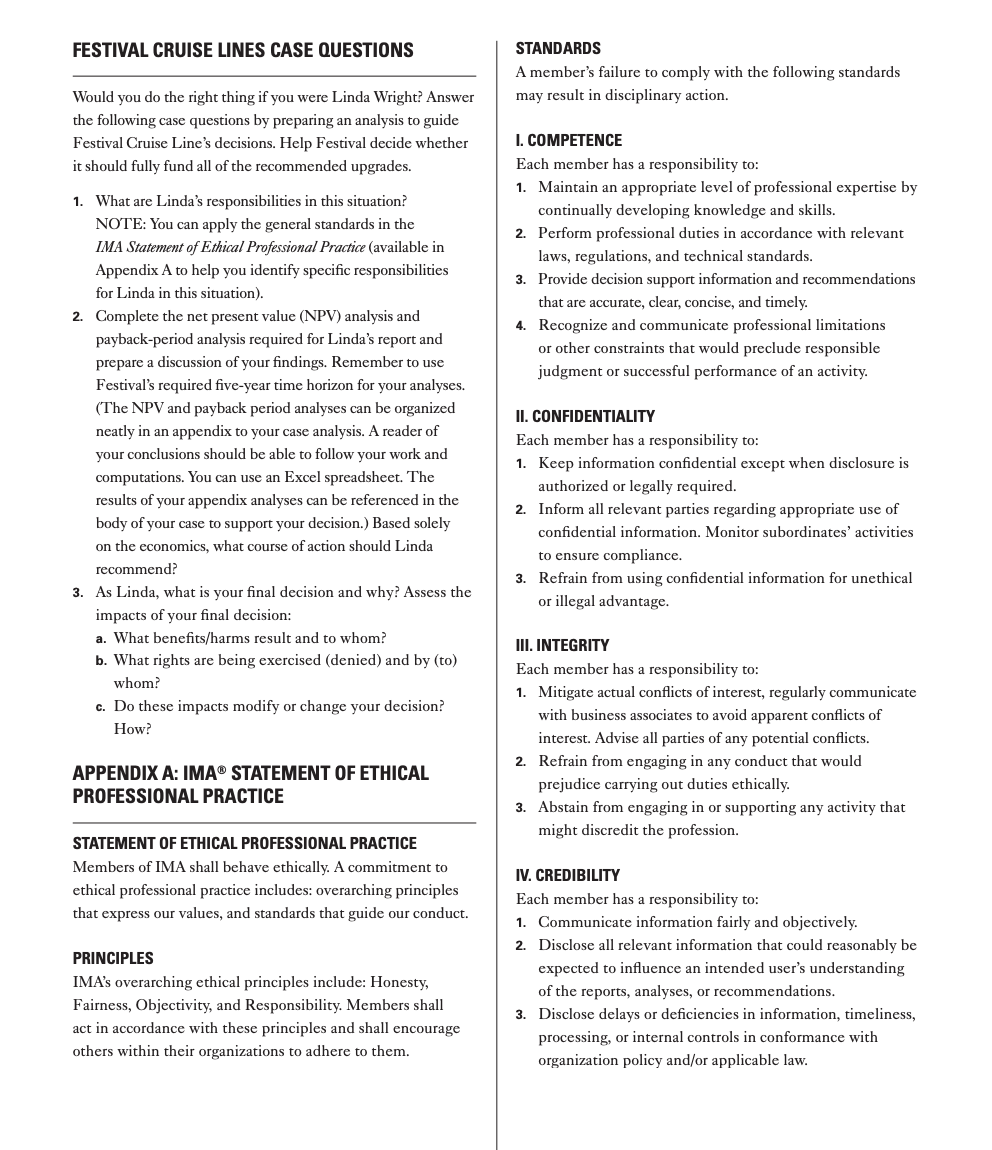
Question: Sunk Costs: What Do You Sea? the following case questions by preparing an analysis to guide Festival Cruise Line 's decisions. Help Festival decide whether
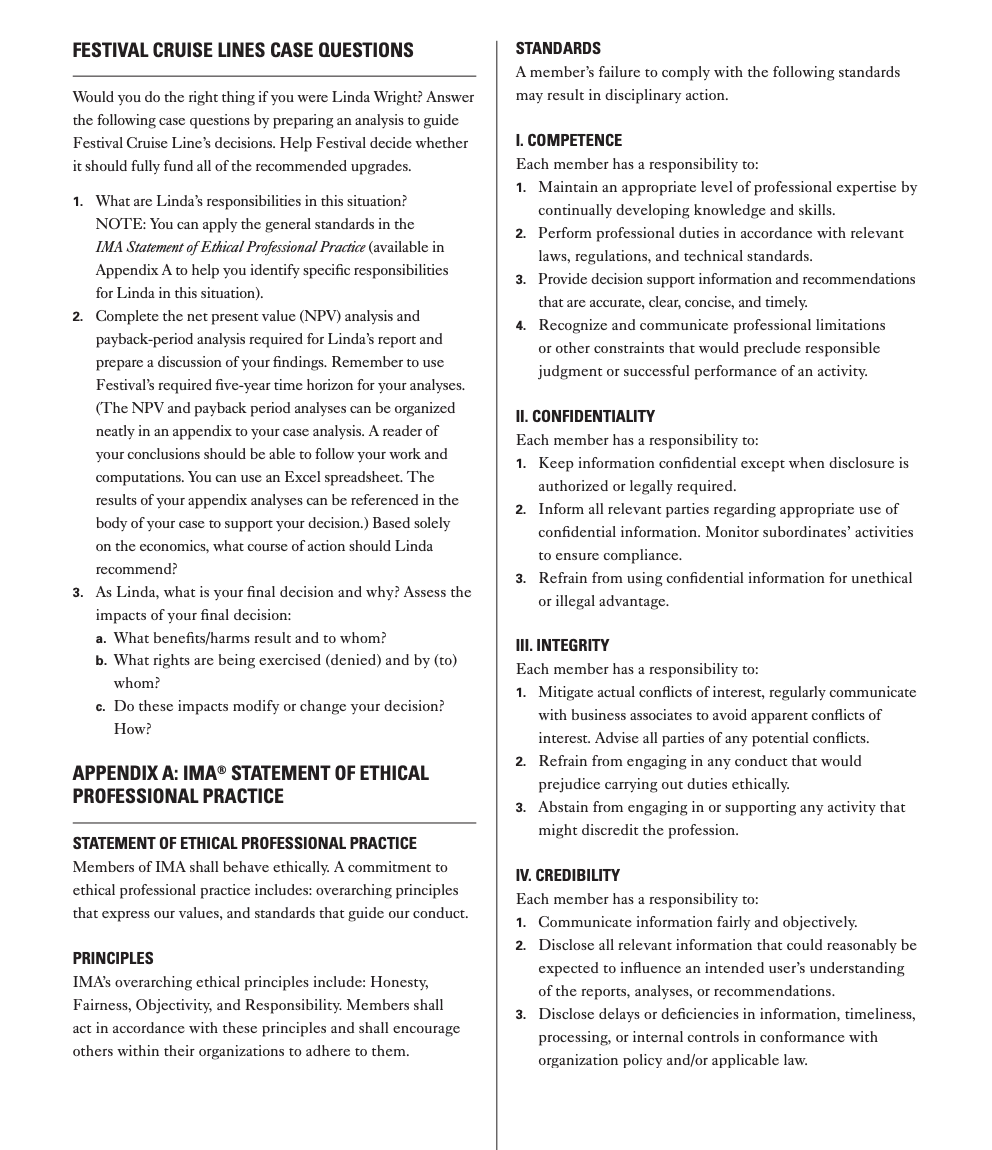
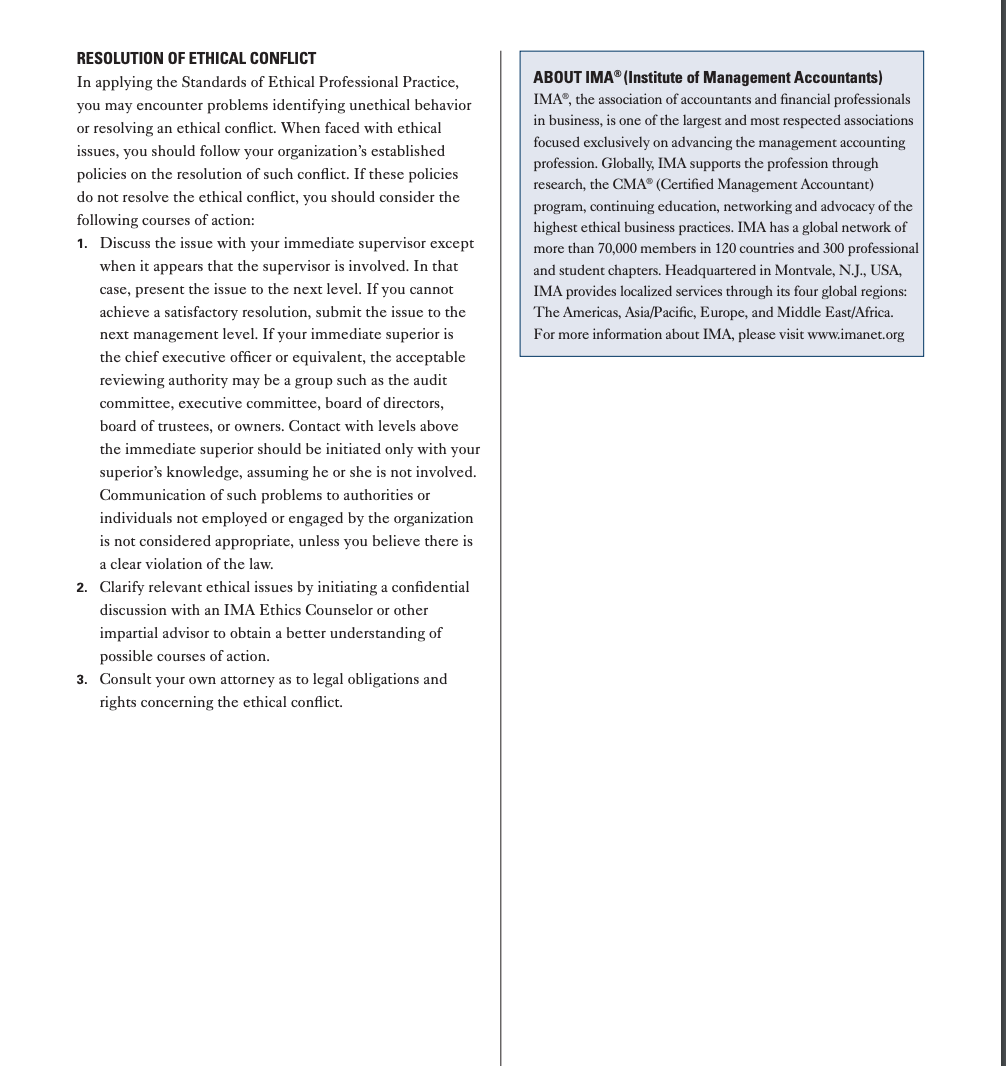
Sunk Costs: What Do You Sea? the following case questions by preparing an analysis to guide Festival Cruise Line's decisions. Help Festival decide whether it should fully fund all of the recommended upgrades. 1. What are Linda's responsibilities in this situation? NOTE: You can apply the general standards in the IMA Statement of Ethical Professional Practice (available in Appendix A to help you identify specific responsibilities for Linda in this situation). 2. Complete the net present value (NPV) analysis and payback-period analysis required for Linda's report and prepare a discussion of your findings. Remember to use Festival's required five-year time horizon for your analyses. (The NPV and payback period analyses can be organized neatly in an appendix to your case analysis. A reader of your conclusions should be able to follow your work and computations. You can use an Excel spreadsheet. The results of your appendix analyses can be referenced in the body of your case to support your decision.) Based solely on the economics, what course of action should Linda recommend? 3. As Linda, what is your final decision and why? Assess the impacts of your final decision: a. What benefits/harms result and to whom? b. What rights are being exercised (denied) and by (to) whom? c. Do these impacts modify or change your decision? How?
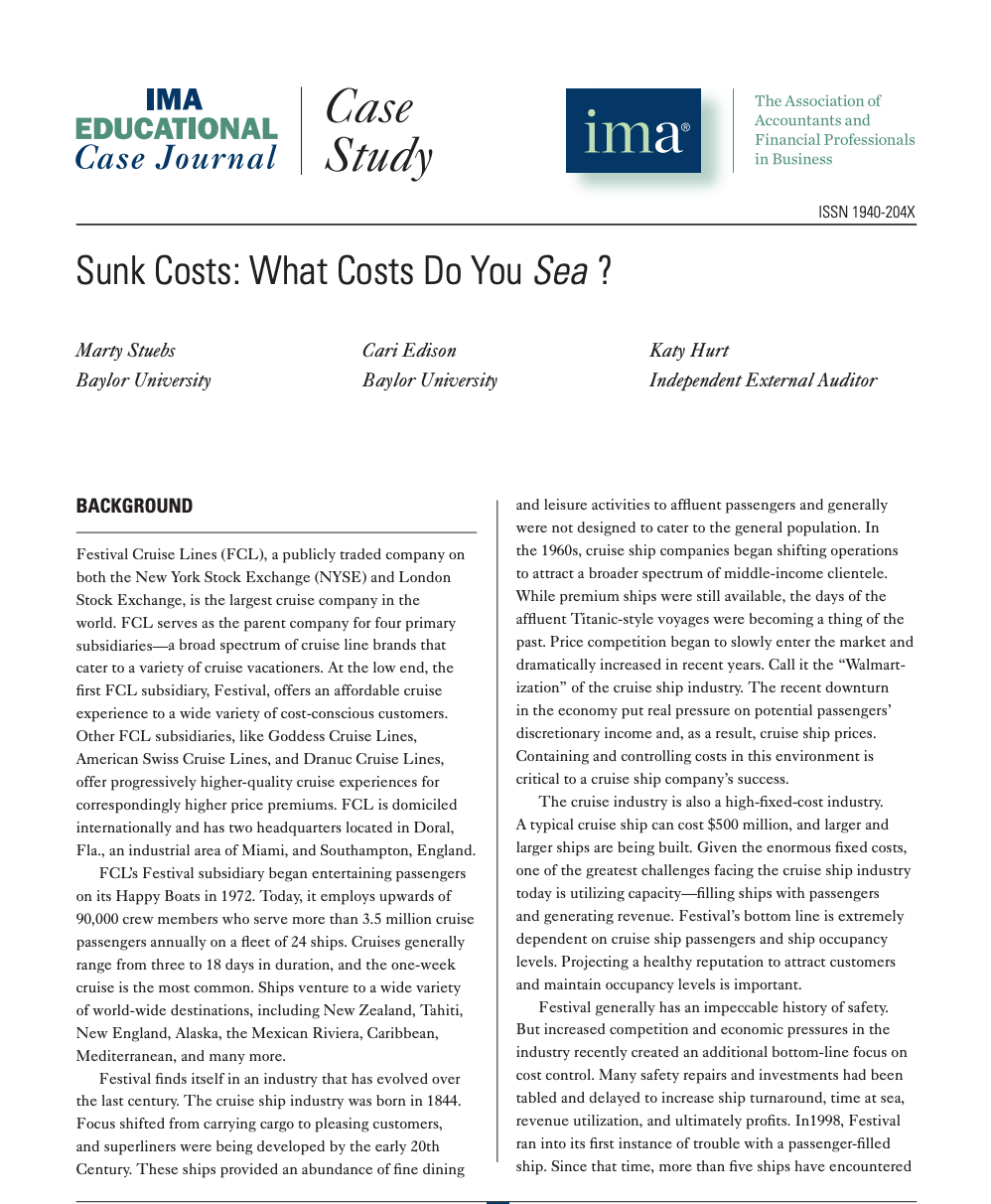
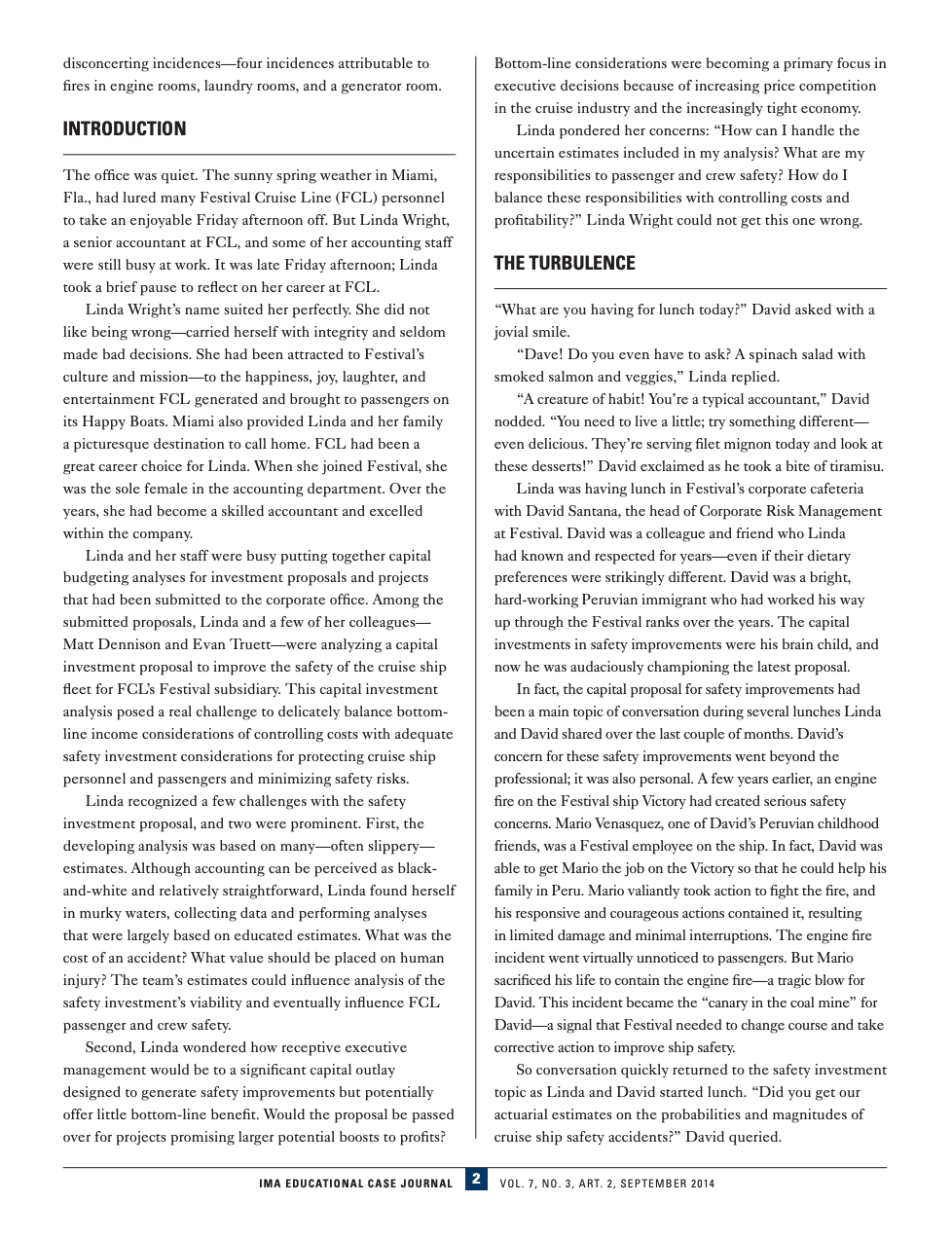
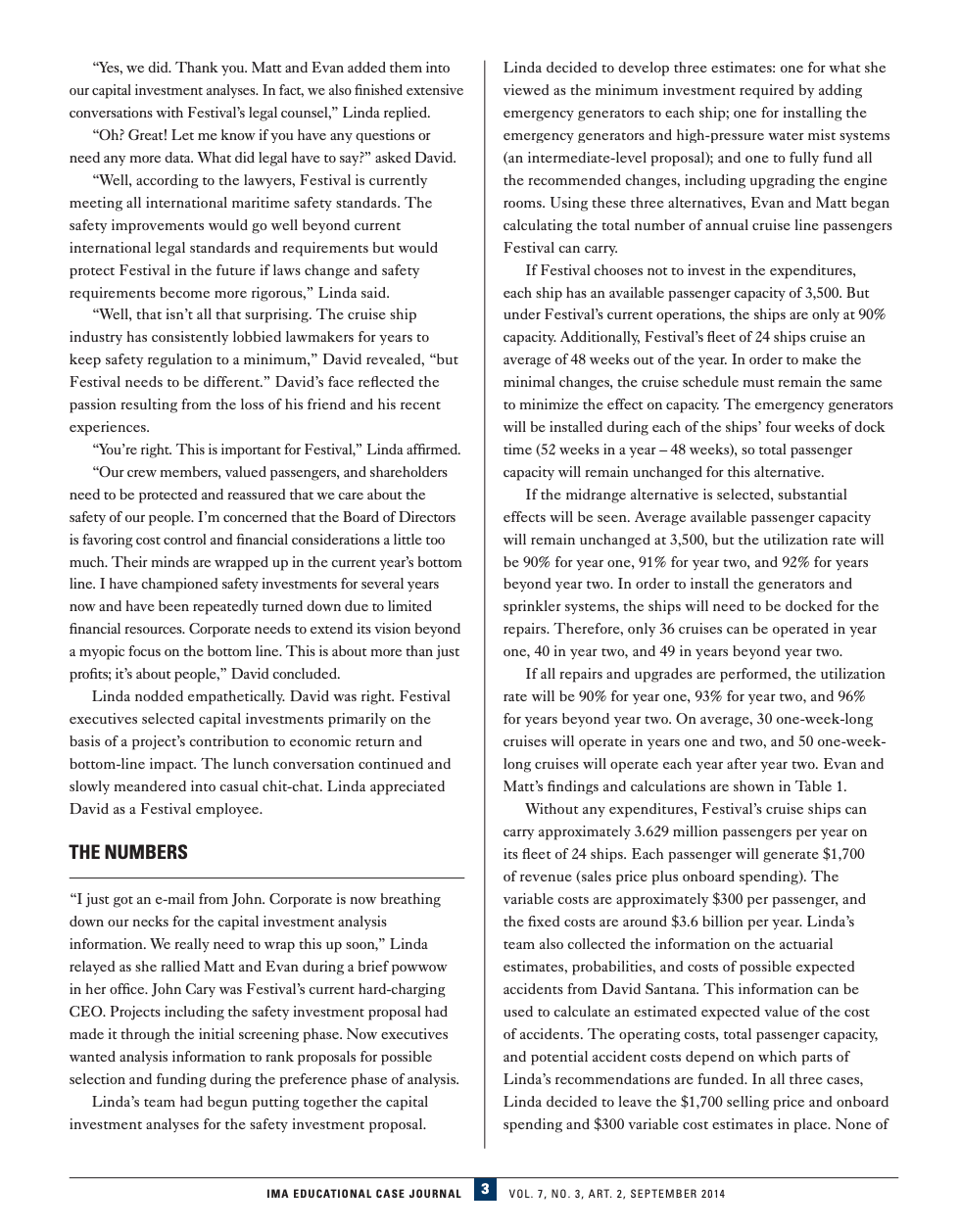
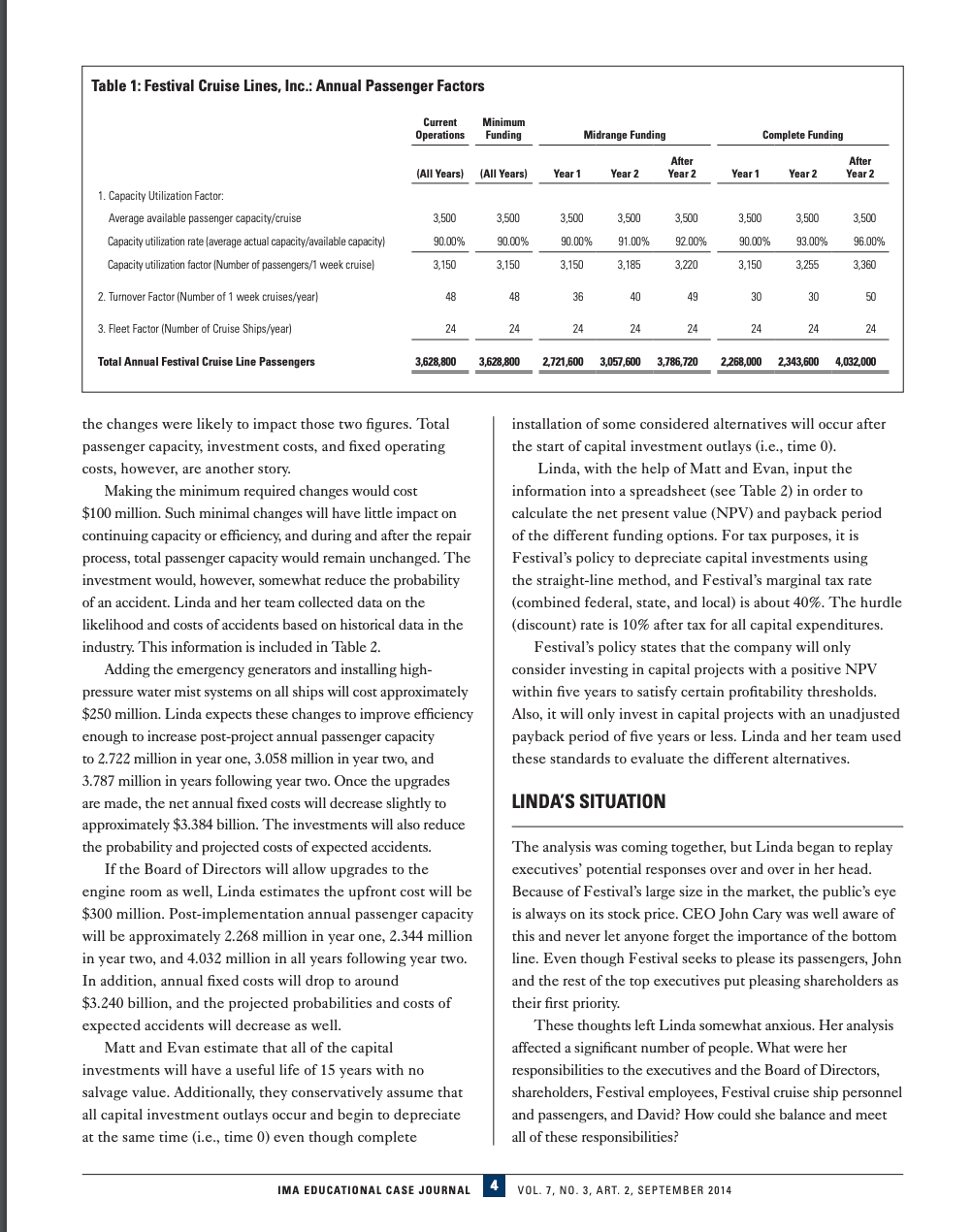
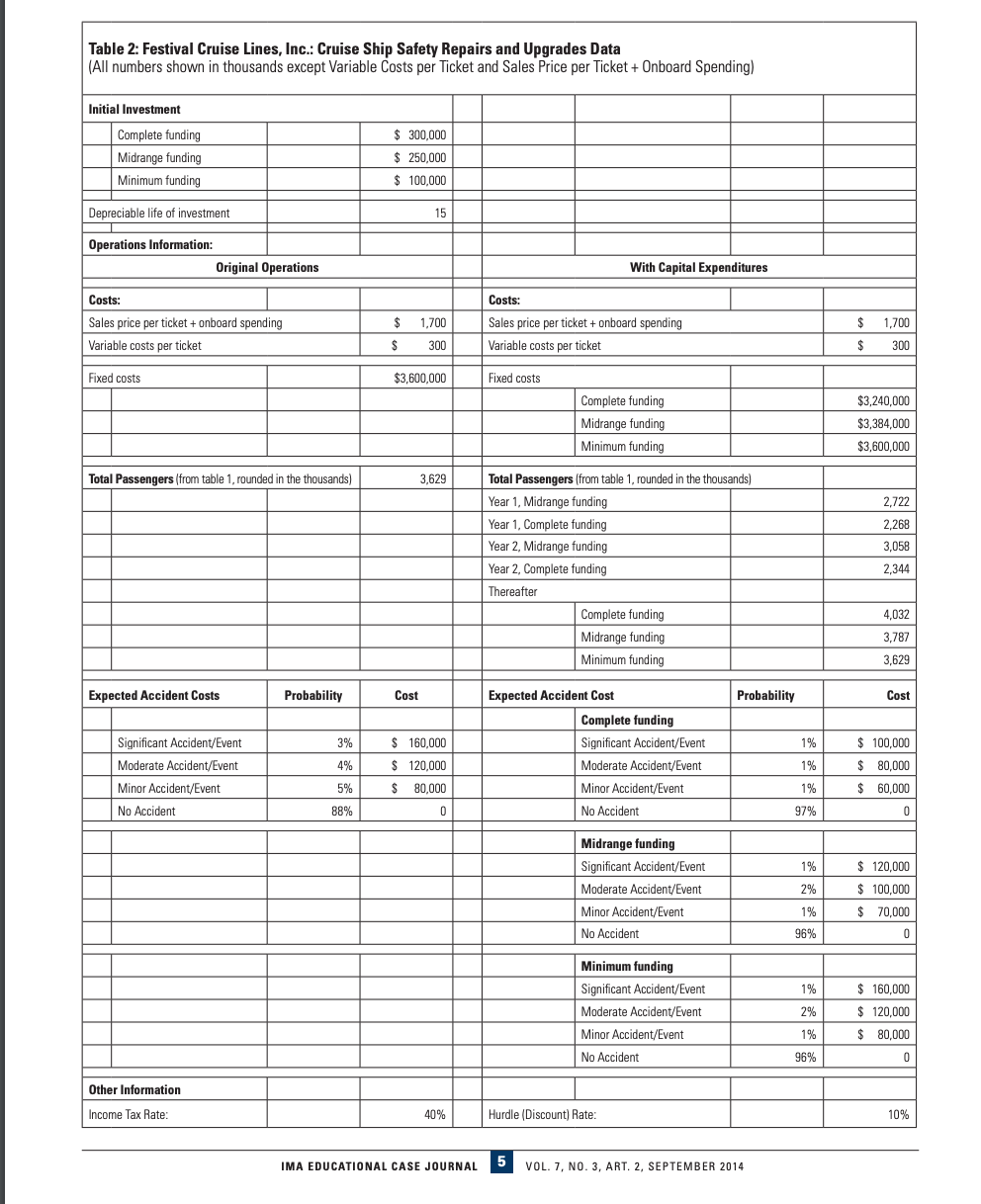
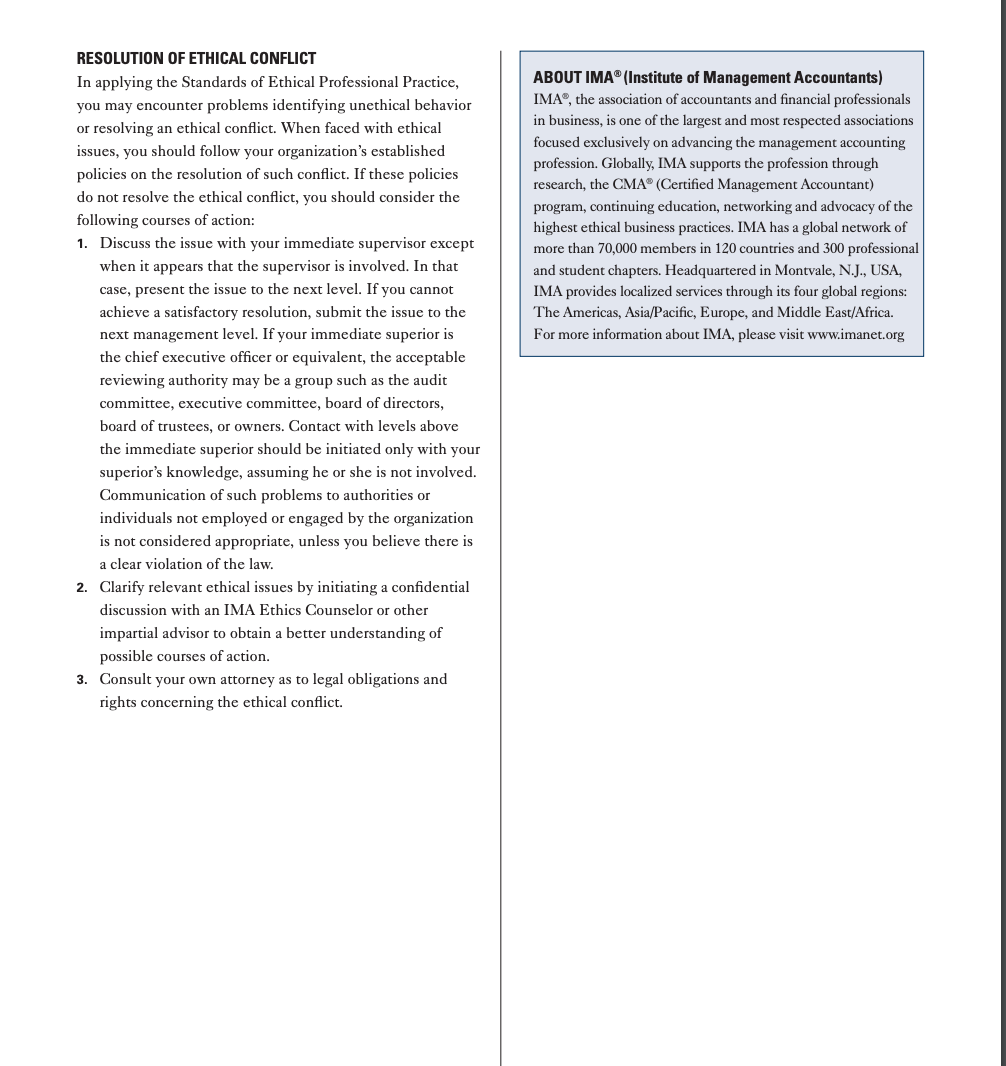
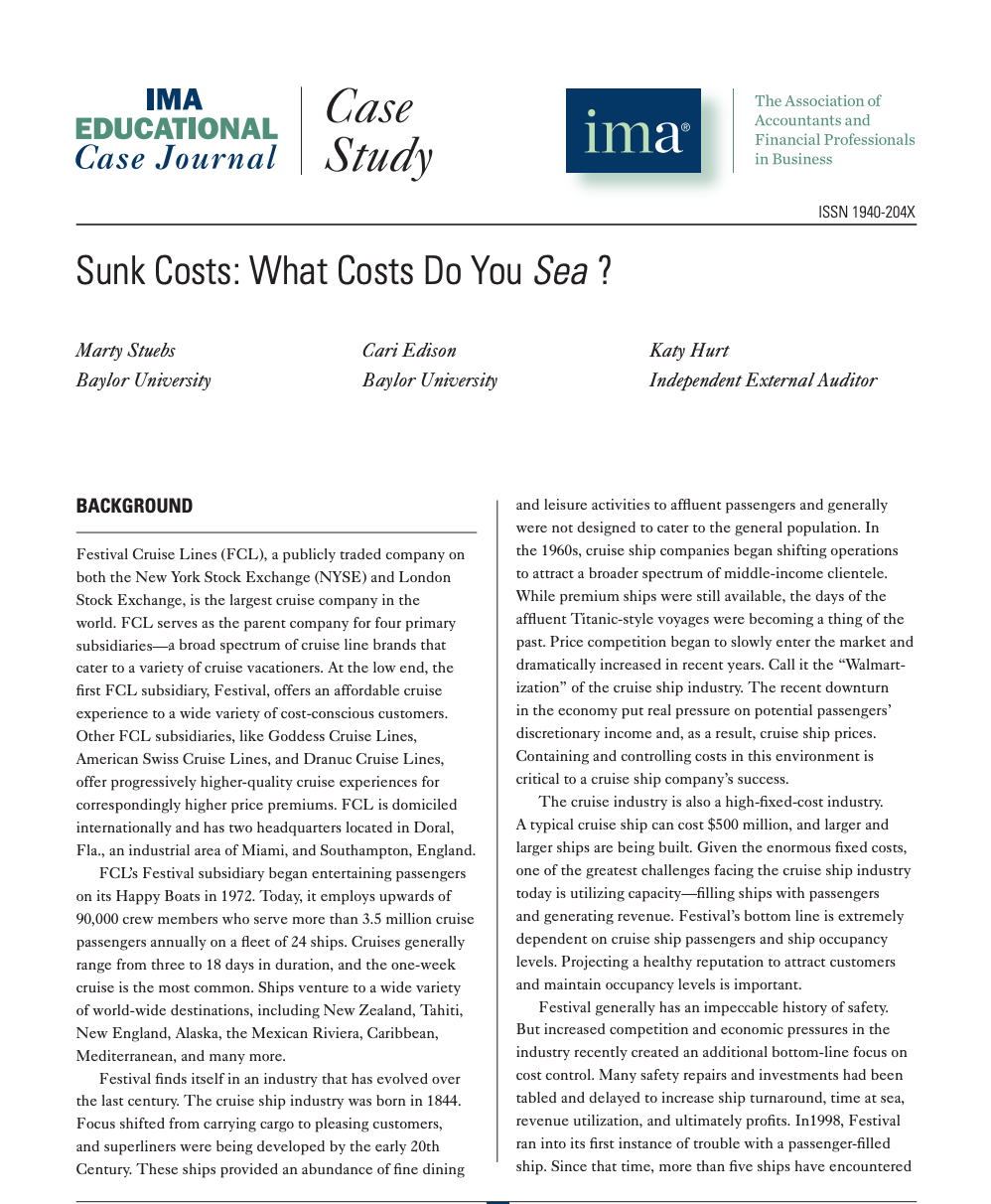
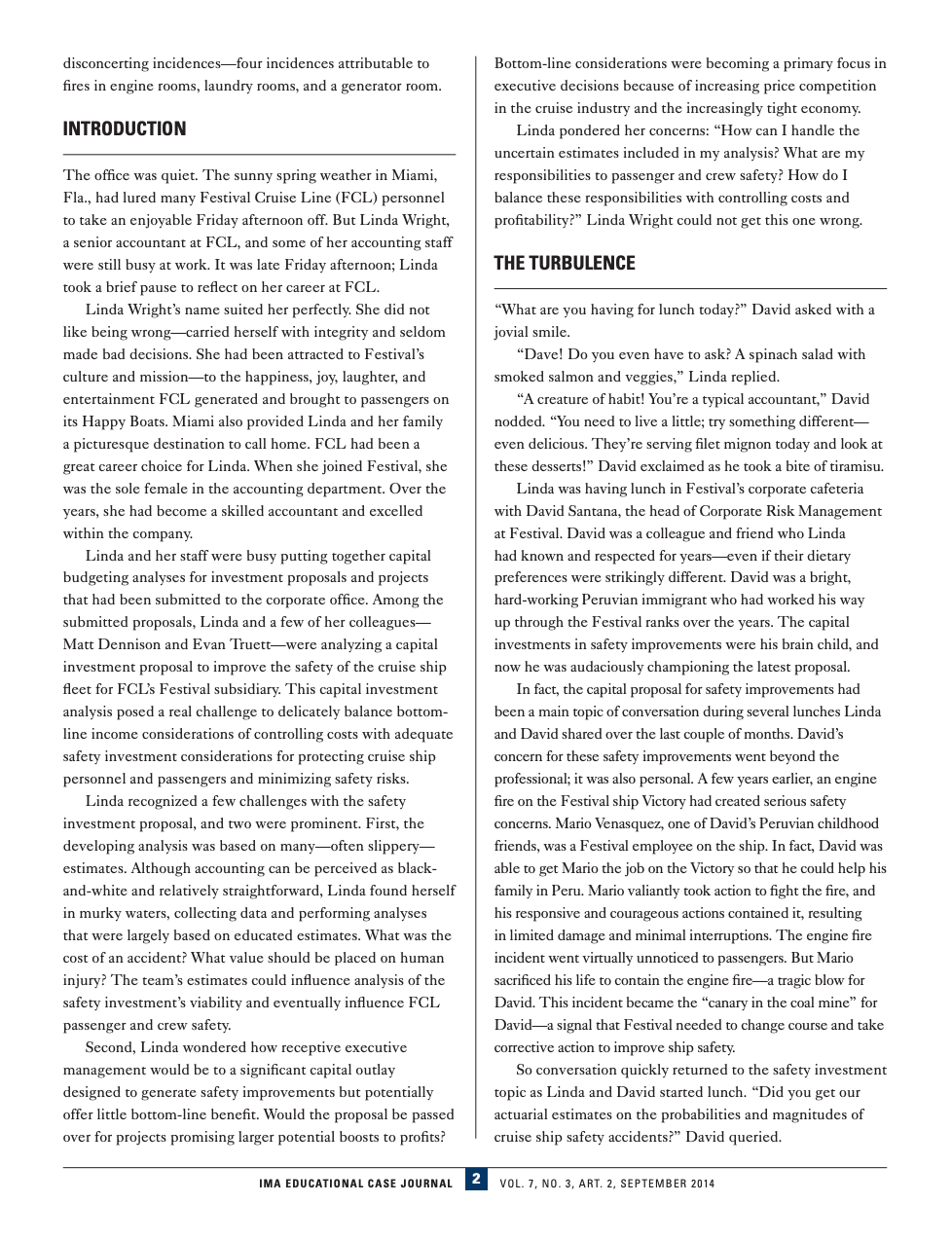
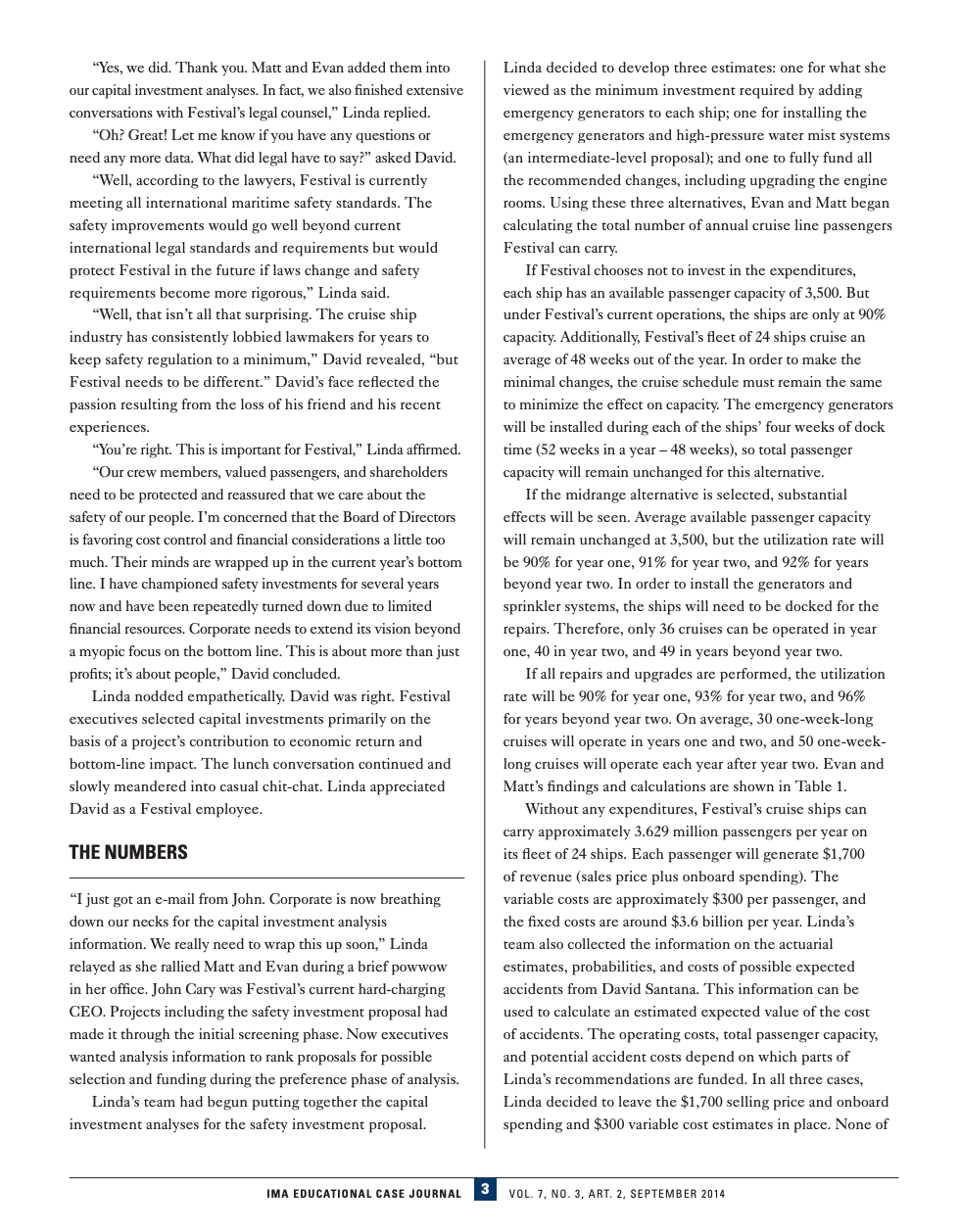
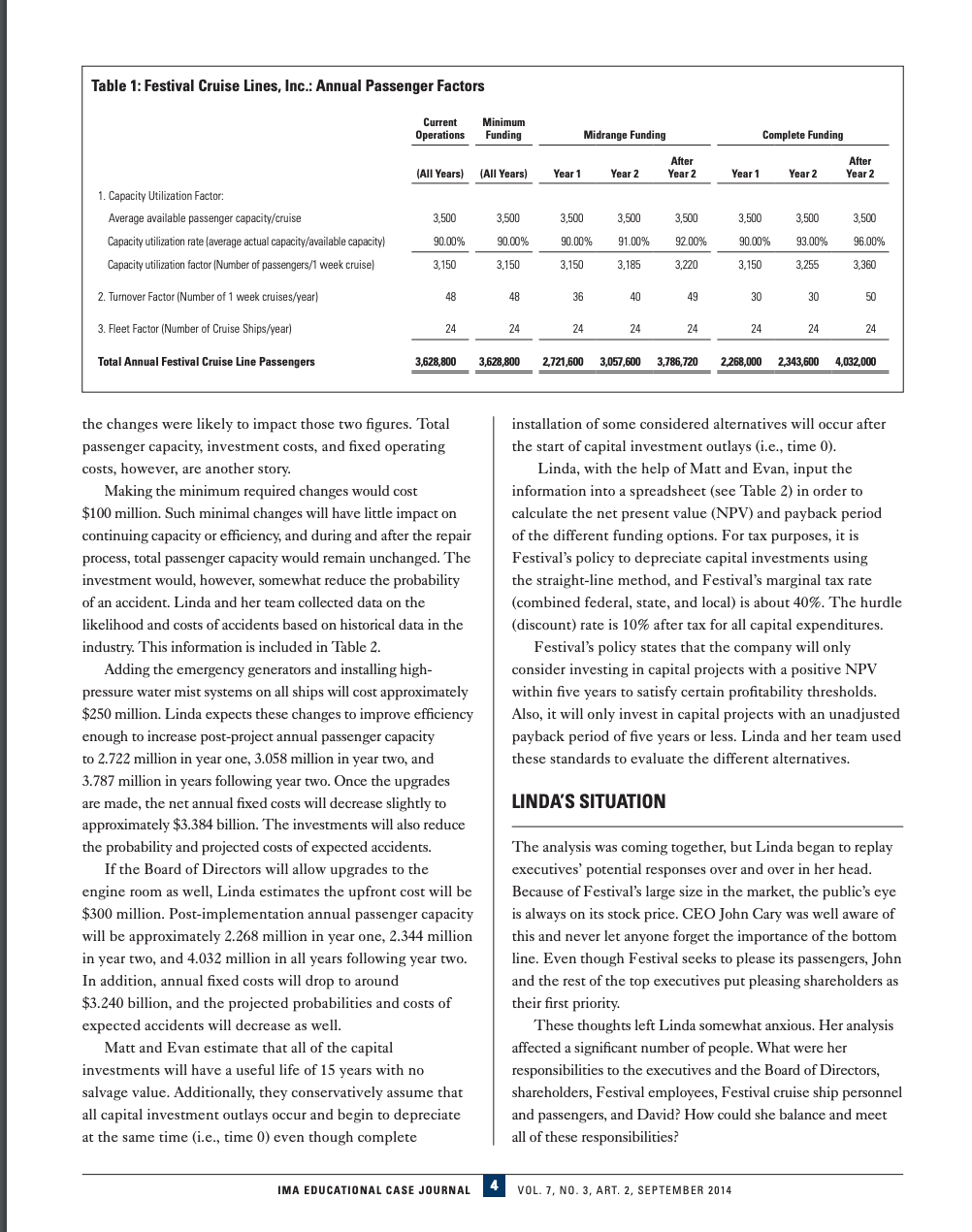
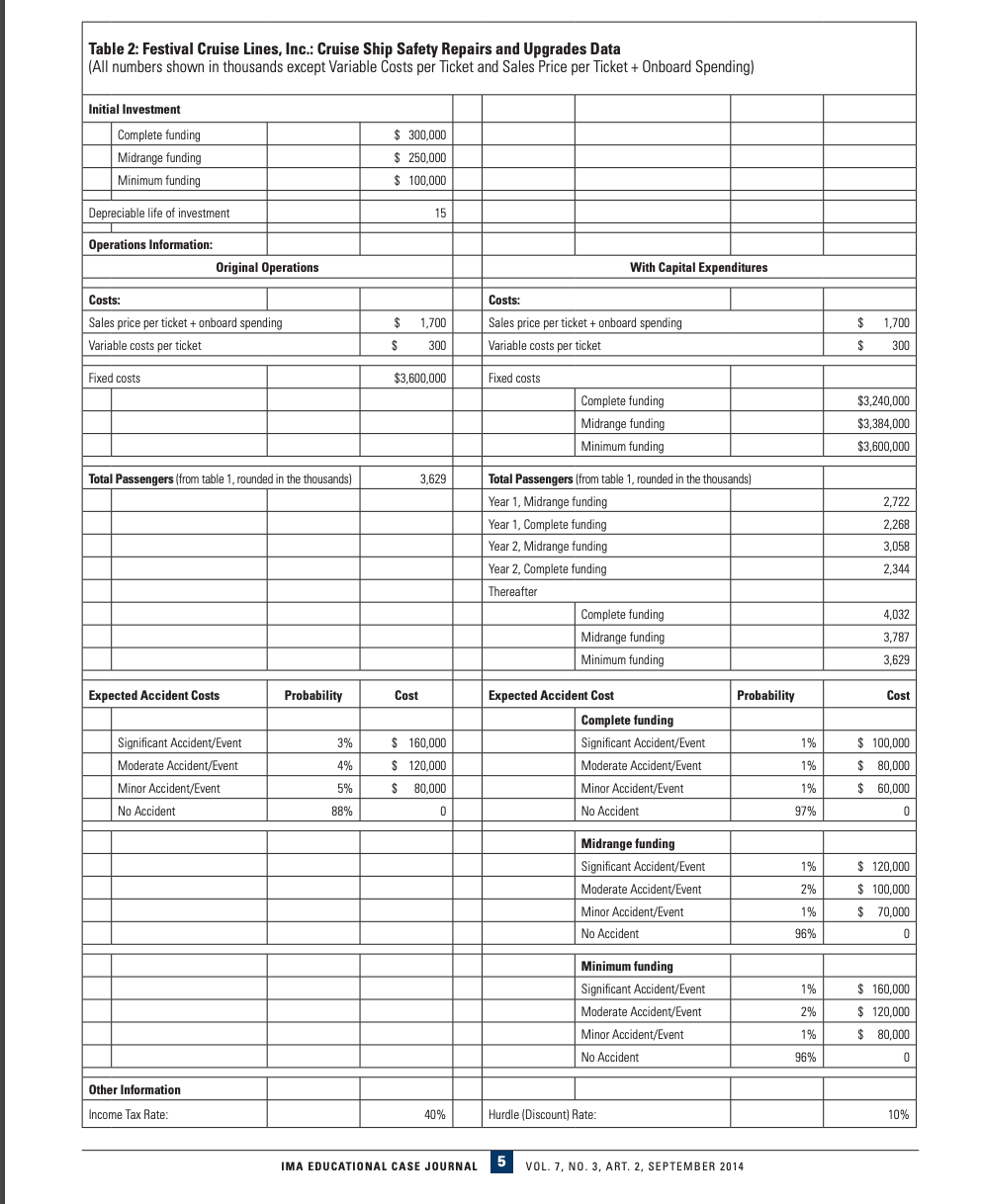
I'MA EDUCATIONAL Case The Association of Accountants and* Case Journal Study Financial Professionals in Business ISSN 1940 - 204X) Sunk Costs : What Costs Do You Sea ?! Marty Stuebs Cari Edison Katy Hurt Baylor University Baylor University Independent External Auditor BACKGROUND and leisure activities to affluent passengers and generally were not designed to cater to the general population . In Festival Cruise Lines ( FCL ), a publicly traded company on the 1960s , cruise ship companies began shifting operations* both the New York Stock Exchange IN Y'S E ; and London* to attract a broader spectrum of middle - income clientele . Stock Exchange , is the largest cruise company in the* While premium ships were still available , the days of the world . FCL serves as the parent company for four primary* affluent Titanic - style voyages were becoming a thing of the subsidiaries - broad spectrum of cruise line brands that* past . Price competition began to slowly enter the market and cater to a variety of cruise vacationers . At the low end , the* dramatically increased in recent years . Call it the " Walmart - first FCI subsidiary , Festival , offers an affordable cruise* zation" of the cruise ship industry ." The recent downturn* experience to a wide variety of cost- conscious customers . in the economy put real pressure on potential passengers " Other FOL subsidiaries , like Goddess Cruise Lines , discretionary income and , as a result , cruise ship prices . American Swiss Cruise Lines , and Dranuc Cruise Lines , Containing and controlling costs in this environment is offer progressively higher- quality cruise experiences for* critical to a cruise ship company's success .* correspondingly higher price premiums . FCL is domiciled* The cruise industry is also a high- fixed- cost industry . internationally and has two headquarters located in Doral , A typical cruise ship can cost $500 million , and larger and* Fla., an industrial area of Miami , and Southampton , England . larger ships are being built . Given the enormous fixed costs . F CL's Festival subsidiary began entertaining passengers one of the greatest challenges facing the cruise ship industry on its Happy Boats in 1972." Today , it employs upwards of today is utilizing capacity - filling ships with passengers* 90, 000 crew members who serve more than 3. 5 million cruise* and generating revenue . Festival's bottom line is extremely* passengers annually on a fleet of 2 4 ships . Cruises generally* dependent on cruise ship passengers and ship occupancy* range from three to 18 days in duration , and the one - week levels . Projecting a healthy reputation to attract customers cruise is the most common . Ships venture to a wide variety* and maintain occupancy levels is important ." of world - wide destinations , including New Zealand , Tahiti . Festival generally has an impeccable history of safety .* New England , Alaska , the Mexican Riviera , Caribbean . But increased competition and economic pressures in the Mediterranean , and many more .* industry recently created an additional bottom- line focus on Festival finds itself in an industry that has evolved over cost control . Many safety repairs and investments had been* the last century ."The cruise ship industry was born in 1844 . tabled and delayed to increase ship turnaround , time at sea. Focus shifted from carrying cargo to pleasing customers , revenue utilization , and ultimately profits . In 1998 , Festival and superliners were being developed by the early 20th ran into its first instance of trouble with a passenger-filled Century ." These ships provided an abundance of fine dining* ship . Since that time , more than five ships have encountereddisconcerting incidencesfour incidences attributable to res in engine rooms, laundry rooms. and a generator room. INTRODUCTION The ofce was quiet. The sunny spring weather in Miami. Fla., had lured many Festival Cruise Line (FCL) personnel to take an enjoyable Friday afternoon off. But Linda Wright, a senior accountant at FCL, and some of her accounting staff were still busy at work. It was late Friday afternoon; Linda took a brief pause to reflect on her career at FCL. Linda Wright's name suited her perfectly. She did not like being wrongcarried herself with integrity and seldom made bad decisions. She had been attracted to Festival's culture and missionto the happiness, joy. laughter, and entertainment FCL generated and brought to passengers on its Happy Boats. Miami also provided Linda and her family a picturesque destination to call home. FCL had been a great career choice for Linda. When she joined Festival. she was the sole female in the accounting department. Over the years, she had become a skilled accountant and excelled within the company. Linda and her staff were busy putting together capital budgeting analyses for investment proposals and projects that had been submitted to the corporate ofce. Among the submitted proposals. Linda and a few of her colleagues Matt Dennison and Evan Truettwere analyzing a capital investment proposal to improve the safety of the cruise ship fleet for FCL's Festival subsidiary. This capital investment analysis posed a real challenge to delicately balance bottom line income considerations of controlling costs with adequate safety investment considerations for protecting cruise ship personnel and passengers and minimizing safety risks. Linda recognized a few challenges with the safety investment proposal, and two were prominent. First. the developing analysis was based on manyoften slippery estimates. Although accounting can be perceived as black andwhite and relatively straightforward, Linda found herself in murky waters, collecting data and performing analyses that were largely based on educated estimates. What was the cost of an accident? What value should be placed on human injury? The team's estimates could inuence analysis of the safety investment's viability and eventually inuence FCL passenger and crew safety. Second, Linda wondered how receptive executive management would be to a signicant capital outlay designed to generate safety improvements but potentially offer little bottomline benet. Would the proposal be passed over for projects promising larger potential boosts to prots? Bottomline considerations were becoming a primary focus in executive decisions because of increasing price competition in the cruise industry and the increasingly tight economy. Linda pondered her concerns: \"How canI handle the uncertain estimates included in my analysis? What are my responsibilities to passenger and crew safety? How do I balance these responsibilities with controlling costs and protability?\" Linda Wright could not get this one wrong. THE TUBBULENBE I\"What are you having for lunch today?\" David asked with a jovial smile. \"Dave! Do you even have to ask? A spinach salad with smoked salmon and veggies.\" Linda replied. \"A creature of habit! You're a typical accountant,\" David nodded. \"You need to live a little; try something different even delicious. They're serving let mignon today and look at these desserts!\" David exclaimed as he took a bite of tiramisu. Linda was having lunch in Festival's corporate cafeteria with David Santana, the head of Corporate Risk Management at Festival. David was a colleague and friend who Linda had known and respected for yearseven if their dietary preferences were stlikingly different. David was a bright, hardworking Pemvian immigrant who had worked his way up through the Festival ranks over the years. The capital investments in safety improvements were his brain ch ild. and now he was audaciously championing the latest proposal. In fact, the capital proposal for safety improvements had been a main topic of conversation during several lunches Linda and David shared over the last couple of months. David's concern for these safety improvements went beyond the professional; it was also personal. A few years earlier, an engine re on the Festival ship Victory had created serious safety concerns. Mario Venasquez. one of David's Peruvian childhood friends, was a Festival employee on the ship. In fact, David was able to get Mario the job on the Victory so that he could help his family in Peru. Mario valiantly took action to ght the re and his responsive and courageous actions contained it, resulting in limited damage and minimal intemiptiorts. The engine re incident went virtually unnoticed to passengers. But Mario sacriced his life to contain the engine rea tragic blow for David. This incident became the \"canary in the coal mine\" for Davida signal that Festival needed to change course and take corrective action to improve ship safety. So conversation quickly returned to the safety investment topic as Linda and David started lunch. I'Did you get our actuarial estimates on the probabilities and magnitudes of cruise ship safety accidents?\" David queried. IMA EDUOM'IOIAI. OISE JOURNAL a 'u'IJL 2', HI]. 3, ART. 2, SEPTEMBER 2014 I\"I'es, we did. Thank you. helatt and Evan added them into our capital investment analyses. In fact, we also nished extensive conversations widi Festival's legal counsel,\" Linda replied. \"Oh? Great! Let me know if you have any questions or need any more data. What did legal have to say?\" asked David. \"Well, according to the lawyers, Festival is currently meeting all intemational maritime safety standards. The safety improvements would go well beyond current international legal standards and requirements but would protect Festival in the future if laws change and safety requirements become more rigorous," Linda said. I\"Well, that isn't all that surprising. The cruise ship industry has consistently lobbied lawmakers for years to keep safety regulation to a minimum,\" David revealed, \"but Festival needs to be different.\" David's face reected the passion resulting from the loss of his friend and his recent experiences. \"You're right. This is important for Festival.\" Linda afrmed. \"Our crew members, valued passengers, and shareholders need to be protected and reassured drat we care about the safety of our people. I'm concerned that the Board of Directors is favoring cost control and nancial considerations a little too much. Their minds are wrapped up in the current year's bottom line. I have championed safety investments for several years now and have been repeatedly turned down due to limited nancial resources. Corporate needs to extend its vision beyond a myopic focus on the bottom line. This is about rrrore than just prots; it's about people,\" David concluded. Linda nodded empathetically. David was right. Festival executives selected capital investments primarily on the basis of a project's contribution to economic return and bottomline impact. The lunch conversation continued and slowly meandered into casual chitchat. Linda appreciated David as a Festival employee. THE NUMBERS \"Ijust got an email from John. Corporate is now breathing down our necks for the capital investment analysis information. We really need to wrap this up soon,\" Linda relayed as she rallied Matt and Evan during a brief powwow in her ofce. John Cary was Festival's current hardcharging CEO. Projects including the safety investment proposal had made it through the initial screening phase. Now executives wanted analysis information to rank proposals for possible selection and funding during the preference phase of analysis. Linda's team had begun putting together the capital investment analyses for the safety investment proposal. Linda decided to develop three estimates: one for what she viewed as the minimum investment required by adding emergency generators to each ship; one for installing the emergency generators and highpressure water mist systems (an intermediateFIevel proposal); and one to fully fund all the recommended changes, including upgrading the engine rooms. Using these three alternatives, Evan and Matt began calculating the total number of annual cruise line passengers Festival can carry. If Festin chooses not to invest in the expenditures, each ship has an available passenger capacity of 3.500. But under Festival's current operations, the ships are only at 90% capacity. Additionally, Festival's fleet of 24 ships cruise an average of 43 weeks out of the year. In order to make the minimal changes, the cruise schedule must remain the same to minimize the eect on capacity. The emergency generators will be installed during each of the ships' four weeks of clock time {52 weeks in a year 43 weeks), so total passenger capacity will remain unchanged for this alternative. If the midrange alternative is selected, substantial effects will be seen. Average available passenger capacity will remain unchanged at 3,500, but the utilization rate will be 90% for year one, 91% for year two, and 92% for years beyond year two. In order to install the generators and sprinkler systems, the ships will need to be docked for the repairs. Therefore, only 36 cruises can be operated in year one. 40 in year two. and 49 in years beyond year two. If all repairs and upgrades are performed, the utilization rate will be 90% for year one, 93% for year two. and 96% for years beyond year two. On average, 30 oneweeklong cmises will operate in years one and two, and 50 oneweek long cruises will operate each year after year two. Evan and Matt's ndings and calculations are shown in Table 1. Without any expenditures, Festival's cruise ships can carry approximately 3.629 million passengers per year on its eet of 24 ships. Each passenger will generate $1500 of revenue {sales price plus onboard spending). The variable costs are approximately $300 per passenger, and the xed costs are around $3.6 billion per year. Linda's team also collected the information on the actuarial estimates, probabilities, and costs of possible expected accidents from David Santana. This information can be used to calculate an estimated expected value of the cost of accidents. The operating costs, total passenger capacity, and potential accident costs depend on which parts of Linda's recommendations are funded. In all three cases. Linda decided to leave the $1,700 selling price and onboard spending and $300 variable cost estimates in place. None of IMA EDUCM'IOIAI. BASE JOURNAL 5 VOL T, NI]. 3, ART. 1, SEPTEMBER 2014 Table 1 : Festival Cruise Lines , Inc .: Annual Passenger Factors Current Minimum Operations Funding Midrange Funding Complete Funding* |All Years )\\ [ All Years !* Year !` Year 2 After Year ? Year !* Year 2 After Year 2 1 . Capacity Utilization Factor ! Average available passenger capacity / cruise* 3.5010 3. 5 010 3.50.0 3,50.0 3, 50.0 3.5010 3.5010 3.500 Capacity utilization rate (average actual capacity / available capacity ! 90.0 09 90.0.09 90.0.096 91.0.0 96 92010% 90.0.09/6 93. 01090 96. 01 96 Capacity utilization factor ( Number of passengers ,'T week cruise ! 3. 150 3. 150 3. 150 3. 18:5 3, 220 3. 150 3. 255 2 . Turnover Factor ( Number of I week cruises / year ! 40 40 3 . Fleet Factor ( Number of Cruise Ships / year ! 24 Total Annual Festival Cruise Line Passengers* 3. 6:28, 800 3, 6:28, 8:00 2.721 ,500 3, 057 , 600 3, 786, 720\\ 2.268, 00.0 2,3:43, 600\\ 4, 032,000 the changes were likely to impact those two figures ." Total installation of some considered alternatives will occur after passenger capacity , investment costs , and fixed operating* the start of capital investment outlays ( i.e ., time ! ) . costs , however , are another story .\\ Linda , with the help of Matt and Fran , input the Making the minimum required changes would cost* Information into a spreadsheet ( see Table ? ) in order to $100 million . Such minimal changes will have little impact on calculate the net present value IN PV ) and payback period continuing capacity or efficiency , and during and after the repair of the different funding options . For tax purposes , it is process , total passenger capacity would remain unchanged . The* Festival's policy to depreciate capital investments using* investment would , however , somewhat reduce the probability* the straight - line method , and Festival's marginal tax rate* of an accident . Linda and her team collected data on the* ( combined federal , state , and local ) is about 40% ." The hurdle likelihood and costs of accidents based on historical data in the* ( discount ; rate is 10% after tax for all capital expenditures . industry ." This information is included in Table 2 . Festival's policy states that the company will only* Adding the emergency generators and installing high - consider investing in capital projects with a positive NPV* pressure water mist systems on all ships will cost approximately* within five years to satisfy certain profitability thresholds . $250 million . Linda expects these changes to improve efficiency* Also , it will only invest in capital projects with an unadjusted enough to increase post - project annual passenger capacity* payback period of five years or less . Linda and her team used to 2. 72 2 million in year one , 3. 058 million in year two , and these standards to evaluate the different alternatives . 3. 787 million in years following year two . Once the upgrades are made , the net annual Fixed costs will decrease slightly to LINDA'S SITUATION approximately $3.3 84 billion ." The investments will also reduce* the probability and projected costs of expected accidents . The analysis was coming together , but Linda began to replay If the Board of Directors will allow upgrades to the executives" potential responses over and over in her head . engine room as well , Linda estimates the upfront cost will be Because of Festival's large size in the market , the public's eve $300 million . Post-implementation annual passenger capacity* is always on its stock price . CEO John Cary was well aware of will be approximately 2. 268 million in year one , 2. 3 4 4 million* this and never let anyone forget the importance of the bottom* in year two , and 4 .03 2 million in all years following year two . line . Even though Festival seeks to please it's passengers , John In addition , annual fixed costs will drop to around and the rest of the top executives put pleasing shareholders as $3. 240 billion , and the projected probabilities and costs of* their first priority .* expected accidents will decrease as well ." These thoughts left Linda somewhat anxious . Her analysis* Matt and Evan estimate that all of the capital affected a significant number of people . What were her* investments will have a useful life of 15 years with no responsibilities to the executives and the Board of Directors , salvage value . Additionally , they conservatively assume that shareholders , Festival employees , Festival cruise ship personnel all capital investment outlays occur and begin to depreciate* and passengers , and David ? How could she balance and meet* at the same time li.e ., time O ) even though complete* all of these responsibilities ?" I'MA EDUCATIONAL CASE JOURNAL\\ VOL . T . NO . 3 . ART . 2. SEPTEMBER 2014Table 2: Festival Cruise Lines , Inc . : Cruise Ship Safety Repairs and Upgrades Data* \\All numbers shown in thousands except Variable Costs per Ticket and Sales Price per Ticket + Onboard Spending ! Initial Investment* Complete funding $ 300 , 0.00 Midrange funding $ 250, 000 Minimum funding* $ 100, 000\\ Depreciable life at investment* Operations Information " Original Operations* With Capital Expenditures* Costs :` Costs : Sales price per ticket + onboard spending 1 , 700 Sales price per ticket + onboard spending $ 1, 700 Variable costs per ticket\\ $ 300 Variable costs per ticket $ 300 Fixed costs $ 3.600, 000 Fixed costs Complete funding $3 , 240, 000 Midrange funding* $3, 384 , 000 Minimum funding* $ 3, 690 , 000 Total Passengers ( from table 1 . rounded in the thousands )\\ 3.6:29 Total Passengers ( from table I , rounded in the thousands ! Year 1 , Midrange funding 2, 722 Year 1 , Complete funding* 2, 26 8 Year 2 , Midrange funding* 3.058 Year 2 , Complete funding* 2, 344 Thereafter* Complete funding 4 , 0:32 Midrange funding* 3. 787\\ Minimum funding 3.629 Expected Accident Costs* Probability Cost Expected Accident Cost Probability Cost Complete funding\\ Significant Accident / Event $ 160,000 Significant Accident / Event $ 100, 000 96 1 Moderate Accident / Event* 496\\ $ 120,000 Moderate Accident / Event 1 96 \\ $ 80,000 Minor Accident / Event* 5 96\\ 80 .0.0D\\\\ Minor Accident / Event* 1 96\\ 60 . ODD \\ No Accident 8 8 % No Accident 9796 Midrange funding Significant Accident / Event 196 $ 120,000 Moderate Accident / Event $ 100, 000 Minor Accident / Event $ 70,ODD No Accident 96 96 Minimum funding* Significant Accident / Event $ 160, 000 96 1 Moderate Accident / Event $ 120,000 Minor Accident / Event 1 96\\ 80 ,000 No Accident* 96 %6\\ Other Information* Income Tax Plate ! 40%\\ Hurdle / Discount ) Hate* I'MA EDUCATIONAL CASE JOURNAL* VOL . T . NO . 3 . ART . 2 . SEPTEMBER 2014FESTIVAL CRUISE LINES CASE QUESTIONS STANDARDS A member's failure to comply with the following standards Would you do the right thing if you were Linda Wright ? Answer may result in disciplinary action . the following case questions by preparing an analysis to guide* Festival Cruise Line's decisions . Help Festival decide whether* 1 . COMPETENCE it should fully fund all of the recommended upgrades . Each member has a responsibility to :` 1 . What are Linda's responsibilities in this situation ?" 1 . Maintain an appropriate level of professional expertise by NOTE : You can apply the general standards in the* continually developing knowledge and skills ." INLA Statement of Ethical Professional Practice ( available in* 2 . Perform professional duties in accordance with relevant Appendix A to help you identify specific responsibilities* laws , regulations , and technical standards .\\ for Linda in this situation ) . 3 . Provide decision support information and recommendations* that are accurate , clear , concise , and timely .* 2 . Complete the net present value IN FYI analysis and payback - period analysis required for Linda's report and 4 . Recognize and communicate professional limitations* prepare a discussion of your findings . Remember to use* or other constraints that would preclude responsible Festival's required five- year time horizon for your analyses . judgment or successful performance of an activity . "The NPV and payback period analyses can be organized neatly in an appendix to your case analysis . A reader of* 11 . CONFIDENTIALITY* your conclusions should be able to follow your work and Each member has a responsibility to :" computations . You can use an Excel spreadsheet . The 1 . Keep information confidential except when disclosure is results of your appendix analyses can be referenced in the authorized or legally required .* body of your case to support your decision . ) Based solely* 2 . Inform all relevant parties regarding appropriate use of on the economics , what course of action should Linda confidential information . Monitor subordinates' activities recommend ?" to ensure compliance .* 3 . As Linda , what is your final decision and why ? Assess the 3 . Refrain from using confidential information for unethical impacts of your final decision :* or illegal advantage . . . What benefits / harms result and to whom ?" b . What rights are being exercised ( denied ; and by ( to )* ILL . INTEGRITY whom ?"* Each member has a responsibility to :" c . Do these impacts modify or change your decision ?" 1 . Mitigate actual conflicts of interest , regularly communicate How ? with business associates to avoid apparent conflicts of* interest . Advise all parties of any potential conflicts .* APPENDIX A : I'MA" STATEMENT OF ETHICAL 2 . Refrain from engaging in any conduct that would PROFESSIONAL PRACTICE prejudice carrying out duties ethically .* 3 . Abstain from engaging in or supporting any activity that STATEMENT OF ETHICAL PROFESSIONAL PRACTICE might discredit the profession . Members of INIA shall behave ethically . A commitment to ethical professional practice includes : overarching principles* IV. CREDIBILITY* that express our values , and standards that guide our conduct . Each member has a responsibility to :` 1 . Communicate information fairly and objectively . PRINCIPLES 2 . Disclose all relevant information that could reasonably be INIA'S overarching ethical principles include : Honesty . expected to influence an intended user's understanding* Fairness , Objectivity , and Responsibility . Members shall* of the reports , analyses , or recommendations .* act in accordance with these principles and shall encourage 3 . Disclose delays or deficiencies in information , timeliness , others within their organizations to adhere to them ." processing , or internal controls in conformance with organization policy and / or applicable law .RESOLUTION OF ETHICAL CONFLICT In applying the Standards of Ethical Professional Practice, ABOUT IMA(Institute of Management Accountants) you may encounter problems identifying unethical behavior IMA", the association of accountants and financial professionals or resolving an ethical conflict. When faced with ethical in business, is one of the largest and most respected associations issues, you should follow your organization's established focused exclusively on advancing the management accounting policies on the resolution of such conflict. If these policies profession. Globally, IMA supports the profession through do not resolve the ethical conflict, you should consider the research, the CMA (Certified Management Accountant) following courses of action: program, continuing education, networking and advocacy of the 1. Discuss the issue with your immediate supervisor except highest ethical business practices. IMA has a global network of when it appears that the supervisor is involved. In that more than 70,000 members in 120 countries and 300 professional and student chapters. Headquartered in Montvale, N.J., USA, case, present the issue to the next level. If you cannot IMA provides localized services through its four global regions: achieve a satisfactory resolution, submit the issue to the The Americas, Asia/Pacific, Europe, and Middle East/Africa. next management level. If your immediate superior is For more information about IMA, please visit www.imanet.org the chief executive officer or equivalent, the acceptable reviewing authority may be a group such as the audit committee, executive committee, board of directors, board of trustees, or owners. Contact with levels above the immediate superior should be initiated only with your superior's knowledge, assuming he or she is not involved. Communication of such problems to authorities or individuals not employed or engaged by the organization is not considered appropriate, unless you believe there is a clear violation of the law. 2. Clarify relevant ethical issues by initiating a confidential discussion with an IMA Ethics Counselor or other impartial advisor to obtain a better understanding of possible courses of action. 3. Consult your own attorney as to legal obligations and rights concerning the ethical conflict
Step by Step Solution
There are 3 Steps involved in it

Get step-by-step solutions from verified subject matter experts
 Study Help