







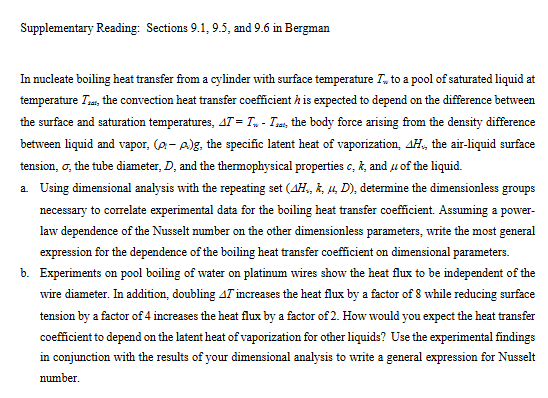
Question: Supplementary Reading: Sections 9 . 1 , 9 . 5 , and 9 . 6 in Bergman In nucleate boiling heat transfer from a cylinder
Supplementary Reading: Sections and in Bergman
In nucleate boiling heat transfer from a cylinder with surface temperature Tw to a pool of saturated liquid at
temperature Tata the convection heat transfer coefficient h is expected to depend on the difference between
the surface and saturation temperatures, Delta TTwTtast the body force arising from the density difference
between liquid and vapor, rho irho g the specific latent heat of vaporization, Delta Hv the airliquid surface
tension, sigma the tube diameter, D and the thermophysical properties ck and mu :Delta Hvkmu D determine the dimensionless groups
necessary to correlate experimental data for the boiling heat transfer coefficient. Assuming a power
law dependence of the Nusselt number on the other dimensionless parameters, write the most general
expression for the dependence of the boiling heat transfer coefficient on dimensional parameters.
b Experiments on pool boiling of water on platinum wires show the heat flux to be independent of the
wire diameter. In addition, doubling Delta T increases the heat flux by a factor of while reducing surface
tension by a factor of increases the heat flux by a factor of How would you expect the heat transfer
coefficient to depend on the latent heat of vaporization for other liquids? Use the experimental findings
in conjunction with the results of your dimensional analysis to write a general expression for Nusselt
number.
Step by Step Solution
There are 3 Steps involved in it
1 Expert Approved Answer
Step: 1 Unlock

Question Has Been Solved by an Expert!
Get step-by-step solutions from verified subject matter experts
Step: 2 Unlock
Step: 3 Unlock
 Study Help