Question: SUPPLY CHAIN MANAGEMENT ONE QUESTION There is a general misconception that negotiation is primarily a price determining technique. Discuss the circumstances under which negotiation can
SUPPLY CHAIN MANAGEMENT
ONE QUESTION
There is a general misconception that negotiation is primarily a price determining technique. Discuss the circumstances under which negotiation can take place.
--------------------------------------------------------------------------------------------------------------------------------------------------------------------------------------------------------------------------------
I THINK YOU WILL NEED THE FOLLOWING INFORMATION:
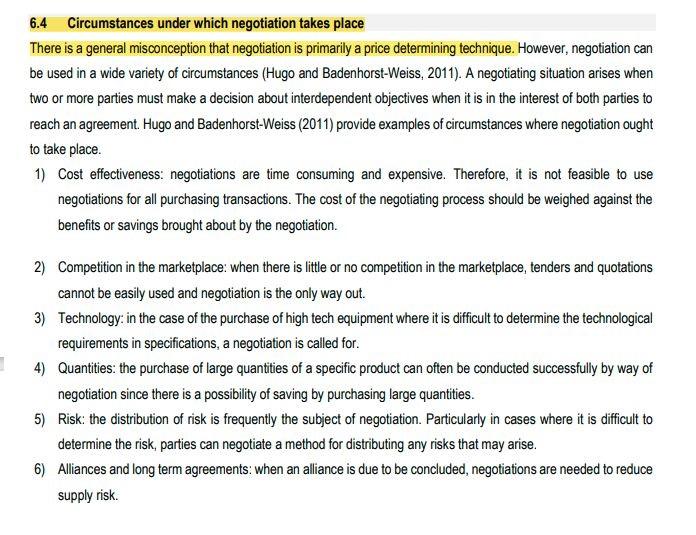
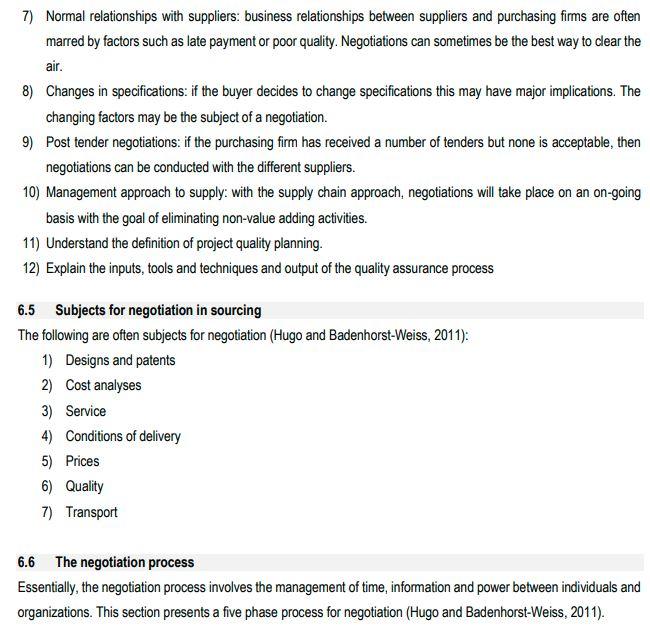
6.4 Circumstances under which negotiation takes place There is a general misconception that negotiation is primarily a price determining technique. However, negotiation can be used in a wide variety of circumstances (Hugo and Badenhorst-Weiss, 2011). A negotiating situation arises when two or more parties must make a decision about interdependent objectives when it is in the interest of both parties to reach an agreement. Hugo and Badenhorst-Weiss (2011) provide examples of circumstances where negotiation ought to take place. 1) Cost effectiveness: negotiations are time consuming and expensive. Therefore, it is not feasible to use negotiations for all purchasing transactions. The cost of the negotiating process should be weighed against the benefits or savings brought about by the negotiation. 1 2) Competition in the marketplace when there is little or no competition in the marketplace, tenders and quotations cannot be easily used and negotiation is the only way out. 3) Technology: in the case of the purchase of high tech equipment where it is difficult to determine the technological requirements in specifications, a negotiation is called for. 4) Quantities: the purchase of large quantities of a specific product can often be conducted successfully by way of negotiation since there is a possibility of saving by purchasing large quantities. 5) Risk: the distribution of risk is frequently the subject of negotiation. Particularly in cases where it is difficult to determine the risk, parties can negotiate a method for distributing any risks that may arise. 6) Alliances and long term agreements: when an alliance is due to be concluded, negotiations are needed to reduce supply risk. 7) Normal relationships with suppliers: business relationships between suppliers and purchasing firms are often marred by factors such as late payment or poor quality. Negotiations can sometimes be the best way to clear the air. 8) Changes in specifications: if the buyer decides to change specifications this may have major implications. The changing factors may be the subject of a negotiation. 9) Post tender negotiations: if the purchasing firm has received a number of tenders but none is acceptable, then negotiations can be conducted with the different suppliers. 10) Management approach to supply: with the supply chain approach, negotiations will take place on an on-going basis with the goal of eliminating non-value adding activities. 11) Understand the definition of project quality planning. 12) Explain the inputs, tools and techniques and output of the quality assurance process 6.5 Subjects for negotiation in sourcing The following are often subjects for negotiation (Hugo and Badenhorst-Weiss, 2011): 1) Designs and patents 2) Cost analyses 3) Service 4) Conditions of delivery 5) Prices 6) Quality 7) Transport 6.6 The negotiation process Essentially, the negotiation process involves the management of time, information and power between individuals and organizations. This section presents a five phase process for negotiation (Hugo and Badenhorst-Weiss, 2011)









 Study Help