







Question: supply chain management Please read the case study nd answer the questions in derail 1.1 Based on the above study, in a business scenario strategic
supply chain management
Please read the case study nd answer the questions in derail
1.1 Based on the above study, in a business scenario "strategic fit means aligning supply chain strategy with competitive strategy." In your view, explain what a competitive strategy is and how can it be aligned with a supply chain strategy to achieve strategic fit.(5 marks) 1.2 Discuss the possible types of competitive strategies that a company can use to achieve competitive advantage. From the list, identify the one that was adopted by Dell. (15 marks) 1.3 According to Chopra (2019) and the above study, creating strategic fit is all about designing a supply chain whose responsiveness aligns with the implied uncertainty it faces. As a result, it is wiser to look at both strategic fit m specific measures; supply chain efficiency and effectiveness. Critique the ways in which Dell company can build and improve its supply chain responsiveness and efficiency. (20 marks)
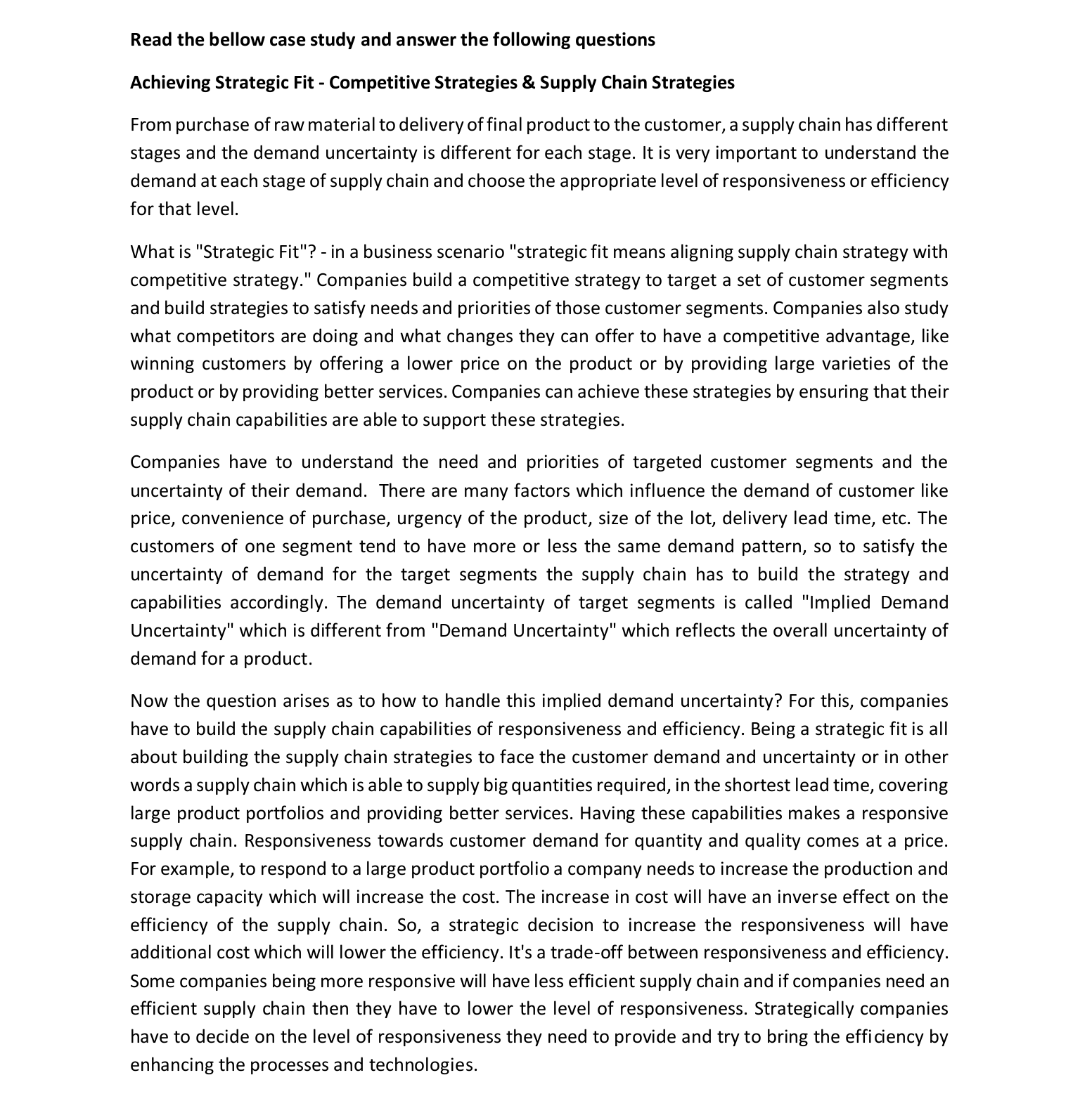
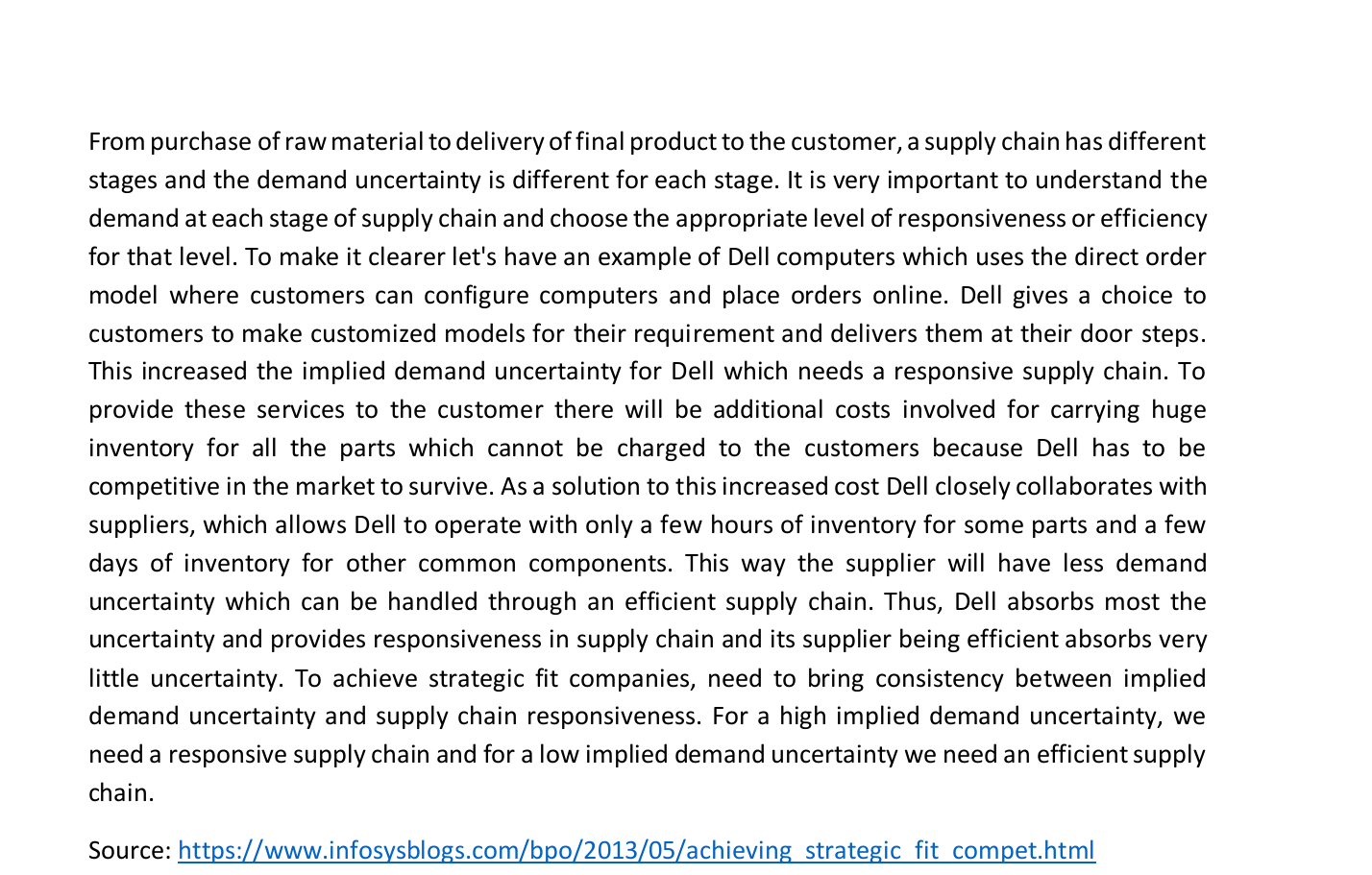
Read the bellow case study and answer the following questions Achieving Strategic Fit - Competitive Strategies & Supply Chain Strategies From purchase of raw material to delivery of final product to the customer, a supply chain has different stages and the demand uncertainty is different for each stage. It is very important to understand the demand at each stage of supply chain and choose the appropriate level of responsiveness or efficiency for that level. What is "Strategic Fit"? - in a business scenario "strategic fit means aligning supply chain strategy with competitive strategy." Companies build a competitive strategy to target a set of customer segments and build strategies to satisfy needs and priorities of those customer segments. Companies also study what competitors are doing and what changes they can offer to have a competitive advantage, like winning customers by offering a lower price on the product or by providing large varieties of the product or by providing better services. Companies can achieve these strategies by ensuring that their supply chain capabilities are able to support these strategies. Companies have to understand the need and priorities of targeted customer segments and the uncertainty of their demand. There are many factors which influence the demand of customer like price, convenience of purchase, urgency of the product, size of the lot, delivery lead time, etc. The customers of one segment tend to have more or less the same demand pattern, so to satisfy the uncertainty of demand for the target segments the supply chain has to build the strategy and capabilities accordingly. The demand uncertainty of target segments is called "Implied Demand Uncertainty" which is different from "Demand Uncertainty" which reflects the overall uncertainty of demand for a product. Now the question arises as to how to handle this implied demand uncertainty? For this, companies have to build the supply chain capabilities of responsiveness and efficiency. Being a strategic fit is all about building the supply chain strategies to face the customer demand and uncertainty or in other words a supply chain which is able to supply big quantities required, in the shortest lead time, covering large product portfolios and providing better services. Having these capabilities makes a responsive supply chain. Responsiveness towards customer demand for quantity and quality comes a price. For example, to respond to a large product portfolio a company needs to increase the production and storage capacity which will increase the cost. The increase in cost will have an inverse effect on the efficiency of the supply chain. So, a strategic decision to increase the responsiveness will have additional cost which will lower the efficiency. It's a trade-off between responsiveness and efficiency. Some companies being more responsive will have less efficient supply chain and if companies need an efficient supply chain then they have to lower the level of responsiveness. Strategically companies have to decide on the level of responsiveness they need to provide and try to bring the efficiency by enhancing the processes and technologies. From purchase of raw material to delivery of final product to the customer, a supply chain has different stages and the demand uncertainty is different for each stage. It is very important to understand the demand at each stage of supply chain and choose the appropriate level of responsiveness or efficiency for that level. To make it clearer let's have an example of Dell computers which uses the direct order model where customers can configure computers and place orders online. Dell gives a choice to customers to make customized models for their requirement and delivers them at their door steps. This increased the implied demand uncertainty for Dell which needs a responsive supply chain. To provide these services to the customer there will be additional costs involved for carrying huge inventory for all the parts which cannot be charged to the customers because Dell has to be competitive in the market to survive. As a solution to this increased cost Dell closely collaborates with suppliers, which allows Dell to operate with only a few hours of inventory for some parts and a few days of inventory for other common components. This way the supplier will have less demand uncertainty which can be handled through an efficient supply chain. Thus, Dell absorbs most the uncertainty and provides responsiveness in supply chain and its supplier being efficient absorbs very little uncertainty. To achieve strategic fit companies, need to bring consistency between implied demand uncertainty and supply chain responsiveness. For a high implied demand uncertainty, we need a responsive supply chain and for a low implied demand uncertainty we need an efficient supply chain. Source: https://www.infosysblogs.com/bpo/2013/05/achieving strategic fit compet.html Read the bellow case study and answer the following questions Achieving Strategic Fit - Competitive Strategies & Supply Chain Strategies From purchase of raw material to delivery of final product to the customer, a supply chain has different stages and the demand uncertainty is different for each stage. It is very important to understand the demand at each stage of supply chain and choose the appropriate level of responsiveness or efficiency for that level. What is "Strategic Fit"? - in a business scenario "strategic fit means aligning supply chain strategy with competitive strategy." Companies build a competitive strategy to target a set of customer segments and build strategies to satisfy needs and priorities of those customer segments. Companies also study what competitors are doing and what changes they can offer to have a competitive advantage, like winning customers by offering a lower price on the product or by providing large varieties of the product or by providing better services. Companies can achieve these strategies by ensuring that their supply chain capabilities are able to support these strategies. Companies have to understand the need and priorities of targeted customer segments and the uncertainty of their demand. There are many factors which influence the demand of customer like price, convenience of purchase, urgency of the product, size of the lot, delivery lead time, etc. The customers of one segment tend to have more or less the same demand pattern, so to satisfy the uncertainty of demand for the target segments the supply chain has to build the strategy and capabilities accordingly. The demand uncertainty of target segments is called "Implied Demand Uncertainty" which is different from "Demand Uncertainty" which reflects the overall uncertainty of demand for a product. Now the question arises as to how to handle this implied demand uncertainty? For this, companies have to build the supply chain capabilities of responsiveness and efficiency. Being a strategic fit is all about building the supply chain strategies to face the customer demand and uncertainty or in other words a supply chain which is able to supply big quantities required, in the shortest lead time, covering large product portfolios and providing better services. Having these capabilities makes a responsive supply chain. Responsiveness towards customer demand for quantity and quality comes a price. For example, to respond to a large product portfolio a company needs to increase the production and storage capacity which will increase the cost. The increase in cost will have an inverse effect on the efficiency of the supply chain. So, a strategic decision to increase the responsiveness will have additional cost which will lower the efficiency. It's a trade-off between responsiveness and efficiency. Some companies being more responsive will have less efficient supply chain and if companies need an efficient supply chain then they have to lower the level of responsiveness. Strategically companies have to decide on the level of responsiveness they need to provide and try to bring the efficiency by enhancing the processes and technologies. From purchase of raw material to delivery of final product to the customer, a supply chain has different stages and the demand uncertainty is different for each stage. It is very important to understand the demand at each stage of supply chain and choose the appropriate level of responsiveness or efficiency for that level. To make it clearer let's have an example of Dell computers which uses the direct order model where customers can configure computers and place orders online. Dell gives a choice to customers to make customized models for their requirement and delivers them at their door steps. This increased the implied demand uncertainty for Dell which needs a responsive supply chain. To provide these services to the customer there will be additional costs involved for carrying huge inventory for all the parts which cannot be charged to the customers because Dell has to be competitive in the market to survive. As a solution to this increased cost Dell closely collaborates with suppliers, which allows Dell to operate with only a few hours of inventory for some parts and a few days of inventory for other common components. This way the supplier will have less demand uncertainty which can be handled through an efficient supply chain. Thus, Dell absorbs most the uncertainty and provides responsiveness in supply chain and its supplier being efficient absorbs very little uncertainty. To achieve strategic fit companies, need to bring consistency between implied demand uncertainty and supply chain responsiveness. For a high implied demand uncertainty, we need a responsive supply chain and for a low implied demand uncertainty we need an efficient supply chain. Source: https://www.infosysblogs.com/bpo/2013/05/achieving strategic fit compet.htmlStep by Step Solution
There are 3 Steps involved in it

Get step-by-step solutions from verified subject matter experts
 Study Help