





Question: SUPPLY CHAIN MANAGEMENT Question 2. Version B. An ABC inventory classification of a 20-item inventory resulted in a classification of (4,5,11) of inventory items and

SUPPLY CHAIN MANAGEMENT
SUPPLY CHAIN MANAGEMENT Question 2. Version B. An

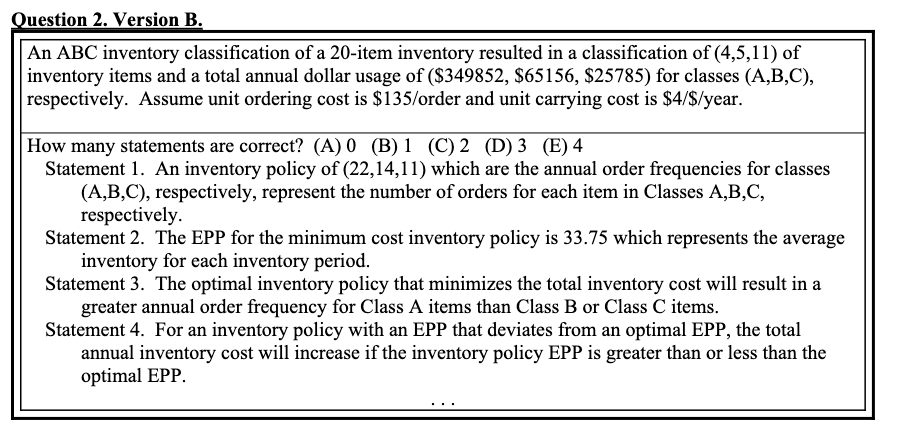
Question 2. Version B. An ABC inventory classification of a 20-item inventory resulted in a classification of (4,5,11) of inventory items and a total annual dollar usage of ($349852, $65156, $25785) for classes (A,B,C), respectively. Assume unit ordering cost is $135/order and unit carrying cost is $4/S/year. How many statements are correct? (A)0 (B)1 (C) 2 (D) 3 (E) 4 Statement 1. An inventory policy of (22,14,11) which are the annual order frequencies for classes (A,B,C), respectively, represent the number of orders for each item in Classes A,B,C, respectively. Statement 2. The EPP for the minimum cost inventory policy is 33.75 which represents the average inventory for each inventory period. Statement 3. The optimal inventory policy that minimizes the total inventory cost will result in a greater annual order frequency for Class A items than Class B or Class C items. Statement 4. For an inventory policy with an EPP that deviates from an optimal EPP, the total annual inventory cost will increase if the inventory policy EPP is greater than or less than the optimal EPP

Step by Step Solution

There are 3 Steps involved in it

1 Expert Approved Answer
Step: 1 Unlock blur-text-image

Question Has Been Solved by an Expert!

Get step-by-step solutions from verified subject matter experts

Step: 2 Unlock
Step: 3 Unlock

Students Have Also Explored These Related General Management Questions!