







Question: Suppose a monopoly has the following production function: q = f(KL) The rate of return on capital (s) is, by definition, operating profits (revenue less
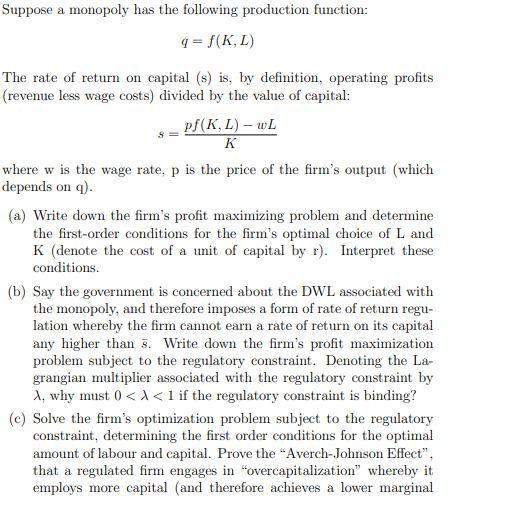
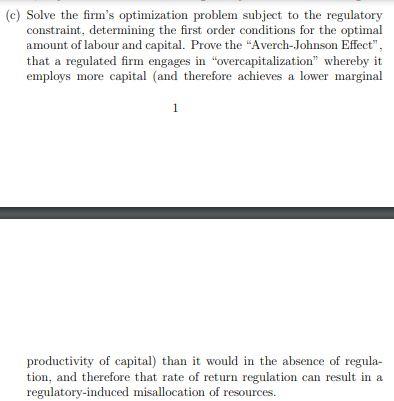
Suppose a monopoly has the following production function: q = f(KL) The rate of return on capital (s) is, by definition, operating profits (revenue less wage costs) divided by the value of capital: pf(KL) - L K where w is the wage rate, p is the price of the firm's output (which depends on q). (a) Write down the firm's profit maximizing problem and determine the first-order conditions for the firm's optimal choice of L and K denote the cost of a unit of capital by r). Interpret these conditions. (b) Say the government is concerned about the DWL associated with the monopoly, and therefore imposes a form of rate of return regu- lation whereby the firm cannot earn a rate of return on its capital any higher than 3. Write down the firm's profit maximization problem subject to the regulatory constraint. Denoting the La- grangian multiplier associated with the regulatory constraint by X, why must 0
Step by Step Solution
There are 3 Steps involved in it

Get step-by-step solutions from verified subject matter experts
 Study Help