



Question: Suppose I have two DFAs D_1, D_2 and I perform the product construction on them to get a DFA for the union of their languages.
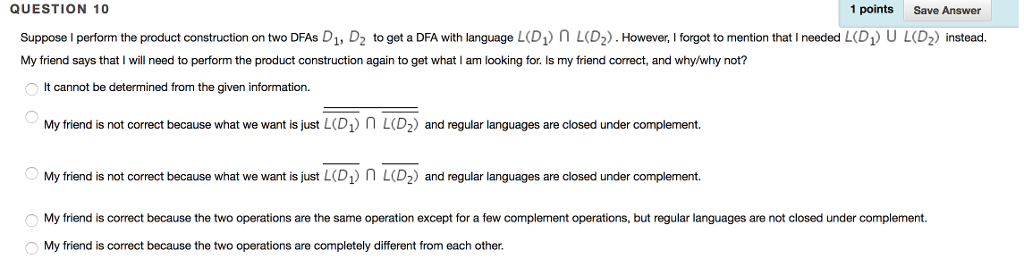
Suppose I have two DFAs D_1, D_2 and I perform the product construction on them to get a DFA for the union of their languages. What is always true about the resulting DFA D ? The number of states in D is equal to the maximum of the number of states in both of D_1, D_2. If L(D_1) = L(D_2). then D has every state being final. If L(D_1) = theta D has every state being final
Step by Step Solution
There are 3 Steps involved in it
1 Expert Approved Answer
Step: 1 Unlock

Question Has Been Solved by an Expert!
Get step-by-step solutions from verified subject matter experts
Step: 2 Unlock
Step: 3 Unlock